WHY GARTNER’S “CONTEXT MESH” CHANGES EVERYTHING AI CONNECTIVITY: THE ROAD AHEAD DON’T MISS API + AI SUMMIT 2026 SEPT 30 – OCT 1
    • Explore the unified API Platform
        • BUILD APIs
        • [
          Kong Insomnia](/en-gb/products/kong-insomnia)
          Kong Insomnia
        • [
          API Design](/en-gb/products/kong-insomnia/api-design)
          API Design
        • [
          API Testing and Debugging](/en-gb/products/kong-insomnia/api-testing-and-debugging)
          API Testing and Debugging
        • RUN APIs
        • [
          API Gateway](/en-gb/products/kong-gateway)
          API Gateway
        • [
          AI Gateway](/en-gb/products/kong-ai-gateway)
          AI Gateway
        • [
          Event Gateway](/en-gb/products/event-gateway)
          Event Gateway
        • [
          Kubernetes Operator](/products/kong-gateway-operator)
          Kubernetes Operator
        • [
          Service Mesh](/en-gb/products/kong-mesh)
          Service Mesh
        • [
          Ingress Controller](/en-gb/products/kong-ingress-controller)
          Ingress Controller
        • [
          Runtime Management](/products/kong-konnect/features/runtime-management)
          Runtime Management
        • DISCOVER APIs
        • [
          Developer Portal](/en-gb/products/kong-konnect/features/developer-portal)
          Developer Portal
        • [
          Service Catalog](/en-gb/products/kong-konnect/features/api-service-catalog)
          Service Catalog
        • GOVERN APIs
        • [
          Analytics](/products/kong-konnect/features/advanced-analytics)
          Analytics
        • [
          APIOps and Automation](/en-gb/products/apiops-automation)
          APIOps and Automation
        • [
          API Observability](/en-gb/products/kong-konnect/features/api-observability)
          API Observability
        • [Why Kong?](/en-gb/company/why-kong)Why Kong?
      • CLOUD
      • [Cloud API Gateways](/products/kong-konnect/features/dedicated-cloud-gateways)Cloud API Gateways
      • [Need a self-hosted or hybrid option?](/products/kong-enterprise)Need a self-hosted or hybrid option?
      • COMPARE
      • [Kong vs. Postman](/en-gb/performance-comparison/kong-vs-postman)Kong vs. Postman
      • [Kong vs. MuleSoft](/en-gb/performance-comparison/kong-vs-mulesoft)Kong vs. MuleSoft
      • [Kong vs. Apigee](/en-gb/performance-comparison/kong-vs-apigee)Kong vs. Apigee
      • [Kong vs. IBM](/performance-comparison/ibm-api-connect-vs-kong)Kong vs. IBM
      • GET STARTED
      • [Sign Up for Kong Konnect](/products/kong-konnect/register)Sign Up for Kong Konnect
      • [Documentation](https://developer.konghq.com/)Documentation
      • FOR PLATFORM TEAMS
      • [Developer Platform](/en-gb/solutions/building-developer-platform)Developer Platform
      • [Kubernetes and Microservices](/en-gb/solutions/build-on-kubernetes)Kubernetes and Microservices
      • [Observability](/en-gb/solutions/observability)Observability
      • [Service Mesh Connectivity ](/solutions/service-mesh-connectivity)Service Mesh Connectivity
      • [Kafka Event Streaming](/en-gb/solutions/kafka-stream-api-management)Kafka Event Streaming
      • FOR EXECUTIVES
      • [Open Banking](/en-gb/solutions/open-banking)Open Banking
      • [Legacy Migration](/en-gb/solutions/legacy-api-management-migration)Legacy Migration
      • [Platform Cost Reduction](/en-gb/solutions/api-platform-consolidation)Platform Cost Reduction
      • [Kafka Cost Optimization](/en-gb/solutions/reduce-kafka-cost)Kafka Cost Optimization
      • [Real-time Business](/solutions/real-time-business)Real-time Business
      • [API Productization](/solutions/api-productization)API Productization
      • FOR AI TEAMS
      • [AI Governance](/en-gb/solutions/ai-governance)AI Governance
      • [AI Security](/en-gb/solutions/ai-security)AI Security
      • [AI Cost Control](/en-gb/solutions/ai-cost-optimization-management)AI Cost Control
      • [Agentic AI](/solutions/agentic-ai-workflows)Agentic AI
      • [MCP Traffic Gateway](/en-gb/solutions/mcp-governance)MCP Traffic Gateway
      • FOR DEVELOPERS
      • [Mobile App API Development](/en-gb/solutions/mobile-application-api-development)Mobile App API Development
      • [GenAI App Development](/solutions/power-openai-applications)GenAI App Development
      • [API Gateway for Istio](/solutions/istio-gateway)API Gateway for Istio
      • [Decentralized Load Balancing](/solutions/decentralized-load-balancing)Decentralized Load Balancing
      • BY INDUSTRY
      • [Financial Services](/en-gb/solutions/financial-services-industry)Financial Services
      • [Healthcare](/en-gb/solutions/healthcare)Healthcare
      • [Higher Education](/solutions/api-platform-for-education-services)Higher Education
      • [Insurance](/en-gb/solutions/insurance)Insurance
      • [Manufacturing](/en-gb/solutions/manufacturing)Manufacturing
      • [Retail](/en-gb/solutions/retail)Retail
      • [Software & Technology](/en-gb/solutions/software-and-technology)Software & Technology
      • [Transportation](/en-gb/solutions/transportation-and-logistics)Transportation
      • [See all Solutions](/en-gb/solutions)See all Solutions
  • [Customers](/customers)Customers
      • Documentation
      • [Kong Konnect](https://developer.konghq.com/konnect/)Kong Konnect
      • [Kong Gateway](https://developer.konghq.com/gateway/)Kong Gateway
      • [Kong Mesh](https://developer.konghq.com/mesh/)Kong Mesh
      • [Kong AI Gateway](https://developer.konghq.com/ai-gateway/)Kong AI Gateway
      • [Kong Insomnia](https://developer.konghq.com/insomnia/)Kong Insomnia
      • [Plugin Hub](https://developer.konghq.com/plugins/)Plugin Hub
      • Explore
      • [Blog](/en-gb/blog)Blog
      • [Learning Center](/en-gb/blog/learning-center)Learning Center
      • [eBooks](/resources/e-book)eBooks
      • [Reports](/resources/reports)Reports
      • [Demos](/resources/demos)Demos
      • [Case Studies](/resources/case-study)Case Studies
      • [Videos](/resources/videos)Videos
      • Events
      • [API Summit](/events/conferences/api-summit)API Summit
      • [Webinars](/events/webinars)Webinars
      • [User Calls](/events/user-calls)User Calls
      • [Workshops](/events/workshops)Workshops
      • [Meetups](/events/meetups)Meetups
      • [See All Events](/events)See All Events
      • For Developers
      • [Get Started](https://developer.konghq.com/)Get Started
      • [Community](/community)Community
      • [Certification](/academy/certification)Certification
      • [Training](https://education.konghq.com)Training
  • [Pricing](/pricing)Pricing
  • [](/search)
  • [Login](https://cloud.konghq.com/login)Login
  • [Get a Demo](/contact-sales)Get a Demo
  • [Start for Free](/products/kong-konnect/register)Start for Free
[Blog](/blog)Blog
  • [AI Gateway](/blog/tag/ai-gateway)AI Gateway
  • [AI Security](/blog/tag/ai-security)AI Security
  • [AIOps](/blog/tag/aiops)AIOps
  • [API Security](/blog/tag/api-security)API Security
  • [API Gateway](/blog/tag/api-gateway)API Gateway
|
    • [API Management](/blog/tag/api-management)API Management
    • [API Development](/blog/tag/api-development)API Development
    • [API Design](/blog/tag/api-design)API Design
    • [Automation](/blog/tag/automation)Automation
    • [Service Mesh](/blog/tag/service-mesh)Service Mesh
    • [Insomnia](/blog/tag/insomnia)Insomnia
    • [View All Blogs](/blog/page/1)View All Blogs
We're Entering the Age of AI Connectivity [Read more](/blog/news/the-age-of-ai-connectivity)Read moreProducts & Agents:
    • [Kong AI Gateway](/products/kong-ai-gateway)Kong AI Gateway
    • [Kong API Gateway](/products/kong-gateway)Kong API Gateway
    • [Kong Event Gateway](/products/event-gateway)Kong Event Gateway
    • [Kong Metering & Billing](/products/usage-based-metering-and-billing)Kong Metering & Billing
    • [Kong Insomnia](/products/kong-insomnia)Kong Insomnia
    • [Kong Konnect](/products/kong-konnect)Kong Konnect
  • [Documentation](https://developer.konghq.com)Documentation
  • [Book Demo](/contact-sales)Book Demo
  1. Home
  2. Blog
  3. Learning Center
  4. What's the Difference: Kubernetes Controllers vs Operators?
[Learning Center](/blog/learning-center)Learning Center
March 21, 2024
8 min read

# What's the Difference: Kubernetes Controllers vs Operators?

Peter Barnard
Content @ Kong

Kubernetes, or K8s, is one of the most powerful open source container orchestration systems — especially for its automatic implementation of a desired state. In other words, as an admin, you get to specify how you want your application and cluster to behave, and the control plane executes it for you using a feedback loop. Pretty neat, right?

The two key methods that enable complex operational task management in Kubernetes are controllers and operators. Both ensure that cluster resources conform to a desired state, but they play different parts within the Kubernetes ecosystem. If this distinction feels confusing, that’s because the differences between controllers and operators can be quite intricate! Especially since operators are a subcategory of controllers. (And hopefully, this article can help.)

Read on for a closer look at how Kubernetes controllers and operators work. We’ll define their key features and list their use cases.

## What are Kubernetes controllers?

Kubernetes controllers are control loops that track your resource clusters and alter them to match the desired state in a continuous cycle. For example, if you need to roast a chicken at 400 degrees Fahrenheit, the control loop in this case would monitor the oven temperature to keep it as close to your desired temperature as possible. If the temperature goes below or above 400, the control loop automatically adjusts the oven controls to fix it.

This is exactly how Kubernetes controllers work — they monitor the resources and conditions an admin has requested in a desired state and implement them automatically. Controllers ensure that the desired and actual states are in constant alignment. 

### Keep your cluster in check: Kubernetes controller functions

Kubernetes controllers perform various functions to observe, maintain, and enforce the desired state of resources within a Kubernetes cluster. The key functions of a controller include:

  • - **Cluster observation** — Controllers continuously watch for state changes in the resource cluster, allowing for timely responses from admins or infrastructure teams.
  • - **Desired state enforcement **— Controllers compare conditions of the admin’s desired state with the current state of the resource cluster and automatically make changes to enforce the desired state. 
  • - **Resource limit enforcement** — Controllers enforce limits on resources used in a namespace to prevent overuse.
  • - **Defined schedule** — Controllers run Jobs on a schedule defined by the user. 
  • - **Event processing** — Controllers process lifecycle events and trigger responses, such as automatically restarting pods upon failure.
  • - **Cluster health maintenance** — Node controllers detect and manage unhealthy nodes, while endpoint controllers maintain up-to-date endpoint objects for service discovery.
  • - **Rollouts and rollbacks** — Deployment controllers provide rollout management of deployments and carry out rollbacks to previous versions.

Kubernetes controllers automate routine cluster operations, enforce policies, react to failures, and strive to continuously reconcile the actual state to match the user's desired configuration.

### Use cases for using Kubernetes controllers

Kubernetes controllers have several key use cases for managing and operating applications and resources within a cluster:

  • - **Scale a front-end web application **— Ensure you always have enough pod replicas running that can handle increasing user traffic to a web app. Controllers such as ReplicaSet will automatically create new pods as needed.
  • - **Run a managed database** — Deploy and manage a stateful database and maintain a stable network ID as pods are restarted or moved with a controller like StatefulSet.
  • - **Batch data processing **— Run pods to completion for batch jobs and ensure that failed pods are re-run. This use case works particularly well in a machine learning training or analytics pipeline setting.
  • - **Maintain a set of pods** — ​​Ensure that sets of multiple identical pods are running at any given time. 
  • - **Schedule tasks** — Run pods on a user-defined schedule with specific tasks using a controller like CronJob.
  • - **Auto-scale deployments **— Scale deployments and replica sets based on different metrics and automatically adjust pod replicas with the HorizontalPodAutoscaler controller.
  • - **Limit resource usage** — Limit resource usage and prevent overload with a controller like ResourceQuota.

Essentially, Kubernetes controllers automate operations to deploy, scale, heal, and enforce policies for applications while maximizing cluster utilization. This reduces manual effort for platform teams and adds self-managing capabilities to Kubernetes.

### The benefits of using Kubernetes controllers

We’ve covered functions and use cases, but what core benefits do Kubernetes controllers provide? The main ones are: 

  • - **Automation** — Controllers reduce manual operations with their auto-scaling and state enforcement capabilities.
  • - **Reliability** — Controllers make applications more reliable with features like scheduling, pod creation, and replica management. 
  • - **Availability** — By automatically addressing failure events, controllers ensure a high availability of applications.
  • - **Efficiency** — Controllers provide efficient cluster resource management with quote management and auto-scaling.
  • - **Agility** —  With features like rolling updates, controllers facilitate faster application deployments and lifecycle management.
  • - **Flexibility** — Controllers are available for a variety of needs, like batch jobs, daemon services, deployments, etc.
  • - **Observability** — Controllers provide clear visibility into cluster resource state changes, events, and health through the K8s API.

## What are Kubernetes operators?

Kubernetes operators are a subcategory of controllers that use API extensions — or custom resources — to complete tasks. Operators are typically constructed as a set of independent controllers, each responsible for its own subset of tasks and resources pertaining to the managed application.

While an operator shares similar functions with a controller, it exclusively utilizes custom resources and focuses on one domain.

On the other hand, controllers work without custom resources or API extensions and don’t need to connect to a specific domain. Operators are well-suited to meet operational needs for a specific application or platform, but they do not accommodate generic resource cluster states as well as controllers.

### Take automation further: Kubernetes operator functions

Kubernetes operators are custom-built controllers that extend Kubernetes functionality to automate the deployment, management, and operations of specific applications or services. Some key functions that operators can provide include:

  • - **Lifecycle management **— Operators manage the full lifecycle of complex stateful applications like databases through deployment, upgrades, and scaling. They can also apply application logic to automate operations like backup and restore.
  • - **Declarative management **— By leveraging K8s abstractions like CRDs, operators provide simple declarative management of applications through custom resources.
  • - **Security** — Operators integrate top-of-the-line security measures, such as encryption, secrets management, and access controls, to protect applications. These measures are customizable from app to app.
  • - **Advanced scheduling** — Operators enable customized scheduling policies for app resources by integrating with K8s schedulers.
  • - **Error detection and tuning** — Operators detect errors and resource abnormalities like deadlocks through app-specific health checks and take actions to correct them. They can also auto-tune apps by analyzing metrics and conditions using domain knowledge.
  • - **Migration** - Operators can automatically migrate apps across resource clusters and Kubernetes versions with minimal disruption.
  • - **Disaster recovery** — Using app-centric logic, operators create and execute backup and disaster recovery workflows for stateful apps. 

By encoding this operational knowledge into automated controllers, Kubernetes operators reduce manual work and human error while ensuring applications run reliably on Kubernetes clusters following best practices.

### Use cases for K8s operators

Kubernetes operators have several key use cases for managing and automating applications and services within a cluster:

  • - **Manage databases **— Deploy, upgrade, backup, and restore databases using an operator like MySQL or Postgres.
  • - **Provision storage** — Provision and manage storage operations for stateful applications based on their specific needs.
  • - **Log and monitor** — Simplify your analysis and metrics collection by deploying logging and monitoring tools like Elasticsearch or Prometheus.
  • - **Deploy CI/CD tools** — Automate the deployment, configuration, and scaling of CI/CD pipelines using tools like Jenkins in your operator.
  • - **Integrate messaging systems** — Automatically perform cluster scaling, upgrades, and health checks with a messaging operator that can manage systems, like RabbitMQ.
  • - **Use service mesh tools** — Install service mesh tools like Istio to manage application traffic, automate canary rollouts, and more.
  • - **Backup and restore** — Automatically back up your application and utilize disaster recovery systems for specific applications. 

Overall, Kubernetes operators bring an applications-centric approach to managing services on Kubernetes. They enable fully automated operations while improving reliability, observability, and optimization — all following best practices.

### The benefits of using Kubernetes operators

Kubernetes operators provide several key benefits:

  • - **Simplified application management **— Operators manage complex app operations and provide declarative management via custom resources. 
  • - **Increased productivity** — Operators automate heavy workloads typically needed to run and maintain complex apps, allowing developers to focus more on code.
  • - **Deployment consistency** — Operators allow complex stateful apps to run consistently across on-premises, hybrid, or public cloud environments.  
  • - **Extensibility** — By extending K8s APIs with CRDs, operators allow admins to support a wide variety of applications without adding extra workload.
  • - **Ecosystem management** — With a rich ecosystem of operators, infrastructure teams can more easily manage a diversity of complex apps on K8s.
  • - **Modularity** — Operators are modular since they typically focus on automating tasks for a single application or platform.
  • - **Easier legacy transitions** — Operators drastically simplify the transition to K8s for legacy organizations with complex apps.

The key benefit of using operators is encoding operational expertise and allowing Kubernetes to fully automate the deployment and operations of complex applications or services.

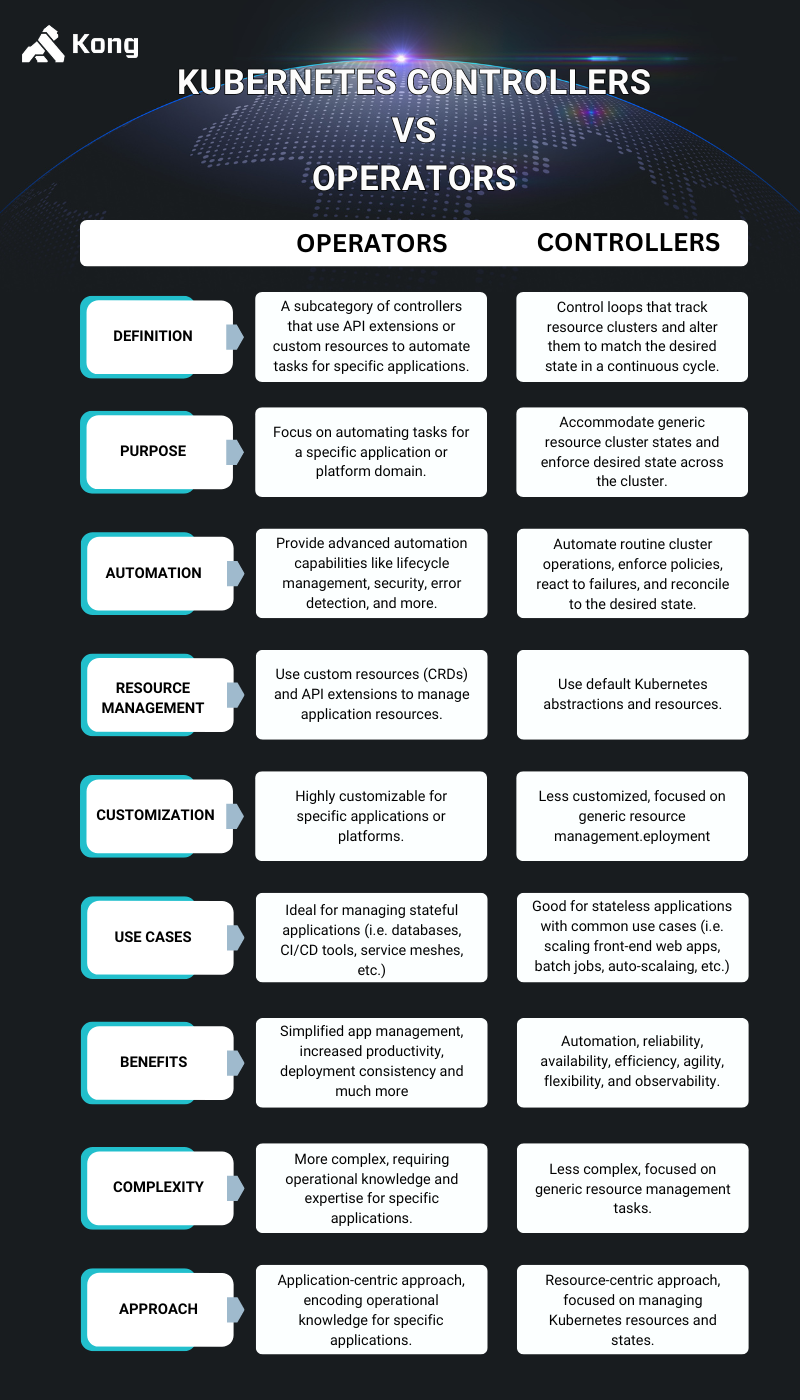
## Comparison Chart: Kubernetes Controllers vs. Operators 

Want a quick summary of how they compare? Here's a chart to keep as a reference.


kubernetes controller vs kubernetes operator

## Controllers vs. operators: Which method should I use?

Now you know the functions, use cases, and benefits of K8s controllers and operators — but how do you decide which method is right for your organization? Let us provide some context to fuel your decision.

Kubernetes controllers are typically used for stateless apps with common use cases, like frontends. As mentioned before, controllers accommodate generic resource cluster states, so they work best for simpler apps with basic automation requirements for functions like scaling and backups. Controllers also use default Kubernetes abstractions, meaning they pair well with cloud-native apps in single environments that have minimal operational needs. If your main goal is to extend and control Kubernetes at the API resource level, then your best bet may be a controller that can fulfill generic purposes not tied to a specific domain. 

Kubernetes operators, on the other hand, are useful for deploying and managing stateful apps like databases. Operators automate complex tasks for specific applications and platforms using deep operational knowledge. They allow admins to create custom resources and achieve advanced automation of lifecycle management tasks like scaling, upgrades, and storage. Additionally, operators are the best option for organizations looking to transition from legacy apps or deploy apps consistently across environments. If you need to work at a granular level in a complex application and reduce operational overhead, a Kubernetes operator would be the right choice.

Overall, controllers extend Kubernetes at the resource level, while operators focus on automating specific, complex applications. You should evaluate your app characteristics, environments, operational knowledge, and automation needs to make the final decision between a Kubernetes controller or operator.

## Conclusion

Kubernetes controllers and operators will undoubtedly take your cluster resource task management to the next level. We hope this guide can serve as a roadmap to help you evaluate your specific application knowledge and needs, so you can start your Kubernetes journey as soon as possible.

Luckily, Kong is the ultimate partner to help you take control of your Kubernetes clusters. With our support, you can natively manage your APIs in Kubernetes to implement policies for security, identity, and traffic management, completely hassle-free. The best part? You’ll reduce disruptions and strengthen security at the same time.

If you’re ready to learn more about a Kubernetes solution with Kong, [request a demo](https://konghq.com/contact-sales)request a demo today.

Continued Learning & Related Resources

  • - [Kubernetes Operators vs HELM: Package Management Comparison](https://konghq.com/blog/learning-center/kubernetes-operators-vs-helm)Kubernetes Operators vs HELM: Package Management Comparison[](https://konghq.com/blog/learning-center/guide-to-understanding-kubernetes-deployments)
  • - [Guide to Understanding Kubernetes Deployments](https://konghq.com/blog/learning-center/guide-to-understanding-kubernetes-deployments)Guide to Understanding Kubernetes Deployments
  • - [What is a Kubernetes Operator?](https://konghq.com/blog/learning-center/what-is-a-kubernetes-operator)What is a Kubernetes Operator?
  • - [What is Kubernetes Ingress?](https://konghq.com/blog/learning-center/what-is-kubernetes-ingress)What is Kubernetes Ingress?
  • - [What is a Kubernetes Ingress Controller?](https://konghq.com/blog/learning-center/what-is-a-kubernetes-ingress-controller)What is a Kubernetes Ingress Controller?
  • - [What is Kubernetes?](https://konghq.com/blog/learning-center/what-is-kubernetes)What is Kubernetes?
  • - [Understanding The Basics of Kubernetes Architecture](https://konghq.com/blog/learning-center/kubernetes-architecture)Understanding The Basics of Kubernetes Architecture
- [Kubernetes](/blog/tag/kubernetes)Kubernetes- [Kubernetes Operator](/blog/tag/kubernetes-operator)Kubernetes Operator- [Kong Ingress Controller](/blog/tag/kong-ingress-controller)Kong Ingress Controller- [Ingress](/blog/tag/ingress)Ingress

## More on this topic

_Videos_

## Supercharge Kubernetes Ingress with Kong Ingress Controller

_Videos_

## Deploying a Docker App with Kubernetes and Kong Ingress Controller

## See Kong in action

Accelerate deployments, reduce vulnerabilities, and gain real-time visibility. 

[Get a Demo](/contact-sales)Get a Demo
**Topics**
- [Kubernetes](/blog/tag/kubernetes)Kubernetes- [Kubernetes Operator](/blog/tag/kubernetes-operator)Kubernetes Operator- [Kong Ingress Controller](/blog/tag/kong-ingress-controller)Kong Ingress Controller- [Ingress](/blog/tag/ingress)Ingress
Peter Barnard
Content @ Kong

Recommended posts

# Announcing Kong Operator 2.0

[Product Releases](/blog)Product ReleasesOctober 1, 2025

Simplified controller configuration When using the Kong Ingress Controller, a significant amount of effort was needed to apply configuration to the controller by setting environment variables. The new ControlPlane resource greatly simplifies this an

Justin Davies
[](https://konghq.com/blog/product-releases/kong-operator-2-0)

# What’s New in Kong Ingress Controller 3.1?

[Product Releases](/blog)Product ReleasesFebruary 9, 2024

Kong Ingress Controller 3.1 provides brand-new capabilities for keeping your secrets secure. We’ve introduced new KongVault and KongLicense CRDs, and added a way to keep sensitive information in your cluster when using KIC in Konnect. Finally, t

Michael Heap
[](https://konghq.com/blog/product-releases/kic-3-1)

# Kong Ingress Controller 2.7: Kubernetes Gateway APIs Go Beta

[Product Releases](/blog)Product ReleasesSeptember 28, 2022

At Kong Summit this year, we announced the general availability of Kong Ingress Controller (KIC) 2.6. Today we are excited to announce the release of KIC 2.7 with even more features and improvements. Earlier this year, we launched KIC 2.2 with

Sean Chow
[](https://konghq.com/blog/product-releases/kong-ingress-controller-2-6)

# What is Kubernetes?

Kong Logo
[Learning Center](/blog)Learning CenterMarch 27, 2024

What is Kubernetes? Kubernetes, or K8s as it's known for short, and container orchestration are changing the landscape of software development and deployment. But what exactly does Kubernetes do? In this comprehensive guide, we'll explain the basics

Kong
[](https://konghq.com/blog/learning-center/what-is-kubernetes)

# Kubernetes Operators vs HELM: Package Management Comparison

[Learning Center](/blog)Learning CenterMarch 27, 2024

While Kubernetes has become the standard platform for container orchestration, managing complex application lifecycles can still be a challenge. That's where Kubernetes Operators and Helm Charts come in. This guide dives into both of these too

Peter Barnard
[](https://konghq.com/blog/learning-center/kubernetes-operators-vs-helm)

# Guide to Understanding Kubernetes Deployments

[Learning Center](/blog)Learning CenterMarch 20, 2024

Rolling out new versions of your apps on Kubernetes can be tricky, but knowing the different deployment options is important for keeping your services running smoothly with little to no downtime. This rabbithole of Kubernetes deployment methods may

Peter Barnard
[](https://konghq.com/blog/learning-center/guide-to-understanding-kubernetes-deployments)

# Understanding the Basics of Kubernetes Architecture

Kong Logo
[Learning Center](/blog)Learning CenterMarch 9, 2022

Before you get started with Kubernetes, its helpful to understand the architecture of the container orchestration platform. Kubernetes Architecture and Components Kubernetes , or K8s as its often known, is an open source platform for deploying conta

Kong
[](https://konghq.com/blog/learning-center/kubernetes-architecture)

## Ready to see Kong in action?

Get a personalized walkthrough of Kong's platform tailored to your architecture, use cases, and scale requirements.

[Get a Demo](/contact-sales)Get a Demo
Ask AI for a summary of Kong
  • [](https://chatgpt.com/s/t_69b981cfa37081919ce25ce107c431c1)
  • [](https://share.google/aimode/hyefOiNwl8pg8W99d)
  • [](https://www.perplexity.ai/search/what-solutions-does-kong-offer-VsYWPddxQjajgvLA4B9hjQ)
Stay connected

## step-0

    • Company
    • [About Kong](/company/about-us)About Kong
    • [Customers](/customer-stories)Customers
    • [Careers](/company/careers)Careers
    • [Press](/company/press-room)Press
    • [Events](/events)Events
    • [Contact](/company/contact-us)Contact
    • [Pricing](/pricing)Pricing
    • Legal
    • [Terms](/legal/terms-of-use)Terms
    • [Privacy](/legal/privacy-policy)Privacy
    • [Trust and Compliance](https://trust.konghq.com)Trust and Compliance
    • Platform
    • [Kong AI Gateway](/products/kong-ai-gateway)Kong AI Gateway
    • [Kong Konnect](/products/kong-konnect)Kong Konnect
    • [Kong Gateway](/products/kong-gateway)Kong Gateway
    • [Kong Event Gateway](/products/event-gateway)Kong Event Gateway
    • [Kong Insomnia](/products/kong-insomnia)Kong Insomnia
    • [Documentation](https://developer.konghq.com)Documentation
    • [Book Demo](/contact-sales)Book Demo
    • Compare
    • [AI Gateway Alternatives](/performance-comparison/ai-gateway-alternatives)AI Gateway Alternatives
    • [Kong vs Apigee](/performance-comparison/kong-vs-apigee)Kong vs Apigee
    • [Kong vs IBM](/performance-comparison/ibm-api-connect-vs-kong)Kong vs IBM
    • [Kong vs Postman](/performance-comparison/kong-vs-postman)Kong vs Postman
    • [Kong vs Mulesoft](/performance-comparison/kong-vs-mulesoft)Kong vs Mulesoft
    • Explore More
    • [Open Banking API Solutions](/solutions/open-banking)Open Banking API Solutions
    • [API Governance Solutions](/solutions/api-governance)API Governance Solutions
    • [Istio API Gateway Integration](/solutions/istio-gateway)Istio API Gateway Integration
    • [Kubernetes API Management](/solutions/build-on-kubernetes)Kubernetes API Management
    • [API Gateway: Build vs Buy](/campaign/secure-api-scalability)API Gateway: Build vs Buy
    • [Kong vs Apigee](/performance-comparison/kong-vs-apigee)Kong vs Apigee
    • Open Source
    • [Kong Gateway](https://developer.konghq.com/gateway/install/)Kong Gateway
    • [Kuma](https://kuma.io/)Kuma
    • [Insomnia](https://insomnia.rest/)Insomnia
    • [Kong Community](/community)Kong Community

Kong enables the connectivity layer for the agentic era – securely connecting, governing, and monetizing APIs and AI tokens across any model or cloud.

  • Japanese
  • Frenchcoming soon
  • Spanishcoming soon
  • Germancoming soon
© Kong Inc. 2026
Interaction mode