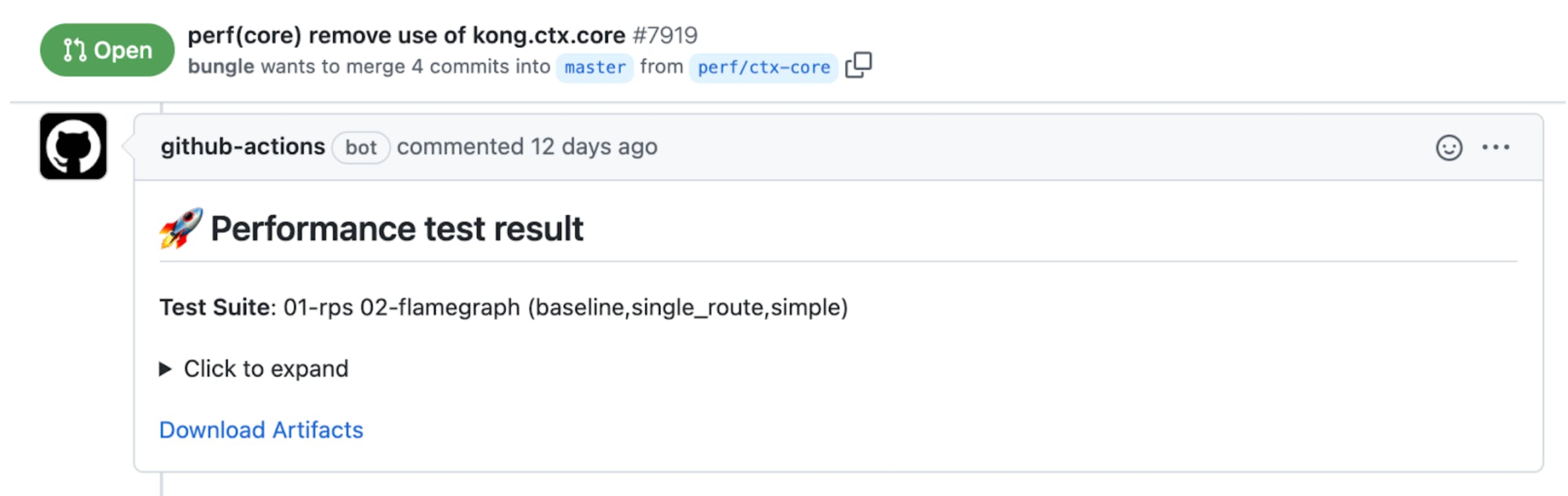
With that workflow in place, we figured one of the most significant parts of Kong's hotpath is Nginx variable accesses.
The flame graph above is generated by counting each function involved in executing the test. The wider the bar appears in the flame graph, the more CPU time is taken in that function. In the above flame graph, resty.core.var:var_get and resty.core.var:var_get are APIs to access Nginx variables; they add up to take 21% of samples in Kong's access phase.
## Nginx Variable
An Nginx variable starts with an "$" in the Nginx configuration; it’s widely used in almost every Nginx module. We usually rely on Nginx variables to read the current request's state (like $host for the current host) or set some state for the current request (like $request_uri for rewriting path). Nginx variables are also used to interact with other Nginx modules. It also allows OpenResty to read the module's state (through variable read) or set their behaviors (by variable write).
## text
if ($request_method = POST ) {
  return 405;
}
if ($args ~ post=140){
  rewrite ^ http://example.com/ permanent;
}
If you are already familiar with Kong, you may see variables being used in many places, especially when Kong is routing the requests. Our team spotted the Nginx variable access as a potential bottleneck because it took a large chunk in the flame graph.
To solve the bottleneck, let's first look at how Nginx variables are accessed in OpenResty.
## Nginx Variable in OpenResty
To access variables in OpenResty, we use the ngx.var API, including getting and setting the variable. The Lua part of ngx.var, implemented at lua-resty-core, uses a Lua metatable to turn ordinary Lua table access into variable get and set operations.
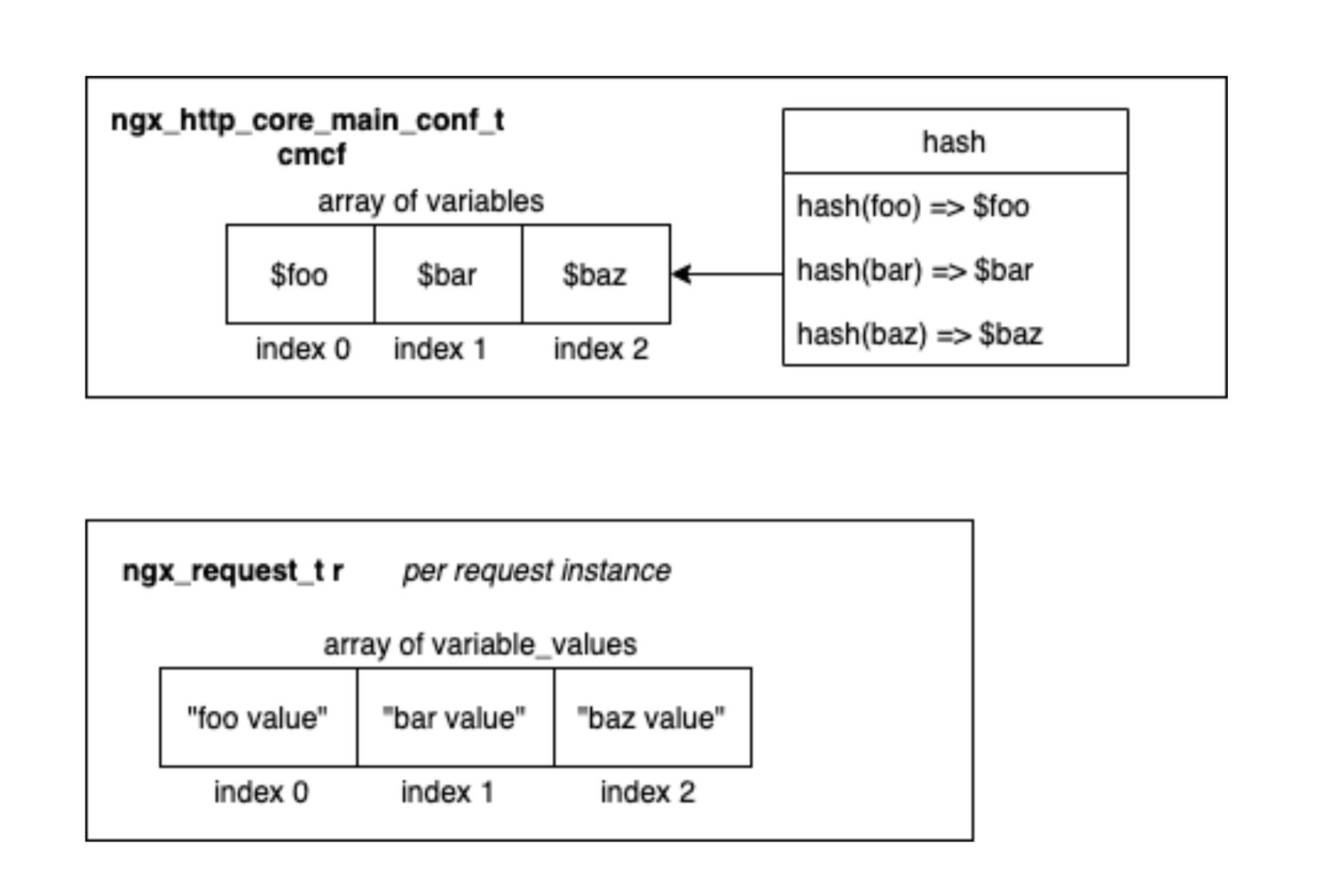
The core logic uses ngx_hash_strlow, which calculates the hash of the variable's name accessed and stores the lower case form of name_data. Then with the hash, we can perform a hash table lookup and find the instance of the variable for the current request with ngx_http_get_variable. Note that Nginx configuration declares the variables themselves at config parsing time, but variable values are only available in the ngx_request_t instance at run time.
Let's hold the analysis first and look at how the Nginx module access variables. We will use ngx_http_memcached_module as an example. The module expects a special variable "$memcached_key" to exist to use as the key for caching. Two parts seem to relate to this variable. First one is in function ngx_http_memcached_pass:
## text
C
static char *
ngx_http_memcached_pass(ngx_conf_t *cf, ngx_command_t *cmd, void *conf)
{
    ngx_http_memcached_loc_conf_t *mlcf = conf;

    /* codes in between are omitted */

    mlcf->index = ngx_http_get_variable_index(cf, &ngx_http_memcached_key);

    if (mlcf->index == NGX_ERROR) {
        return NGX_CONF_ERROR;
    }
This function is the handler for the memcache_pass directive, so it will be called during the config phase, i.e., when Nginx loads its configuration. Note the function ngx_http_get_variable_index, where the numeric index is retrieved from the current conf context cf and stored into a member index of the current module's context mlcf.
Note function ngx_http_get_indexed_variable is used to get variable value by passing the index previously stored in module context mlcf.
## What Are the Differences
Now we can identify the difference between how Nginx variables are being used. If we search for occurrences of ngx_http_get_variable versus ngx_http_get_indexed_variable in Nginx official modules source code, most modules use the later one; there are two exceptions: the perl module and the ssi module:
One might already notice that those using ngx_http_get_indexed_variable always expect the variable to be accessed already in configuration time, where ngx_http_get_variable is used in cases where the variable appears in the dynamically interpreted script. This is also the reason OpenResty chooses the hash-based API to access variables, as it's nearly impossible to know what variables will be used afterward before actually running the Lua code.
Secondly, we introduce a new FFI function to let Lua code pull all known indexes and their corresponding names from Nginx's variable index array.
## text
C
cmcf = ngx_http_cycle_get_module_main_conf(ngx_cycle, ngx_http_core_module);

/* return required size only */
if (names == NULL) {
    return cmcf->variables.nelts;
}

v = cmcf->variables.elts;

ngx_http_lua_kong_assert(v != NULL);

for (i = 0; i < cmcf->variables.nelts; i++) {
    ngx_http_lua_kong_assert(v[i].index == i);
    names[i] = &v[i].name;
}
We use the returned indexes and names on the Lua side to build a Lua table that maps names to numeric indexes.
Finally, we introduce a new FFI function to get variables by index. With get, ngx_http_get_indexed_variable is sufficient to return the variable value; with set, we will use index to find the variable and invoke its set_handler or set the value directly. On the Lua side, we first lookup the Lua table for numeric index and fall back to the original unindexed way only if the index is not found.
Those operations are a drop-in replacement for the current ngx.var API. They're all done in our lua-kong-nginx-module, so end users don't (and can't) manage or modify indexes when accessing variables. The wrong index number could lead to undefined behaviors. Users only need to add the lua_kong_load_var_index directive to cache desired variables to gain performance. The result is that the existing code will automatically take advantage of indexed variable access with the existing safe OpenResty Lua API.
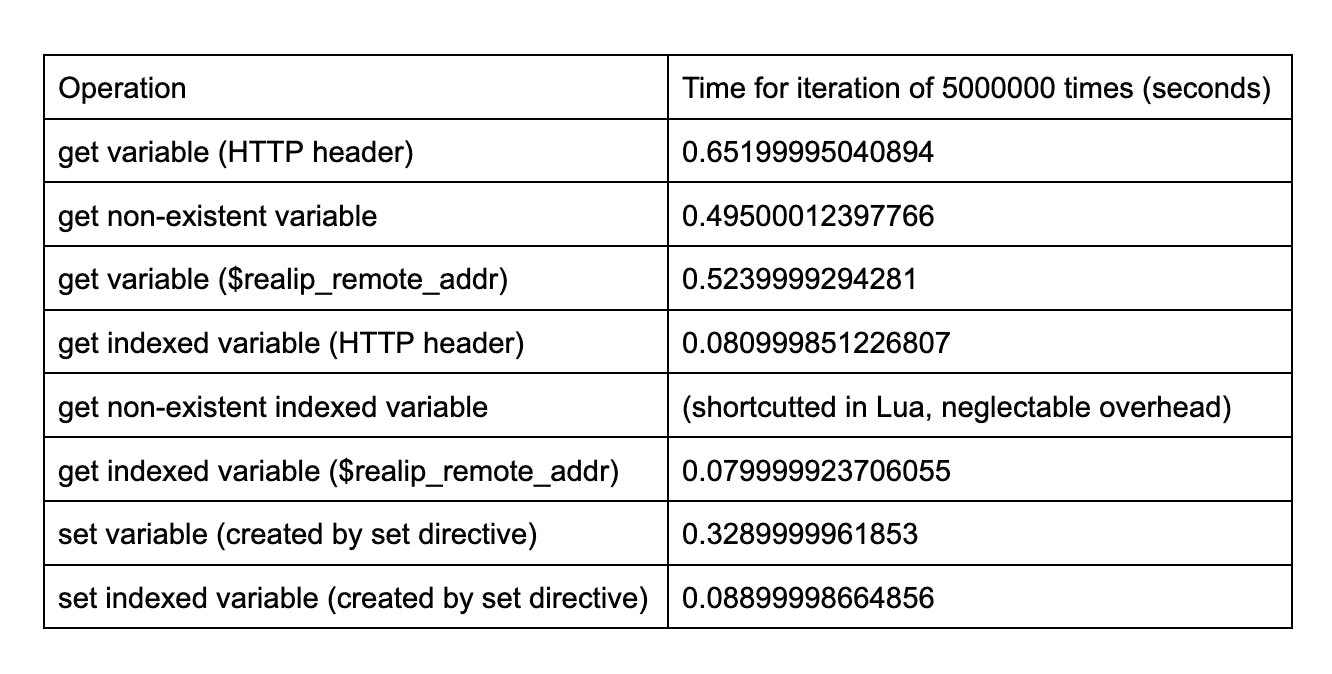
We did a ballpark test of accessing variables with and without an index. It showed our approach boosted the speed at 73% for set and 85% for get.
We also observed our base test for Kong has a 12% increase of requests per second (RPS) and a 37% drop in latency.
In the flame graph with our improvements, we can shrink the samples down to less than 10% in the access phase.
## Future Improvements
Performance optimization doesn't have an end here. That includes the ones we perform for Nginx variables. There are a couple of ways we can further improve. We can add a function style API like kong.var.get(key) and kong.var.set(key, value) to directly invoke FFI functions without the need for metatable magic.
Multi-agent systems are, at their core, context distribution systems. Every agent in your workflow is a consumer and producer of context. The interesting architectural questions are all about how that context moves. Two operations drive everything:
Hugo Guerrero
# Introducing Konnect Debugger: Get Unprecedented API Traffic Visibility
We're excited to announce the general availability of Konnect Debugger, formerly known as Active Tracing during its tech preview phase. This powerful debugging and observability solution in Kong Konnect has evolved from a focused tracing tool into a
Helen Tang
# Introducing Advanced AI Observability: See the Whole Agent Journey
When an AI application fails, knowing that an individual model call returned a 200 isn’t enough. You need to know what led to it. Kong stitches the interactions associated with an AI session together, giving developers a view across the sequence of
Alex Drag
# AI Voice Agents with Kong AI Gateway and Cerebras
Kong Gateway is an API gateway and a core component of the Kong Konnect platform . Built on a plugin-based extensibility model, it centralizes essential functions such as proxying, routing, load balancing, and health checking, efficiently manag
Claudio Acquaviva
# From Chaos to Control: How Kong AI Gateway Streamlined My GenAI Application
🚧 The challenge: Scaling GenAI with governance While building a GenAI-powered agent for one of our company websites, I integrated components like LLM APIs, embedding models, and a RAG (Retrieval-Augmented Generation) pipeline. The application was d
Sachin Ghumbre
# AI Gateway Benchmark: Kong AI Gateway, Portkey, and LiteLLM
In February 2024, Kong became the first API platform to launch a dedicated AI gateway, designed to bring production-grade performance, observability, and policy enforcement to GenAI workloads. At its core, Kong’s AI Gateway provides a universal API
Claudio Acquaviva
# Implementing OpenTelemetry Observability with Kong Konnect & Dynatrace
Observability has become critical to ensuring the effective monitoring of application and system performance and health. It focuses on understanding a system’s internal state by analyzing the data it produces in the context of real-time events and a
Claudio Acquaviva
# The Architecture Decision Your Multi-Agent System Will Live With
Multi-agent systems are, at their core, context distribution systems. Every agent in your workflow is a consumer and producer of context. The interesting architectural questions are all about how that context moves. Two operations drive everything:
Hugo Guerrero
# Introducing Konnect Debugger: Get Unprecedented API Traffic Visibility
We're excited to announce the general availability of Konnect Debugger, formerly known as Active Tracing during its tech preview phase. This powerful debugging and observability solution in Kong Konnect has evolved from a focused tracing tool into a
Helen Tang
# Introducing Advanced AI Observability: See the Whole Agent Journey
When an AI application fails, knowing that an individual model call returned a 200 isn’t enough. You need to know what led to it. Kong stitches the interactions associated with an AI session together, giving developers a view across the sequence of
Alex Drag
# AI Voice Agents with Kong AI Gateway and Cerebras
Kong Gateway is an API gateway and a core component of the Kong Konnect platform . Built on a plugin-based extensibility model, it centralizes essential functions such as proxying, routing, load balancing, and health checking, efficiently manag
Claudio Acquaviva
# From Chaos to Control: How Kong AI Gateway Streamlined My GenAI Application
🚧 The challenge: Scaling GenAI with governance While building a GenAI-powered agent for one of our company websites, I integrated components like LLM APIs, embedding models, and a RAG (Retrieval-Augmented Generation) pipeline. The application was d
Sachin Ghumbre
# AI Gateway Benchmark: Kong AI Gateway, Portkey, and LiteLLM
In February 2024, Kong became the first API platform to launch a dedicated AI gateway, designed to bring production-grade performance, observability, and policy enforcement to GenAI workloads. At its core, Kong’s AI Gateway provides a universal API
Claudio Acquaviva
# Implementing OpenTelemetry Observability with Kong Konnect & Dynatrace
Observability has become critical to ensuring the effective monitoring of application and system performance and health. It focuses on understanding a system’s internal state by analyzing the data it produces in the context of real-time events and a
Claudio Acquaviva
# The Architecture Decision Your Multi-Agent System Will Live With
Multi-agent systems are, at their core, context distribution systems. Every agent in your workflow is a consumer and producer of context. The interesting architectural questions are all about how that context moves. Two operations drive everything:
Hugo Guerrero
# Introducing Konnect Debugger: Get Unprecedented API Traffic Visibility
We're excited to announce the general availability of Konnect Debugger, formerly known as Active Tracing during its tech preview phase. This powerful debugging and observability solution in Kong Konnect has evolved from a focused tracing tool into a
Helen Tang
# Introducing Advanced AI Observability: See the Whole Agent Journey
When an AI application fails, knowing that an individual model call returned a 200 isn’t enough. You need to know what led to it. Kong stitches the interactions associated with an AI session together, giving developers a view across the sequence of
Alex Drag
# AI Voice Agents with Kong AI Gateway and Cerebras
Kong Gateway is an API gateway and a core component of the Kong Konnect platform . Built on a plugin-based extensibility model, it centralizes essential functions such as proxying, routing, load balancing, and health checking, efficiently manag
Claudio Acquaviva
# From Chaos to Control: How Kong AI Gateway Streamlined My GenAI Application
🚧 The challenge: Scaling GenAI with governance While building a GenAI-powered agent for one of our company websites, I integrated components like LLM APIs, embedding models, and a RAG (Retrieval-Augmented Generation) pipeline. The application was d
Sachin Ghumbre
# AI Gateway Benchmark: Kong AI Gateway, Portkey, and LiteLLM
In February 2024, Kong became the first API platform to launch a dedicated AI gateway, designed to bring production-grade performance, observability, and policy enforcement to GenAI workloads. At its core, Kong’s AI Gateway provides a universal API
Claudio Acquaviva
# Implementing OpenTelemetry Observability with Kong Konnect & Dynatrace
Observability has become critical to ensuring the effective monitoring of application and system performance and health. It focuses on understanding a system’s internal state by analyzing the data it produces in the context of real-time events and a
Claudio Acquaviva
## Ready to see Kong in action?
Get a personalized walkthrough of Kong's platform tailored to your architecture, use cases, and scale requirements.