WHY GARTNER’S “CONTEXT MESH” CHANGES EVERYTHING AI CONNECTIVITY: THE ROAD AHEAD DON’T MISS API + AI SUMMIT 2026 SEPT 30 – OCT 1
    • Explore the unified API Platform
        • BUILD APIs
        • [
          Kong Insomnia](/en-gb/products/kong-insomnia)
          Kong Insomnia
        • [
          API Design](/en-gb/products/kong-insomnia/api-design)
          API Design
        • [
          API Testing and Debugging](/en-gb/products/kong-insomnia/api-testing-and-debugging)
          API Testing and Debugging
        • RUN APIs
        • [
          API Gateway](/en-gb/products/kong-gateway)
          API Gateway
        • [
          AI Gateway](/en-gb/products/kong-ai-gateway)
          AI Gateway
        • [
          Event Gateway](/en-gb/products/event-gateway)
          Event Gateway
        • [
          Kubernetes Operator](/products/kong-gateway-operator)
          Kubernetes Operator
        • [
          Service Mesh](/en-gb/products/kong-mesh)
          Service Mesh
        • [
          Ingress Controller](/en-gb/products/kong-ingress-controller)
          Ingress Controller
        • [
          Runtime Management](/products/kong-konnect/features/runtime-management)
          Runtime Management
        • DISCOVER APIs
        • [
          Developer Portal](/en-gb/products/kong-konnect/features/developer-portal)
          Developer Portal
        • [
          Service Catalog](/en-gb/products/kong-konnect/features/api-service-catalog)
          Service Catalog
        • GOVERN APIs
        • [
          Analytics](/products/kong-konnect/features/advanced-analytics)
          Analytics
        • [
          APIOps and Automation](/en-gb/products/apiops-automation)
          APIOps and Automation
        • [
          API Observability](/en-gb/products/kong-konnect/features/api-observability)
          API Observability
        • [Why Kong?](/en-gb/company/why-kong)Why Kong?
      • CLOUD
      • [Cloud API Gateways](/products/kong-konnect/features/dedicated-cloud-gateways)Cloud API Gateways
      • [Need a self-hosted or hybrid option?](/products/kong-enterprise)Need a self-hosted or hybrid option?
      • COMPARE
      • [Kong vs. Postman](/en-gb/performance-comparison/kong-vs-postman)Kong vs. Postman
      • [Kong vs. MuleSoft](/en-gb/performance-comparison/kong-vs-mulesoft)Kong vs. MuleSoft
      • [Kong vs. Apigee](/en-gb/performance-comparison/kong-vs-apigee)Kong vs. Apigee
      • [Kong vs. IBM](/performance-comparison/ibm-api-connect-vs-kong)Kong vs. IBM
      • GET STARTED
      • [Sign Up for Kong Konnect](/products/kong-konnect/register)Sign Up for Kong Konnect
      • [Documentation](https://developer.konghq.com/)Documentation
      • FOR PLATFORM TEAMS
      • [Developer Platform](/en-gb/solutions/building-developer-platform)Developer Platform
      • [Kubernetes and Microservices](/en-gb/solutions/build-on-kubernetes)Kubernetes and Microservices
      • [Observability](/en-gb/solutions/observability)Observability
      • [Service Mesh Connectivity ](/solutions/service-mesh-connectivity)Service Mesh Connectivity
      • [Kafka Event Streaming](/en-gb/solutions/kafka-stream-api-management)Kafka Event Streaming
      • FOR EXECUTIVES
      • [Open Banking](/en-gb/solutions/open-banking)Open Banking
      • [Legacy Migration](/en-gb/solutions/legacy-api-management-migration)Legacy Migration
      • [Platform Cost Reduction](/en-gb/solutions/api-platform-consolidation)Platform Cost Reduction
      • [Kafka Cost Optimization](/en-gb/solutions/reduce-kafka-cost)Kafka Cost Optimization
      • [Real-time Business](/solutions/real-time-business)Real-time Business
      • [API Productization](/solutions/api-productization)API Productization
      • FOR AI TEAMS
      • [AI Governance](/en-gb/solutions/ai-governance)AI Governance
      • [AI Security](/en-gb/solutions/ai-security)AI Security
      • [AI Cost Control](/en-gb/solutions/ai-cost-optimization-management)AI Cost Control
      • [Agentic AI](/solutions/agentic-ai-workflows)Agentic AI
      • [MCP Traffic Gateway](/en-gb/solutions/mcp-governance)MCP Traffic Gateway
      • FOR DEVELOPERS
      • [Mobile App API Development](/en-gb/solutions/mobile-application-api-development)Mobile App API Development
      • [GenAI App Development](/solutions/power-openai-applications)GenAI App Development
      • [API Gateway for Istio](/solutions/istio-gateway)API Gateway for Istio
      • [Decentralized Load Balancing](/solutions/decentralized-load-balancing)Decentralized Load Balancing
      • BY INDUSTRY
      • [Financial Services](/en-gb/solutions/financial-services-industry)Financial Services
      • [Healthcare](/en-gb/solutions/healthcare)Healthcare
      • [Higher Education](/solutions/api-platform-for-education-services)Higher Education
      • [Insurance](/en-gb/solutions/insurance)Insurance
      • [Manufacturing](/en-gb/solutions/manufacturing)Manufacturing
      • [Retail](/en-gb/solutions/retail)Retail
      • [Software & Technology](/en-gb/solutions/software-and-technology)Software & Technology
      • [Transportation](/en-gb/solutions/transportation-and-logistics)Transportation
      • [See all Solutions](/en-gb/solutions)See all Solutions
  • [Customers](/customers)Customers
      • Documentation
      • [Kong Konnect](https://developer.konghq.com/konnect/)Kong Konnect
      • [Kong Gateway](https://developer.konghq.com/gateway/)Kong Gateway
      • [Kong Mesh](https://developer.konghq.com/mesh/)Kong Mesh
      • [Kong AI Gateway](https://developer.konghq.com/ai-gateway/)Kong AI Gateway
      • [Kong Insomnia](https://developer.konghq.com/insomnia/)Kong Insomnia
      • [Plugin Hub](https://developer.konghq.com/plugins/)Plugin Hub
      • Explore
      • [Blog](/en-gb/blog)Blog
      • [Learning Center](/en-gb/blog/learning-center)Learning Center
      • [eBooks](/resources/e-book)eBooks
      • [Reports](/resources/reports)Reports
      • [Demos](/resources/demos)Demos
      • [Case Studies](/resources/case-study)Case Studies
      • [Videos](/resources/videos)Videos
      • Events
      • [API Summit](/events/conferences/api-summit)API Summit
      • [Webinars](/events/webinars)Webinars
      • [User Calls](/events/user-calls)User Calls
      • [Workshops](/events/workshops)Workshops
      • [Meetups](/events/meetups)Meetups
      • [See All Events](/events)See All Events
      • For Developers
      • [Get Started](https://developer.konghq.com/)Get Started
      • [Community](/community)Community
      • [Certification](/academy/certification)Certification
      • [Training](https://education.konghq.com)Training
  • [Pricing](/pricing)Pricing
  • [](/search)
  • [Login](https://cloud.konghq.com/login)Login
  • [Get a Demo](/contact-sales)Get a Demo
  • [Start for Free](/products/kong-konnect/register)Start for Free
[Blog](/blog)Blog
  • [AI Gateway](/blog/tag/ai-gateway)AI Gateway
  • [AI Security](/blog/tag/ai-security)AI Security
  • [AIOps](/blog/tag/aiops)AIOps
  • [API Security](/blog/tag/api-security)API Security
  • [API Gateway](/blog/tag/api-gateway)API Gateway
|
    • [API Management](/blog/tag/api-management)API Management
    • [API Development](/blog/tag/api-development)API Development
    • [API Design](/blog/tag/api-design)API Design
    • [Automation](/blog/tag/automation)Automation
    • [Service Mesh](/blog/tag/service-mesh)Service Mesh
    • [Insomnia](/blog/tag/insomnia)Insomnia
    • [Event Gateway](/blog/tag/event-gateway)Event Gateway
    • [View All Blogs](/blog/page/1)View All Blogs
We're Entering the Age of AI Connectivity [Read more](/blog/news/the-age-of-ai-connectivity)Read moreProducts & Agents:
    • [Kong AI Gateway](/products/kong-ai-gateway)Kong AI Gateway
    • [Kong API Gateway](/products/kong-gateway)Kong API Gateway
    • [Kong Event Gateway](/products/event-gateway)Kong Event Gateway
    • [Kong Metering & Billing](/products/usage-based-metering-and-billing)Kong Metering & Billing
    • [Kong Insomnia](/products/kong-insomnia)Kong Insomnia
    • [Kong Konnect](/products/kong-konnect)Kong Konnect
  • [Documentation](https://developer.konghq.com)Documentation
  • [Book Demo](/contact-sales)Book Demo
  1. Home
  2. Blog
  3. Enterprise
  4. Four Essential Best Practices for API Management in 2024
[Enterprise](/blog/enterprise)Enterprise
November 1, 2024
8 min read

# Four Essential Best Practices for API Management in 2024

Axandria Shepard

The proper management of APIs is vital for organizations seeking to optimize their digital experiences and application performance. [API management](https://konghq.com/blog/learning-center/what-is-api-management)API management solutions facilitate the efficient administration of APIs by offering several features such as access control, rate limiting, developer portals, analytics, and API versioning. Appropriate API management strategies can lead to increased adoption rates amongst developers and an improved developer experience — both of which can increase revenue by enabling [monetization of APIs](https://konghq.com/blog/enterprise/api-monetization-strategy)monetization of APIs. Furthermore, it lets organizations rest assured that regulatory requirements are met while keeping APIs secure.

API management is an important part of development — [empowering enterprises to harness the capabilities of APIs](https://konghq.com/blog/enterprise/enterprise-api-management-requirements)empowering enterprises to harness the capabilities of APIs to build better products and services. In this article, we'll explore API management best practices to help ensure that your API strategy is sound.

## Four pillars of API management

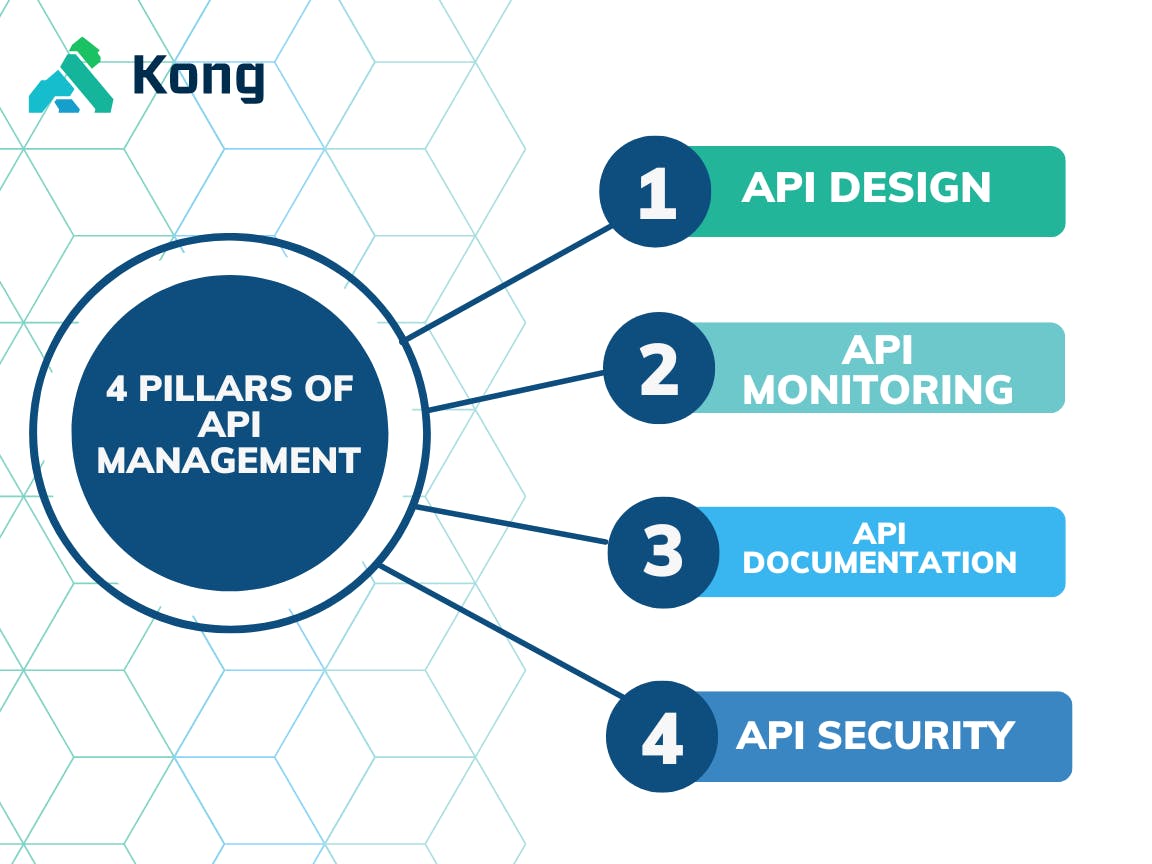
In order to guide the design and [implementation of APIs](https://konghq.com/blog/learning-center/what-is-api)implementation of APIs, there are four fundamental principles that stand as pillars for API management. These pillars must be given equal attention to ensure effective API management. Ignoring any one of them can lead to issues and inefficient development or use.
API Management Best Practices

### API design

Creating an interface that defines the interaction between different software components is known as API design. This incorporates several factors such as defining API endpoints, error handling protocols, and authentication mechanisms along with request and response formats while keeping versioning concerns in mind.

Design is a critical component for effective API management because it establishes how APIs will be developed, deployed, and managed. An efficient interface can significantly enhance developer productivity by simplifying development processes while simultaneously increasing adoption rates.

Conversely, poorly designed interfaces may result in inefficiencies that complicate deployment processes. Well-defined endpoints are fundamental and should be integrated into an API during its development stage. If lacking in clarity, these endpoints can cause developers difficulty utilizing APIs leading to costly mistakes and a delay in progress.

### API monitoring

[API monitoring](https://konghq.com/blog/learning-center/what-is-api-monitoring)API monitoring involves the ongoing process of collecting and analyzing critical performance indicators for an API — such as traffic volume, response time, and error rates — to determine its efficiency. Ensuring that the API is performing optimally while satisfying set objectives hinges on this practice.

This aspect of API management enables imminent detection and resolution of any arising complications before they significantly affect end-users. Effective API management necessitates ongoing monitoring and analysis of API usage and performance. The use of monitoring data facilitates the identification of areas that require improvement while enhancing API performance and ensuring it serves user needs.

Monitoring data also helps with recognizing potential security issues or breaches — facilitating the maintenance of the security and reliability of an API.

### API documentation

Developers tasked with navigating through APIs require documentation on various aspects of the system’s functionality such as endpoint configuration, request and response formats and error-handling protocols. Ultimately, this information comes together to form a vital component known as [API documentation](https://konghq.com/blog/learning-center/guide-to-api-documentation)API documentation which is designed to help fast-track developers' work processes and improve productivity.

Over time, this leads to better developer satisfaction within teams owing to efficiency gains realized through a smooth user experience when dealing with APIs. When managing an API, it's crucial to produce sufficient documentation that will ease accessibility while reducing dependence on assistance from support teams.

Above all, APIs need to align with organizational policies and guidelines; thus, appropriately structured documentation can guarantee this adherence for both developers and users. Ultimately, documenting APIs is a fundamental component necessary for efficient usage and overall success.

### API security

To protect an API from unwanted access, security measures like authentication and authorization mechanisms need to be implemented along with the encryption of data throughout its lifecycle. While vulnerability assessment needs to be conducted regularly, any suspicious events or activities must not go unnoticed.

Organizations should ensure that they comply with all relevant policies alongside keeping potential breaches at bay in order to avoid any damages caused by loss of revenue or lawsuits aimed at tarnishing their reputation. To best achieve effective API security, it's necessary to employ a thorough strategy involving access control, encryption, monitoring, and adhering to relevant regulatory requirements.

Being proactive about addressing potential threats and keeping relevant systems updated are just as important in ensuring optimal protection. Ultimately, proper attention to API security is fundamental in maintaining both safe APIs and secured data transmission.

## Best practices for API management

### Establish and maintain security

The management of APIs requires the utmost care when it comes to ensuring their security. This can be achieved by taking a comprehensive approach that includes certain steps and best practices.

  1. - **Authorization and authentication**: The importance of ensuring tight-knit security standards around APIs can't be emphasized enough. And implementing sound authentication and authorization methods are crucial in achieving this goal. As best practices, leveraging industry-recognized protocols like [OAuth 2.0](https://konghq.com/blog/learning-center/what-is-oauth)OAuth 2.0 or OpenID Connect can deter cyber threats from compromising your API’s integrity.
  2. - **Rate limiting**: Preventing denial-of-service (DoS) attacks and guaranteeing clients’ controlled requests can be accomplished with rate limiting. This mechanism regulates traffic from clients by constraining the amount they can send within a designated time frame, thus preventing overloading and maintenance issues.
  3. - **Logging and monitoring**: For the purpose of detecting and responding to security breaches and suspicious activity, it's essential to implement logging and monitoring. To this effect, deploying specialized tools like intrusion detection systems (IDS) and security information and event management (SIEM) systems can help in actively monitoring activities.
  4. - **RBAC**: API endpoint security is essential, and limiting access to these endpoints can be achieved through the implementation of an access-control mechanism. A role-based system like RBAC enables controlled interaction within the appropriate endpoint among individuals with specific roles determined by admin.
  5. - **Industry standards**: Mitigating risks associated with unauthorized access to your API requires a strategic approach that prioritizes security. With that said, adopting reliable security protocols and best practices advocated for by leading security authorities (like [the OWASP Top 10](https://konghq.com/blog/engineering/owasp-top-10-api-security-2023)the OWASP Top 10) can go a long way in ensuring maximum protection for your API.

By embedding essential security measures and adopting reliable strategies, it's possible to establish the integrity of your API, which guards against unauthorized access and exploitation of critical data. This approach helps maintain your user's trust by protecting their data.

### Maintaining documentation

An integral part of API management involves the maintenance of its corresponding documentation. Maintaining accurate and relevant API documentation can be achieved by following these key steps and best practices:

  1. - **Up-to-date documentation**: To maintain a coherent and useful set of documents for your API consumers, updating the documentation is crucial. Keeping up-to-date with all changes made within the system allows for an accurate representation of data flows from endpoints. Being aware of any modifications to request/response structures is also part of this process. Additionally, including details about authentication methods and revisions concerning error-handling mechanisms must be documented accordingly.
  2. - **Automation tools**: For maintaining consistency and accuracy in documentation, implementing standard documentation tools like Swagger or OpenAPI can be quite helpful. These tools assist in generating documentation automatically, which saves time and effort while ensuring that required standards are followed.
  3. - **Public documentation**: Including documentation that's readily accessible to anyone who seeks it is imperative. Not only does its easy accessibility enhance the acceptance of your API, but it also assists in diminishing concerns encountered by support personnel.
  4. - **Allow for feedback**: Successful documentation depends heavily on incorporating valuable user feedback. This means considering comments related to document clarity and applicability, as well as ideas for new capabilities or enhancements that would benefit users.

By following these steps and best practices, you can ensure your API documentation is accurate, up-to-date, and relevant, improving the developer experience and increasing the adoption of your API.

### Implementing version control

The implementation of API version control is an imperative element in successful API management. To ensure its effectiveness, the following steps are considered best practices:

  1. - **Semantic versioning**: API versioning can be a challenging task, but utilizing semantic versioning can simplify the process. The accepted industry standard provides clear and concise instructions for managing versions effectively.
  2. - **Backward compatibility**: To prevent any disruptions to existing clients, API’s new versions should uphold a backward-compatible stance.
  3. - **API client communication**: API updates demand prompt communication with all clients drawing on the program’s functionalities. On occasions when a new version is published, it's crucial to articulate any variations in writing and offer supporting documentation such as release notes.
  4. - **Deprecation schedules**: Set deprecation schedules for the older versions of your product. This allows clients to be given sufficient notice so that they can smoothly migrate toward newer versions without any hiccups.
  5. - **API URLs**: Employing versioning in API URLs is a highly useful technique that can avoid confusion on the part of both clients and developers. This makes it easy to ascertain which particular iteration of the API is being leveraged by clients, thereby ensuring proper usage.

By following these best practices, you can effectively implement API version control, ensuring that your API is always up to date and meeting the needs of your clients while minimizing disruptions to existing clients.

### Optimizing performance

  1. - **Monitor performance**: Utilizing load testing and performance monitoring tools is crucial in gauging the performance of APIs. The identification of areas requiring improvement will lead to a better understanding of the extent to which changes can leverage improvements.
  2. - **Optimize response times**: Response time optimization hinges on two key actions: one is reducing the size of responses; the other is reducing the number of requests necessary for completing an operation. Faster performance can be achieved through a strategic application of caching and compression methodologies.
  3. - **Data formats**: Efficient data formats such as JSON or Protocol Buffers should be utilized in writing programs to ensure minimal amount of data transfer over the network.
  4. - **Scalable infrastructure**: A vital aspect of constructing an API capable of handling increased loads is using flexible infrastructure that can expand or shrink on demand. Incorporating features like auto-scaling and load-balancing ensures the API runs efficiently even at peak times.
  5. - **Minimize API dependencies**: A key strategy for enhancing an API’s overall effectiveness is to minimize its reliance on external services. By reducing its exposure to such dependencies, one can not only mitigate potential system failures but also improve its overall responsiveness and capability.
  6. - **Error handling**: To maintain optimal API performance, it’s imperative to incorporate faultless error-handling mechanisms. This requires a level of technical competence in anticipating and catching software errors as they occur, then proceeding to tackle them systematically and with the utmost consideration for user experience. With proper error handling, an API becomes more secure against cyber-attacks while maintaining reliable service delivery to its clients.

By following these steps, you can optimize API performance, ensuring that your API is fast, responsive, and reliable, providing a positive user experience for your clients.

##### Conclusion

When it comes to modern software development and integration, API management is a crucial aspect.

The pillars of API management are numerous, including design, documentation, monitoring, security, and version control. Each of these aspects is crucial as they guarantee that APIs are both reliable and effective. Overall best practices for managing APIs include a focus on scalability and usability during API design followed by the maintenance of comprehensive documentation.

Monitoring the performance and usage rates of an organization’s APIs should be routine practice along with implementing appropriate security measures and using version control systems to manage updates effectively.

To enhance integration efforts, minimize development costs, and stand out in the market, organizations should prioritize effective API management. This requires integrating API management as a crucial component of software development and constantly assessing and adapting best practices for sustainable success.

- [API Management](/blog/tag/api-management)API Management- [API Development](/blog/tag/api-development)API Development- [Thought Leadership](/blog/tag/thought-leadership)Thought Leadership

## More on this topic

_eBooks_

## How to Sell Kong's API Platform to your CIO

_eBooks_

## API Product Management Guide: Strategy, Lifecycle & Best Practices

## See Kong in action

Accelerate deployments, reduce vulnerabilities, and gain real-time visibility. 

[Get a Demo](/contact-sales)Get a Demo
**Topics**
- [API Management](/blog/tag/api-management)API Management- [API Development](/blog/tag/api-development)API Development- [Thought Leadership](/blog/tag/thought-leadership)Thought Leadership
Axandria Shepard

Recommended posts

# The Enterprise API Strategy Cookbook: 8 Ingredients for Legacy Modernization

[Enterprise](/blog)EnterpriseFebruary 3, 2026

This is the pitch to the board and the C-suite. It must be brutally concise, focused entirely on your business outcomes, not the technology. If the first page doesn't articulate value, the strategy dies. Why? It immediately frames the initiative in

Steve Roberts
[](https://konghq.com/blog/enterprise/enterprise-api-strategy-legacy-modernization)

# API Product Management Guide: 6 Strategies for the Full Lifecycle

[Enterprise](/blog)EnterpriseJanuary 14, 2026

APIs are the connective tissue of digital products and services, and they're the lifeblood of AI. APIs shape customer experiences, power partner ecosystems, and accelerate enterprise innovation. As organizations double down on API-first strategies,

Amit Dey
[](https://konghq.com/blog/enterprise/api-product-management-guide)

# You Might Be Doing API-First Wrong, New Analyst Research Suggests

[Enterprise](/blog)EnterpriseSeptember 3, 2025

Ever feel like you're fighting an uphill battle with your API strategy? You're building APIs faster than ever, but somehow everything feels harder. Wasn’t  API-first  supposed to make all this easier?  Well, you're not alone. And now industry analys

Heather Halenbeck
[](https://konghq.com/blog/enterprise/you-might-be-doing-api-first-wrong)

# The Critical Role of API Security in the Internet of Things (IoT)

[Enterprise](/blog)EnterpriseAugust 1, 2024

From smart homes to wearable devices to connected cars, the Internet of Things (IoT) is bringing about a new era of hyper-connectivity. Experts expect investments in the IoT ecosystem to rise above $1 trillion in 2026 — with no signs of slowing do

Kong
[](https://konghq.com/blog/enterprise/iot-api-security-guide)

# Building a Modern API Platform: Key Principles and Benefits

[Enterprise](/blog)EnterpriseNovember 9, 2023

APIs have become a crucial part of modern software architecture, allowing different applications and services to communicate with each other. As organizations adopt microservices and distribute their systems, they require a cohesive API platform to

Greg Peranich
[](https://konghq.com/blog/enterprise/modern-api-platform-principles)

# API Infrastructure is Mission Critical — and Increasingly Under Attack

[Enterprise](/blog)EnterpriseJuly 27, 2023

Attacks estimated to surge 996% by 2030 — with the cost per breach rising to $14.5 million APIs have revolutionized every industry. They fuel digital transformation and power the web, making up more than 83% of global internet traffic. And API adop

Kong
[](https://konghq.com/blog/enterprise/apis-are-mission-critical)

# API Platform and Data Mesh: Why Bring Them Together

[Enterprise](/blog)EnterpriseJune 14, 2023

Enterprises are investing in data mesh initiatives to accelerate how decisions are made and to create novel experiences based on machine learning models. Similarly, enterprises are investing in API platform initiatives to productize business domains

Jordi Fernandez Moledo
[](https://konghq.com/blog/enterprise/api-platform-and-data-mesh)

## Ready to see Kong in action?

Get a personalized walkthrough of Kong's platform tailored to your architecture, use cases, and scale requirements.

[Get a Demo](/contact-sales)Get a Demo
Ask AI for a summary of Kong
  • [](https://chatgpt.com/s/t_69b981cfa37081919ce25ce107c431c1)
  • [](https://share.google/aimode/hyefOiNwl8pg8W99d)
  • [](https://www.perplexity.ai/search/what-solutions-does-kong-offer-VsYWPddxQjajgvLA4B9hjQ)
Stay connected

## step-0

    • Company
    • [About Kong](/company/about-us)About Kong
    • [Customers](/customer-stories)Customers
    • [Careers](/company/careers)Careers
    • [Press](/company/press-room)Press
    • [Events](/events)Events
    • [Contact](/company/contact-us)Contact
    • [Pricing](/pricing)Pricing
    • Legal
    • [Terms](/legal/terms-of-use)Terms
    • [Privacy](/legal/privacy-policy)Privacy
    • [Trust and Compliance](https://trust.konghq.com)Trust and Compliance
    • Platform
    • [Kong AI Gateway](/products/kong-ai-gateway)Kong AI Gateway
    • [Kong Konnect](/products/kong-konnect)Kong Konnect
    • [Kong Gateway](/products/kong-gateway)Kong Gateway
    • [Kong Event Gateway](/products/event-gateway)Kong Event Gateway
    • [Kong Insomnia](/products/kong-insomnia)Kong Insomnia
    • [Documentation](https://developer.konghq.com)Documentation
    • [Book Demo](/contact-sales)Book Demo
    • Compare
    • [AI Gateway Alternatives](/performance-comparison/ai-gateway-alternatives)AI Gateway Alternatives
    • [Kong vs Apigee](/performance-comparison/kong-vs-apigee)Kong vs Apigee
    • [Kong vs IBM](/performance-comparison/ibm-api-connect-vs-kong)Kong vs IBM
    • [Kong vs Postman](/performance-comparison/kong-vs-postman)Kong vs Postman
    • [Kong vs Mulesoft](/performance-comparison/kong-vs-mulesoft)Kong vs Mulesoft
    • Explore More
    • [Open Banking API Solutions](/solutions/open-banking)Open Banking API Solutions
    • [API Governance Solutions](/solutions/api-governance)API Governance Solutions
    • [Istio API Gateway Integration](/solutions/istio-gateway)Istio API Gateway Integration
    • [Kubernetes API Management](/solutions/build-on-kubernetes)Kubernetes API Management
    • [API Gateway: Build vs Buy](/campaign/secure-api-scalability)API Gateway: Build vs Buy
    • [Kong vs Apigee](/performance-comparison/kong-vs-apigee)Kong vs Apigee
    • Open Source
    • [Kong Gateway](https://developer.konghq.com/gateway/install/)Kong Gateway
    • [Kuma](https://kuma.io/)Kuma
    • [Insomnia](https://insomnia.rest/)Insomnia
    • [Kong Community](/community)Kong Community

Kong enables the connectivity layer for the agentic era – securely connecting, governing, and monetizing APIs and AI tokens across any model or cloud.

  • Japanese
  • Frenchcoming soon
  • Spanishcoming soon
  • Germancoming soon
© Kong Inc. 2026
Interaction mode