The Kong Gateway jq plugin allows you to run your transforms conditionally, depending on the request or response media type (it defaults to application/json) and response code. This means that you won't try to transform a response body if you get an error response by default.
To configure your jq filter, you need to provide the request_jq_program or response_jq_program options in your plugin config, or you can specify both to transform both the request and the response.
The [Kong documentation](https://docs.konghq.com/hub/kong-inc/jq)Kong documentation has a comprehensive overview of the available options, which can be provided to the admin API as an HTTP request or via declarative configuration. Here's a sample declarative configuration file that uses jq to extract the title key from multiple items in a response:
curl -X POST http://localhost:8001/services/Demo/plugins \
    --data "name=jq"  \
    --data "config.response_jq_program=[.[].title]"
## Example Use Cases
The best way to learn jq is to see it used in some real-world scenarios. In this post, we'll cover three real-world scenarios and one fun example to show the power of jq:
- Transform a request body from one structure to another
- Remove sensitive information from a response
- Convert a JSON API to CSV
- Convert Celsius to Fahrenheit (this is the fun one!)
Let's dive in with how to restructure a request body before sending it to the upstream.
### **1. Transform a Request Body to Maintain Backwards Compatibility**
How could we fix this without impacting our early access customers? jq to the rescue!
By assigning a field using = and the del() function, we can create a new field containing the value of referer and delete the old key. This has the effect of renaming a key in the request body:
## text
.referrer = .referer | del(.referer)
Although this program contains spaces, there is no need to encode the request:
### **2. Delete Sensitive Information From a Response**
The next scenario is a backend team built an API for us, but they've left in some sensitive information that we don't want to share with customers. We asked for it to be removed, but the API should have been launched last week, and we can't wait another two weeks for the team to make the changes.
We want to launch today but only show the standard pricing field:
How do we remove these sensitive fields from the response dynamically? Once again,jq to the rescue! There are a couple of ways to achieve what we want to do. The first is to call del() multiple times:
## text
del(.pricing.base) | del(.pricing.partner)
This works but isn't the most efficient way to accomplish our goal. Instead, we can step in to pricing then delete multiple keys within that object:
## text
del(.pricing | .base,.partner)
Once we apply this transform using response_jq_program, we'll get the following response body:
The data we wanted to remove is gone, and we can ship our new API today!
### **3. Convert a JSON Response to CSV**
Imagine that we built a lovely JSON API for our customers that works great, but then one of our valuable customers comes back to us saying, "But it doesn't work in my spreadsheets! Can you provide the data as CSV too?"
We don't want to invest more development time for just one customer, but we want to make them happy. How do we tackle it? That's right! We can use jq.
[
  {
    "title": "Opening Keynote: Developing the Connected World",
    "description": "Join Kong's co-founders, along with special guests, live as they explore cloud connectivity in today's digital world and what that means for modern, connected enterprises. They will also unveil the latest in Kong products and technology -- be the first to see a sneak peek of Kong's newest features and updates.",
    "presenters": [
      "Augusto Marietti",
      "Marco Palladino",
      "Reza Shafii"
    ],
    "date": "2021-09-28"
  }
]
This is a slightly more complicated processing pipeline than the examples shown so far, so we'll build it up section by section. The first row we need to output is a list of field names. We can do this by fetching the keys from the first entry in the array:
## text
.[0] | keys_unsorted as $keys
Next, we need to process the payload to remove any complex data structures as they can't be represented in a CSV. In our API, the only complex data is the list of presenters, which we'll convert to a string by mapping over each entry and joining the list with a comma:
## text
map(.presenters = (.presenters | join(", ")))
Now that the data only contains strings, we need to remove all key names. We can do that using map and $keys. It looks odd, but what we're saying is "add a row containing all of the available keys, then return a list of values, one for each available key":
## text
([$keys] + map([.[ $keys[] ]]))
At this point, our data looks like the following:
## text
[
  [
    "title",
    "description",
    "presenters",
    "date"
  ],
  [
      "Opening Keynote: Developing the Connected World",
      "Join Kong's co-founders, along with special guests, live as they explore cloud connectivity in today's digital world and what that means for modern, connected enterprises. They will also unveil the latest in Kong products and technology -- be the first to see a sneak peek of Kong's newest features and updates.",
      "Augusto Marietti, Marco Palladino, Reza Shafii",
      "2021-09-28"
  ]
]
The final thing to do is to remove the wrapper array and convert it to CSV:
"title","description","presenters","date"
"Opening Keynote: Developing the Connected World","Join Kong's co-founders, along with special guests, live as they explore cloud connectivity in today's digital world and what that means for modern, connected enterprises. They will also unveil the latest in Kong products and technology -- be the first to see a sneak peek of Kong's newest features and updates.","Augusto Marietti, Marco Palladino, Reza Shafii","2021-09-28"
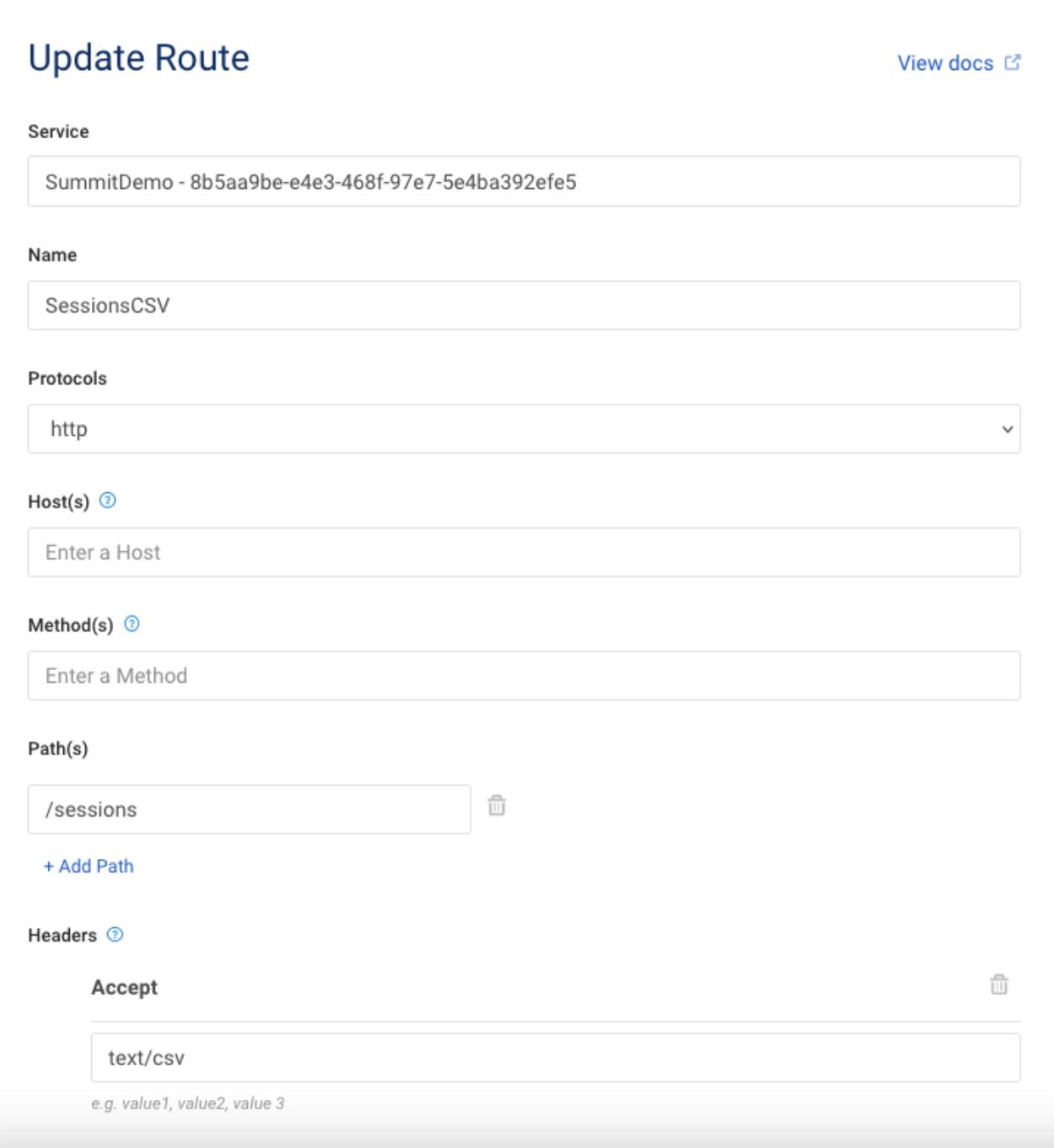
We're almost there, but not quite! We don't want to return a CSV payload to everyone, so we need to register a new route using Kong. We expect consumers to send an Accept: text/csv header to get the CSV response. Here's the configuration I used to create this route:
Finally, we have to enable the jq plugin on our new route. We can use the jq expression above as config.request_jq_program like normal, but we need a few other configuration options when working with CSV. The default options for jq are to compress the output and escape any quotes. As we're returning CSV data, we don't want this to happen, so we need to set config.response_jq_program_options.compact_output to false and config.response_jq_program_options.raw_output to true.
Once we set those configuration options, we're all good to go! We now have an endpoint that returns CSV data for our high-profile customer with zero development effort.
### **4. Convert Celsius to Fahrenheit**
One final example before you go and try the jq plugin out yourself.
Imagine this—we've got a wildly successful greenhouse temperature monitoring product that's working really well in the EU, and we want to launch the product in the US. We're unsure if it will do as well, so we do some initial user testing. Feedback is positive except for one thing—they'd prefer to see the temperature in Fahrenheit rather than Celsius.
As it's a small batch of testers that we're very hands on with, we decide to convert on the fly using jq to validate our hypothesis rather than getting our engineering team to build the functionality. An API that returns data in the following format powers our application:
Our UI uses the units and temperature from the API, so we need to rewrite those two fields in both current and previous to be in Fahrenheit. Once again, we'll be using map to apply to each entry in the response.
This will convert the temperature and units values in every key in the returned object. This works for the simple use case above, but what if our response was a little more complex? What if it also contained a location and an account ID?
Using the jq expression above would result in an error:
## text
jq: error (at <stdin>:16): null (null) and number (9) cannot be multiplied
Thankfully, jq also supports if statements that allow us to run our transform conditionally. Here's a transformation that checks that the units key has a value of celsius before trying to convert to Fahrenheit. If it doesn't equal celsius then it returns the original object:
Once we apply this jq plugin to a specific route that we're using in our beta testing, we can go ahead and test with US customers once again - this time with the units they're familiar with.
Event Hooks is a new Kong Enterprise feature launched in the Kong Gateway 2.5 Release . This feature sends you notifications when certain events happen on your Kong Gateway deployment. Kong Gateway listens for events, like routes, services, consum
Steve Young
# How to Test Gateway APIs Directly from Kong Konnect with Insomnia
What You'll Build
To explore the new integration, I'll build a realistic API platform workflow using Konnect, Kong Gateway, and Insomnia.
By the end of this tutorial, I'll have:
A Konnect Control Plane (KongAir Dev)
A local Kong Gateway Data Pl
Juhi Singh
# How to Track Service Level Objectives with Kong and OpenTelemetry
In this blog post, we will explore how organizations can leverage Kong and OpenTelemetry to establish and monitor Service Level Objectives (SLOs) and manage error budgets more effectively. By tracking performance metrics and error rates against pred
We're pleased to announce the launch of Standard Webhooks! Kong has been part of the Technical Committee of this standard with other great companies like Svix (the initiator of the project), Ngrok, Zapier, Twillio, Lob, Mux, and Supabase. This was
Vincent Le Goff
# Using Kong Gateway to Adapt SOAP Services to the JSON World
While JSON-based APIs are ubiquitous in the API-centric world of today, many industries adapted internet-based protocols for automated information exchange way before REST and JSON became popular. One attempt to establish a standardized protocol sui
Hans Hübner
# Debugging Kong Requests: 7 Kong Gateway Troubleshooting Tips
Developers will remember times when they were trying to figure out why something they were working on wasn’t behaving as expected. Hours of frustration, too much (or perhaps never enough) caffeine consumed, and sotto voce curses uttered. And then
Viktor Gamov and Rick Spurgeon co-authored this blog post. Kong Gateway provides dynamic plugin ordering allowing administrators to control plugin execution order. Dynamic plugin ordering was added in Kong Enterprise 3.0 and the full technical re
Event Hooks is a new Kong Enterprise feature launched in the Kong Gateway 2.5 Release . This feature sends you notifications when certain events happen on your Kong Gateway deployment. Kong Gateway listens for events, like routes, services, consum
Steve Young
# How to Test Gateway APIs Directly from Kong Konnect with Insomnia
What You'll Build
To explore the new integration, I'll build a realistic API platform workflow using Konnect, Kong Gateway, and Insomnia.
By the end of this tutorial, I'll have:
A Konnect Control Plane (KongAir Dev)
A local Kong Gateway Data Pl
Juhi Singh
# How to Track Service Level Objectives with Kong and OpenTelemetry
In this blog post, we will explore how organizations can leverage Kong and OpenTelemetry to establish and monitor Service Level Objectives (SLOs) and manage error budgets more effectively. By tracking performance metrics and error rates against pred
We're pleased to announce the launch of Standard Webhooks! Kong has been part of the Technical Committee of this standard with other great companies like Svix (the initiator of the project), Ngrok, Zapier, Twillio, Lob, Mux, and Supabase. This was
Vincent Le Goff
# Using Kong Gateway to Adapt SOAP Services to the JSON World
While JSON-based APIs are ubiquitous in the API-centric world of today, many industries adapted internet-based protocols for automated information exchange way before REST and JSON became popular. One attempt to establish a standardized protocol sui
Hans Hübner
# Debugging Kong Requests: 7 Kong Gateway Troubleshooting Tips
Developers will remember times when they were trying to figure out why something they were working on wasn’t behaving as expected. Hours of frustration, too much (or perhaps never enough) caffeine consumed, and sotto voce curses uttered. And then
Viktor Gamov and Rick Spurgeon co-authored this blog post. Kong Gateway provides dynamic plugin ordering allowing administrators to control plugin execution order. Dynamic plugin ordering was added in Kong Enterprise 3.0 and the full technical re
Event Hooks is a new Kong Enterprise feature launched in the Kong Gateway 2.5 Release . This feature sends you notifications when certain events happen on your Kong Gateway deployment. Kong Gateway listens for events, like routes, services, consum
Steve Young
# How to Test Gateway APIs Directly from Kong Konnect with Insomnia
What You'll Build
To explore the new integration, I'll build a realistic API platform workflow using Konnect, Kong Gateway, and Insomnia.
By the end of this tutorial, I'll have:
A Konnect Control Plane (KongAir Dev)
A local Kong Gateway Data Pl
Juhi Singh
# How to Track Service Level Objectives with Kong and OpenTelemetry
In this blog post, we will explore how organizations can leverage Kong and OpenTelemetry to establish and monitor Service Level Objectives (SLOs) and manage error budgets more effectively. By tracking performance metrics and error rates against pred
We're pleased to announce the launch of Standard Webhooks! Kong has been part of the Technical Committee of this standard with other great companies like Svix (the initiator of the project), Ngrok, Zapier, Twillio, Lob, Mux, and Supabase. This was
Vincent Le Goff
# Using Kong Gateway to Adapt SOAP Services to the JSON World
While JSON-based APIs are ubiquitous in the API-centric world of today, many industries adapted internet-based protocols for automated information exchange way before REST and JSON became popular. One attempt to establish a standardized protocol sui
Hans Hübner
# Debugging Kong Requests: 7 Kong Gateway Troubleshooting Tips
Developers will remember times when they were trying to figure out why something they were working on wasn’t behaving as expected. Hours of frustration, too much (or perhaps never enough) caffeine consumed, and sotto voce curses uttered. And then
Viktor Gamov and Rick Spurgeon co-authored this blog post. Kong Gateway provides dynamic plugin ordering allowing administrators to control plugin execution order. Dynamic plugin ordering was added in Kong Enterprise 3.0 and the full technical re
Viktor Gamov
## Ready to see Kong in action?
Get a personalized walkthrough of Kong's platform tailored to your architecture, use cases, and scale requirements.