*This is the second part of our three-part blog series on APIs, sustainability and climate change. Missed the first part? *[*Check it out here*](https://konghq.com/blog/climate-change-reduce-impact-api)*Check it out here**. In this blog, we examine ways to consume and embed APIs to make our own processes greener and show how APIs are the building blocks of a new wave of green innovation.*
The [API economy](https://konghq.com/blog/api-economy)API economy - and therefore the ways we can use APIs to cut carbon emissions and make technology more sustainable - is not just about building APIs but consuming them too. These are APIs that have been built by partners, greentech startups, suppliers and maybe even your own customers.
We can use these APIs to enhance our own workflows, both internal and external, to make them greener. APIs enable us to build ecosystems that span multiple domains and embed capabilities into our own offerings that we may not necessarily build ourselves; i.e., APIs give us an easy way to compensate in the short term for longer term changes we need to make.
*Access the complete guide that explores the vital role that API technology can play in helping to *[*mitigate climate change and facilitate sustainability*](https://konghq.com/resources/e-book/only-constant-is-climate-change)*mitigate climate change and facilitate sustainability**.*
## APIs for Carbon Offsetting
We know one of the primary use cases for APIs is to open new, API-based revenue streams. Well, here's a great example: There are increasingly many companies offering B2B APIs that can make your own products and processes greener, for example by assessing or offsetting your carbon emissions. You embed these into your own workflows to provide greener services to your customers, ultimately making it easier for them to reduce *their* environmental footprint: something a growing number of consumers are demanding.
One such example is [Patch](https://www.patch.io)Patch, which offers "API-first carbon removal:" an API that enables businesses to programmatically calculate their emissions and immediately offset them by investing into a range of vetted projects. [Shopify](https://www.shopify.co.uk/blog/carbon-offsets)Shopify, the e-commerce platform, offers carbon offsets in the Offset app to both merchants and buyers to offset the emissions from shipping their packages.
They do this by embedding services from [Pachama](https://pachama.com)Pachama into the buying workflow, a carbon offsetting company that uses AI and ML on satellite observations to measure carbon captured in forests and map how it changes over time, as well as conserving and restoring forests.
It's important to note here that we need to do more than just compensate for our own emissions, but it's a better starting point than doing nothing. Offsetting emissions means we just counter in one place the damage we do elsewhere, resulting in a net zero ecosystem in which we don't make things worse overall. It's *not* the same as reducing our emissions in the first place and actually making things better.
## APIs for Innovative Sustainability
It's often said that APIs are the building blocks of innovation. This is just as applicable when thinking about green APIs; there are a large number of public and paid-for APIs that we can build new projects on top of—projects that can make a significant difference.
For example, the [Emissions API](https://emissions-api.org)Emissions API based on the European Space Agency's satellite data enables you to see different types of emissions from different countries, regions and cities. This API empowers you to build impactful climate-focused programs, like a 3D visualizer of carbon monoxide concentrations that could compare data over time to evaluate the effectiveness of environmental regulations.
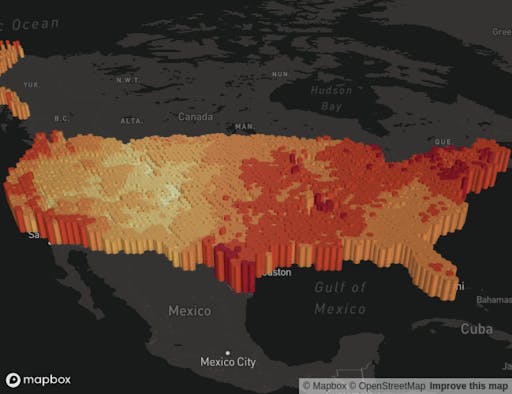
That's just one example of countless APIs you can find online yourself, but innovation doesn't stop there. A staggering [$87.5 billion](https://www.cnbc.com/2021/12/14/climate-tech-investment-is-soaring-this-year-pwc.html)$87.5 billion was invested globally in climate tech between H2 2020 and H1 2021; it now accounts for 14 cents of every venture capital dollar. This is a rapidly growing and incredibly exciting domain.
## Tomorrow.io
This movement is apparent with organizations like [Tomorrow.io](https://bit.ly/3BIGj7k)Tomorrow.io, the world's first weather and climate security platform. Its team are firm believers that "climate security is the next cyber security." Tomorrow.io addresses climate challenges in two ways: by providing more accurate weather forecasts than other sources, leading to more efficient operational decisions, and by providing insights on their data to help organizations reduce the negative impact of climate change and more frequent and volatile weather events, i.e. "climate resilience."
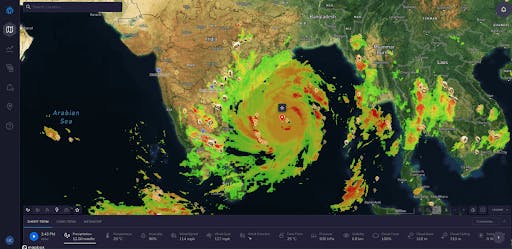
Their platform combines global weather data from millions of sensors and numerous other sources, which will include data from their own [radar-equipped satellites](https://www.tomorrow.io/space?utm_source=Kong)radar-equipped satellites launching later this year, machine learning, artificial intelligence and complex event processing - all available through both a platform application (hello, fascinating dashboards!) and directly through APIs (all managed by Kong).
This then provides customers with hyperlocal and highly accurate weather forecasts, along with actionable insights based on the weather data. Businesses can then use these insights to better inform their operations.
An airline, for example, could leverage Tomorrow.io to understand when and how much to fuel aircraft based on the weather forecast of upcoming flight paths. And obviously flying with the right amount of fuel rather than carrying too much burns less fuel in the first place.
The weather data is also available through a [public API](https://www.tomorrow.io/weather-api?utm_source=Kong)public API that is currently used by over 30,000 developers. This means 30,000 innovators across the world are building their own applications on top of Tomorrow.io's unique weather and climate insights - and [you could be one of them](https://app.tomorrow.io/signin)you could be one of them.
## Uplight
Another innovative company - and Kong customer - is [Uplight](https://uplight.com)Uplight. Uplight provides software, services and insights to electric and gas utilities, connecting its customers to products and services that help accelerate decarbonization, save energy customers money, and positively impact people and their communities. Uplight helps these utility companies optimize their energy use through data and APIs: The software monitors and models consumer behavior, enabling the utilities to adapt how their networks operate in real time based on consumption patterns to maximize efficiency, reduce peak loads and increase grid resiliency.
Uplight's goal is to ultimately reduce global CO2 emissions by more than 100 million metric tons, saving consumers more than $10 billion on their energy bills in the process. This is a company that didn't exist (in its current form) three years ago, is a certified B-Corporation and is already valued at $1.5 billion. They're using technological advancements to create and scale solutions with a purpose to “create a more sustainable future using business as a force for good."
## What will you create?
We have all the building blocks ready for us to build on top of; the missing ingredient is you. That idea you had a few months ago, the hackathon you're planning, the conference talk you were inspired by - what will you create?
Consumers are increasingly demanding greener alternatives and turning towards environmentally aware companies; [50% of consumers](https://www.businesswire.com/news/home/20211014005090/en/Recent-Study-Reveals-More-Than-a-Third-of-Global-Consumers-Are-Willing-to-Pay-More-for-Sustainability-as-Demand-Grows-for-Environmentally-Friendly-Alternatives)50% of consumers now rank sustainability as a top five value driver. It's not just an ethical decision to be more sustainable now but a business one. We have an opportunity to innovate and develop the solutions.
We have a growing expectation from our customers to provide sustainable products. Let's use our technical experience and creativity to do just that.
*Check out *[*Part 1 of this blog series*](https://konghq.com/blog/climate-change-reduce-impact-api)*Part 1 of this blog series** for ways to build more efficient and sustainable APIs and *[*Part 3*](https://konghq.com/blog/the-environmental-impact-of-common-architecture-patterns)*Part 3** for considerations to have in mind when adopting architecture patterns such as microservices, APIs and event-driven architectures.*