# How to Manage Your API Policies with OPA (Open Policy Agent)
Sven Bernhardt
APIs are essential to modern applications, but managing access and security policies can be complex. Traditional access control mechanisms can fall short when flexible, scalable, and fine-grained control over who can access specific resources is needed.
This is where OPA (Open Policy Agent) steps in. OPA provides a unified framework for consistently defining and enforcing policies across microservices, APIs, Kubernetes clusters, and beyond.
Consistent policy management is essential for enterprises. Here are a few reasons why:
- **Security**: Restrict access to sensitive data or actions.
- **Compliance**: Ensure API requests comply with internal or external regulatory standards (e.g., GDPR).
- **Consistency**: Provide a single source of truth for authorization policies across services.
- **Agility**: Enable fast iterations and updates of API policies as requirements evolve.
In this post, we'll explore how to manage API policies effectively using OPA in combination with Kong Gateway.
## API gateway as a central point of control
An API gateway is a central entry point for securely interfacing with an enterprise’s services and data. As such, enforcing access control policies, rate limiting, and other security measures is natural. The API gateway becomes a single source of truth for access control policies, ensuring consistency and reducing the risk of misconfigurations. It's also an essential building block for a secure and scalable API infrastructure. It also frees developers from implementing these policies in each service, allowing them to focus on business logic.
Let’s look at an example to illustrate this.
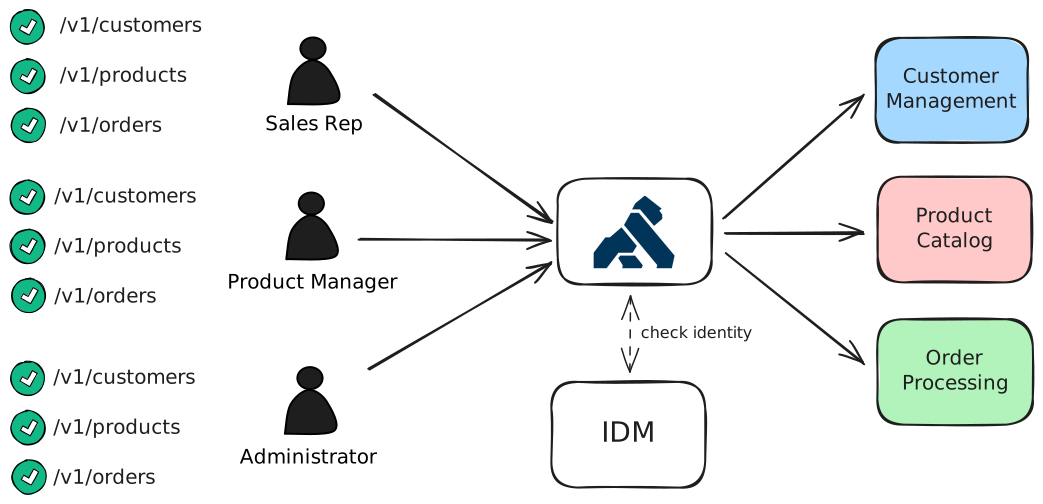
Imagine a set of microservices providing different functionalities, such as customer management, product catalog, and order processing. Each microservice has its own access control logic, which can lead to inconsistencies and duplication. Now, the security department defines only authenticated users as those who can access data from these services. Rather than distributing across and implementing this policy in each service, you can centralize them in an API gateway like Kong Gateway.
Kong Gateway can enforce this policy for all incoming requests, ensuring that only authenticated users can access the services. For this purpose, it can be integrated with an existing identity management solution like Keycloak.
*Figure 1: API gateway as a central gatekeeper*
Implementing an API gateway as a central policy layer is a good practice to ensure consistent and secure access control across your APIs.
## Policy management requirements
However, managing policies can become challenging as the number of services and APIs grows. Over time, policies can become complex and difficult to manage, especially critical fine-grained access control policies. Such policies often require data from external sources to decide whether users can access services or the respective data. In particular, when policies are reused across services or when they’re subject to being updated frequently, it becomes even more challenging.
The logic required to cover those enhanced use cases is quite dynamic. It needs more logic and data from external sources, and the implementation might bloat the API Gateway. Therefore, such policy logic is usually realized in the respective backend services.
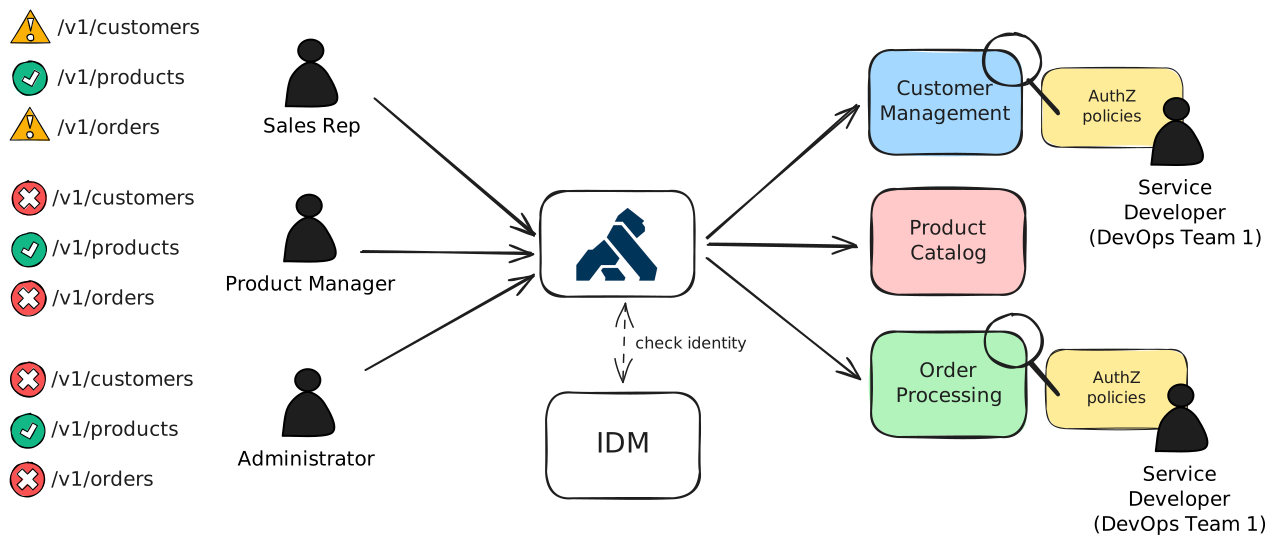
Coming back to our example scenario: Imagine due to compliance and data privacy reasons (GDPR), the security department extends the policy restricting customer and order data access. Only sales reps should be allowed to access this data in the future. Furthermore, write access should be restricted so that a sales rep can only edit data for customers and orders they’re responsible for. Viewing the respective data is allowed for all sales reps.
*Figure 2: AuthZ policy logic implemented in backend services*
In this case, policies become more complex and must be implemented in customer management and order processing services, as shown in Figure 2. Different teams are responsible for these services, so the implementation must be coordinated and tested.
if (user.role == "sales-rep" &&
http.method in ("PUT","POST","PATCH","DELETE") &&
customer.salesRep.name == user.name)
return trueelse if (user.role == "sales-rep" &&
http.method in ("GET"))
return trueelse
return false
*Listing 1: AuthZ policies pseudocode*
The outlined approach can lead to duplication and inconsistency. Furthermore, services risk not being compliant with company policies or regulations. Likewise, they’re harder to maintain and update.
Integrating a separate policy engine, like Open Policy Agent (OPA), with Kong Gateway lets you offload policy decisions from your backend services, ensuring consistent and fine-grained access control.
## Policy management with OPA
OPA is an open source, general-purpose policy engine. It can decouple policy decisions from the service logic, making managing and maintaining complex decisions like access controls easier. OPA evaluates policies written in [Rego](https://www.openpolicyagent.org/docs/latest/policy-language/)Rego, a declarative language, and provides a REST API to manage policies and query policy decisions.
OPA provides a flexible and powerful way to define policies that can be reused across services. It allows you to define policies based on various attributes, such as user roles, request methods, headers, and more. This makes it easy to create fine-grained access control policies that can be easily updated and maintained.
OPA operates alongside Kong Gateway, microservices, or any other service that needs policy decisions. It receives requests, evaluates them against the policies you’ve defined in Rego, and returns an allow/deny decision. Doing so ensures that the policies are consistently enforced across all your services. In addition, you can easily update and test policies without redeploying your services. Moreover, you can version policies independently of the services, allowing for a more agile policy management process.
## OPA and Kong API Gateway
As mentioned, OPA can be integrated with Kong Gateway to provide fine-grained access control for your APIs. But what does this mean, how does it work, and what are the benefits?
When enterprises implement a combined approach of OPA and Kong Gateway, the benefits for API management include:
- Fine-grained access control
- Scalability for distributed systems and microservices
- Declarative policy language (Rego)
- Consistency across various layers of an application (API, Kubernetes, databases, etc.)
Integrating OPA in existing architectures is straightforward. OPA provides a REST API for managing policies and requesting policy decisions from the policy engine. Integrating OPA with Kong Gateway is even easier, as Kong provides an [OPA plugin](https://docs.konghq.com/hub/kong-inc/opa/)OPA plugin allowing you to delegate authorization decisions to OPA. The OPA plugin for Kong acts as a bridge between Kong and OPA. To developers familiar with Kong’s plugin mechanism, the configuration is intuitive.
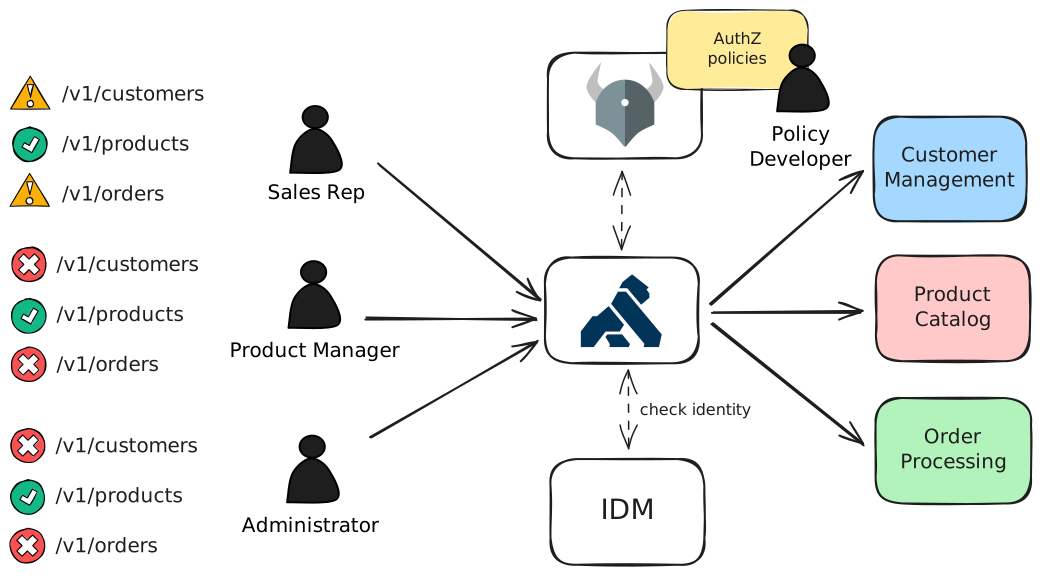
Concerning our example, establishing this approach helps to separate complex policy logic from the Gateway configuration. As Figure 3 shows, a policy developer can define the new policies, depicted as pseudocode in Listing 1, in Rego. One crucial fact the figure shows is that a policy developer is not necessarily a service developer but might be part of the security department. This separation of concerns allows for a more agile development process, as policies can be updated and tested independently of the services.
*Figure 3: OPA integrated with Kong API Gateway*
Once the development is done, the policies can be tested and validated locally and independently of the services. Finally, when the policies are ready, they can be deployed to OPA.
A CI/CD pipeline can automate validating, testing, and deploying the policies to OPA. Following a GitOps approach, you can comprehensively version your policies and gain complete visibility into policy evolvement. This is important for compliance and auditing purposes. And it’s a consistent way to manage policies the GitOps way, as we do the same with the application code, the infrastructure, and the API lifecycle ([APIOps](https://konghq.com/blog/enterprise/what-is-apiops)APIOps) as well.
After the new policies have been deployed to OPA, Kong can be configured to delegate authorization decisions to OPA using the Kong OPA plugin.
## Conclusion
In times of increasing regulations and compliance requirements, having a clear overview of your policies is crucial to avoid duplication. Furthermore, it's important to establish clear responsibility for policy management and to define a process for amending testing and versioning policies. In addition, changes to policies should be comprehensibly documented. Having a clear understanding of policies available and where they’re used furthers security and compliance and helps avoid misconfigurations.
Adding OPA to your [API management platform](https://konghq.com/products/kong-konnect)API management platform as a building block is essential to tackle these challenges in modern, highly distributed architectures. It allows you to manage all policies in a structured way in a central place and allows for visibility on different levels. On the API gateway level, you can see which endpoints are protected, how they’re protected, and what policies are enforced. On the OPA level, you can see which fine-grained policies are defined, and how they are versioned and implemented.
Take control of your policy management today. Implement OPA in your API management platform to ensure consistent enforcement, gain complete visibility, and streamline compliance across all services. Don’t let policy misconfigurations compromise your security — start building a modern, resilient architecture now.
We announced the Kong Premium Technology Partner Program at API Summit 2024, and Confluent was one of the first in the program. This initial development was all about ensuring that the relationship between Kong and Confluent — from a business an
API gateway request transformation policies are incredibly powerful. There are many situations when an API developer can take advantage of request transformations to adjust the shape and values of a request to cleanly fit their API. Let’s say you’re
Running Kong in front of your Solace Broker adds real benefits: Authentication & Access Control – protect your broker from unauthorized publishers. Validation & Transformation – enforce schemas, sanitize data, and map REST calls into event topics.
The goal of Integration Platform as a Service (iPaaS) is to simplify how companies connect their applications and data. The promise for the first wave of iPaaS platforms like Mulesoft and Boomi was straightforward: a central platform where APIs, sys
APIs have quietly powered the global shift to an interconnected economy. They’ve served as the data exchange highways behind the seamless experiences we now take for granted — booking a ride, paying a vendor, sending a message, syncing financial rec
Since our last Kong Konnect monthly update , we've been hard at work to deliver some more powerful features in Kong Konnect , including consumer groups, dynamic client registration using Curity and Auth0, plugin ordering, and streamlined Docker ru
An API Gateway is becoming an essential part of modern application architecture. It acts as a reverse proxy that routes API requests to appropriate backend services. Along with routing, API Gateways provide capabilities like security, monitoring, ra