DISCOVER & TEST KONNECT APIS IN REAL TIME WITH INSOMNIA 13 MIGRATE 50% FASTER WITH KONG MIGRATION SERVICES DON'T MISS OUT ON API + AI SUMMIT 2026 | PRICES INCREASE AUGUST 16
[Blog](/blog)Blog
  • [AI Gateway ](/blog/tag/ai-gateway)AI Gateway
  • [AI Security ](/blog/tag/ai-security)AI Security
  • [AIOps ](/blog/tag/aiops)AIOps
  • [API Security ](/blog/tag/api-security)API Security
  • [API Gateway ](/blog/tag/api-gateway)API Gateway
|
    • [API Management ](/blog/tag/api-management)API Management
    • [API Development ](/blog/tag/api-development)API Development
    • [API Design ](/blog/tag/api-design)API Design
    • [Automation ](/blog/tag/automation)Automation
    • [Service Mesh ](/blog/tag/service-mesh)Service Mesh
    • [Insomnia ](/blog/tag/insomnia)Insomnia
    • [Event Gateway ](/blog/tag/event-gateway)Event Gateway
    • [View All Blogs ](/blog/page/1)View All Blogs
We're Entering the Age of AI Connectivity [Read more](/blog/news/the-age-of-ai-connectivity)Read moreProducts & Agents:
    • [Kong AI Gateway](/products/kong-ai-gateway)Kong AI Gateway
    • [Kong API Gateway](/products/kong-gateway)Kong API Gateway
    • [Kong Event Gateway](/products/event-gateway)Kong Event Gateway
    • [Kong Metering & Billing](/products/kong-konnect/features/usage-based-metering-and-billing)Kong Metering & Billing
    • [Kong Insomnia](/products/kong-insomnia)Kong Insomnia
    • [Kong Konnect](/products/kong-konnect)Kong Konnect
  • [Documentation](https://developer.konghq.com)Documentation
  • [Book Demo](/contact-sales)Book Demo
  1. Home
  2. Blog
  3. Learning Center
  4. What is an API Gateway? Core Fundamentals and Use Cases
[API Gateway](/blog/tag/api-gateway)API Gateway
June 10, 2026
17 min read

# What is an API Gateway? Core Fundamentals and Use Cases

Kong

APIs are the connective tissue of modern software and as the number and complexity of APIs grow, managing them efficiently becomes critical. That is where API gateways come in.

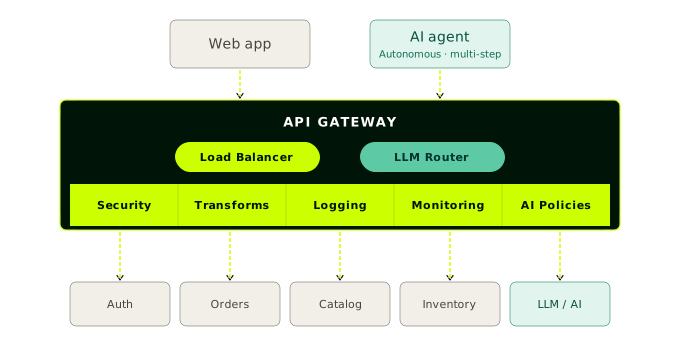
An API gateway is the infrastructure layer that sits in front of your APIs to manage traffic, enforce security policies, handle authentication, and route requests to the right backend services. It is not the API itself — an API is a set of rules and protocols that allows software applications to communicate — but rather the traffic controller that governs how those APIs are accessed and consumed. And as AI agents join web and mobile apps as major API consumers, the gateway's role is expanding — it is now the enforcement point for both traditional and AI-driven traffic. For teams working in gateway programming and distributed architectures, the API gateway is the operational backbone of any API strategy.

## In simple terms, what is an api gateway?

An API Gateway acts as a mediator between client applications and the backend services within the microservices architecture. It is a software layer that functions as a single endpoint for various APIs performing tasks such as request composition, routing, and protocol translation. The API gateway controls requests and responses by managing the traffic of APIs while enforcing security policies. This simplifies API management by providing one central point of control which aids developers in focusing on building individual services rather than being encumbered by complex networks of APIs, including tasks such as user authentication and rate limiting.

## How do API Gateways Work?

The beauty of modern-day software systems lies in their ability to handle complex operations with ease.

The introduction of an API Gateway is no different. This innovative technology acts as a buffer between clients and backend services, taking care of all error-detection procedures while also granting access privileges where needed. At the core of this lies a well-structured architecture that enables proper routing based on request paths and other relevant factors. The foundation of a [microservices architecture](https://konghq.com/blog/learning-center/what-are-microservices)microservices architecture lies in its efficient communication method within an ecosystem of multiple self-contained services. Upon reception of its first contact, the backend service sends back responses through the API Gateway once processing completes. After this step, the Gateway takes over by analyzing these outputs before relaying them back to their intended party clients seeking collaboration with various involved services using one unified point of access. Furthermore, not only does an API Gateway provide credible clustering but also has options like working as a proxy server that accepts requests instead and directs actions accordingly. Additionally, an API Gateway can also be deployed as a load balancer at the multi-cluster level, as an Ingress controller at the cluster-level, or within the Kubernetes cluster as a service mesh.

### Architecture of API Gateway

API Gateway's architecture consists of multiple components working together seamlessly. It typically involves handling incoming API requests, routing them to the appropriate backend services, managing API versioning, and enforcing security policies. Additionally, it contains functionalities like rate limiting, load balancing, and SSL termination to enhance performance and security. The structure may include a reverse proxy for traffic routing and an ingress controller for managing ingress to backend services efficiently. These components collectively ensure smooth communication between clients and backend systems. This simplifies API management by providing one central point of control which aids developers in focusing on building individual services rather than being encumbered by complex networks of APIs.

Modern API gateways support multiple deployment models to match diverse infrastructure requirements. They can be deployed as standalone proxies, Kubernetes ingress controllers, sidecar proxies, or fully managed SaaS services. Kong Gateway, for example, offers deploy-anywhere flexibility — self-hosted, hybrid, or fully managed across AWS, Azure, and GCP — giving teams the freedom to choose the model that fits their environment.

An API gateway can also sit at the network edge to manage north-south traffic (requests from external clients into internal services) or be deployed internally to govern east-west traffic between services — a pattern that becomes especially relevant when comparing gateways to service meshes.

## API Gateway Features

API Gateway technology offers a range of benefits such as efficient management of incoming requests that easily routes them to pertinent backend services. Moreover, it can automatically translate protocols so that clients can interact with the service effortlessly.

  • - **API Traffic Management:** Businesses can now simplify their complex backend systems to ensure seamless user experiences. An API gateway manages incoming requests and routes them based on key factors such as request path, headers, and query parameters, among others. It allows for efficient distribution of traffic and ensures proper load balancing among target endpoints.
  • - **Protocol Translation:** When using an API Gateway, differentiation is resolved through its ability to convert one protocol into another. By translating data transmission modes at ease, the gateway makes interaction between clients and back-end services much more straightforward.
  • - **Caching:** This is one key aspect that plays a critical role by enabling frequent storage of commonly used data so that back-end infrastructure handles lesser traffic while achieving optimum performance levels. In AI workloads, semantic caching takes this further — serving cached responses for prompts with equivalent meaning, reducing both LLM costs and latency.
  • - **Load Balancing:** By implementing Load Balancing through an API Gateway, incoming requests can be effectively shared among multiple instances of a backend service to improve both the scalability and availability of that service.
  • - **Developer Portal:** Developers can take full advantage of an extensive developer portal made available through the implementation of an API Gateway. With the aid of this inclusive platform, they can easily discover APIs alongside tools for testing and consumption. Additionally, these resourceful sites contain helpful documentation, code samples and numerous other assets allowing for quick starts.
  • - **Plugin Extensibility:** Modern API gateways use plugin architectures to extend their capabilities without custom code. Plugins can handle authentication, rate limiting, request and response transformations, logging, and observability — all configurable at the route or service level. Kong Gateway provides hundreds of out-of-the-box plugins covering security, traffic control, analytics, and integrations, enabling teams to compose exactly the behavior they need for each API

### AI and API Gateways

APIs are no longer consumed exclusively by web and mobile applications. AI agents, coding assistants, and autonomous workflows now call APIs just like any other client — retrieving data, triggering actions, and chaining services together without human intervention. This is a fundamental shift in how APIs are consumed, and it makes the API gateway more relevant than ever. Every governance concern that applies to traditional API consumers — authentication, rate limiting, access control, observability — applies equally to AI-driven consumers, often with higher stakes because machines operate at speeds and volumes that amplify any gap in policy enforcement.

An AI gateway extends traditional API gateway capabilities to govern this new class of traffic. Where a conventional gateway manages requests between applications and backend services, an AI gateway manages traffic between applications and large language models (LLMs), MCP (Model Context Protocol) servers, and AI agents. It applies the same foundational principles — authentication, rate limiting, observability, and cost controls — while adding AI-specific capabilities. These include semantic routing, which selects the right model based on prompt meaning rather than static rules; semantic caching, which serves cached responses for prompts with equivalent meaning to reduce latency and cost; prompt guards that enforce content policies without brittle keyword lists; and PII sanitization across 30+ categories to prevent sensitive data from reaching external model providers.

For organizations building their API infrastructure today, the connection between API gateways and AI gateways is not a stretch — it is a natural extension. The teams that govern API traffic are the same teams responsible for governing AI traffic, and doing both from a single control plane eliminates the need for separate, disconnected tools. Kong AI Gateway runs on the same core runtime as Kong Gateway, which means policies, observability, credentials, and infrastructure-as-code tooling work across both traditional API and AI workloads without duplication. AI traffic is just traffic — it deserves the same governance enterprises already apply to APIs.

Machine learning also plays a growing role in API gateway security itself. ML-based threat detection can identify and respond to attacks in real time, recognizing anomalous patterns such as credential-stuffing attempts, bot-driven abuse, and injection attacks that rule-based systems may miss. As cyber threats become more sophisticated, the integration of AI and ML into gateway security will continue to expand — making API environments more resilient against evolving attack vectors.

### API Gateway vs Microservices

As organizations adopt microservices architecture, API gateways are becoming increasingly popular. The gateway acts as a single entry point for all backend services and simplifies development, deployment and management of the system for developers. [Microservices](https://konghq.com/blog/learning-center/what-are-microservices)Microservices present unique challenges such as managing cross-cutting concerns and service discovery, but a well-implemented API gateway can help address these issues.

Each backend service is designed to function as an independent application in a microservices architecture which can make it tricky to navigate client requests correctly or merge multiple services into one response. Building modern applications often requires dealing with numerous backends that may have separate routes or interfaces that must be handled uniquely. Enter the API gateway - it addresses this challenge by functioning as a singular interface between multiple backends, enabling developers to handle request-processing flow seamlessly from end-to-end.

Consider a real-world example: an e-commerce platform uses API gateways for microservices by routing `/checkout` requests to the payments service, `/catalog` to the product service, and `/account` to the user service. The gateway handles authentication for every request, applies rate limiting to protect backend services from traffic spikes during flash sales, and aggregates responses from multiple services into a single reply to the client. Kong Gateway handles this at scale, processing millions of requests per second with sub-millisecond latency — ensuring that the customer experience remains fast and reliable even under peak load.

### API Gateway and Kubernetes Integration

API Gateways play a crucial role in integrating with [Kubernetes](https://konghq.com/blog/learning-center/what-is-kubernetes)Kubernetes, enabling seamless communication between backend services and applications. By leveraging the gateway's configuration capabilities, Kubernetes clusters can efficiently handle authentication, authorization, and traffic management. This integration enhances the overall functionality and security of the system, ensuring that API calls are directed to the appropriate services within the Kubernetes environment. [Kubernetes and API Gateways](https://konghq.com/blog/engineering/how-to-manage-your-kubernetes-services-with-an-api-gateway)Kubernetes and API Gateways complement each other to streamline access control and load balancing operations.

Kong Gateway natively supports the Kubernetes Gateway API specification, functioning as both an ingress controller and a full-featured API gateway within Kubernetes clusters. This means teams can manage external traffic routing, apply security policies, and enforce rate limits using Kubernetes-native configuration — no separate tooling required.

For a deeper comparison of API gateways vs. Kubernetes ingress controllers, download our free e-book: [API Gateways vs. Kubernetes Ingress — Know Your Best-Fit Solution](/resources/e-book/api-gateways-vs-kubernetes-ingress)API Gateways vs. Kubernetes Ingress — Know Your Best-Fit Solution.

## What are the benefits of using API Gateways?

API Gateways are essential for their ability to simplify management, improve scalability and availability while ensuring adequate security measures are in place. Facilitating protocol translations and providing analytics support uniquely empowers organizations to build robust applications that meet the demand of customers in today's constantly evolving ecosystem. With the use of API Gateways, developers can create, maintain, and secure [RESTful API](https://konghq.com/blog/learning-center/what-is-restful-api)RESTful APIs at any scale, acting as the "front door" for applications to access data, business logic, or functionality from backend services. This enables real-time two-way communication applications and provides numerous benefits for organizations.

## Simplified API Management

[Managing APIs](https://konghq.com/blog/learning-center/what-is-api-management)Managing APIs in a world where every app seems to have its own set of interfaces and endpoints can be a time-consuming task - unless you use an API Gateway. Centralizing your API controls saves you heaps of time and effort by merging all your different software interfaces under one umbrella solution offering greater flexibility and efficiency for various use cases. Routing requests through a single entry point can work wonders in simplifying your system, especially when dealing with multiple backend services. By unifying the interface to your application and grouping multiple requests into one or transforming them for simpler processing by your backend systems, it takes a lot of load off developing and using the application.

### Enhanced API Security

A possible weak point for any business's software or applications is the handling of client data. Attacks such as DoS (Denial of Service) or DDoS (Distributed Denial of Service) work by overloading servers until they can no longer function effectively. API Gateways act as an efficient tool to safeguard against these cyber threats by processing any incoming traffic through low latency traffic routing before it reaches its ultimate destination. They are particularly useful in identifying suspicious requests quickly and providing [API authentication](https://konghq.com/blog/learning-center/api-gateway-authentication)API authentication checks for additional safety from potential damage.

Beyond DDoS protection, a modern API gateway enforces security at multiple layers. Authentication protocols such as OAuth 2.0 and JWT validation ensure that only authorized clients can access your APIs. TLS termination encrypts traffic between clients and the gateway, while mutual TLS (mTLS) extends encryption to service-to-service communication — critical for zero-trust architectures where every connection must be verified.

API gateways also defend against application-layer threats including injection attacks, shadow API exploitation, and bot-driven abuse. By sitting at the perimeter, the gateway can inspect and filter requests before they reach backend services, acting as the first line of defense for your API infrastructure.

Rate limiting and throttling are essential capabilities for protecting backend services from overload. A well-configured gateway enforces per-consumer and per-route rate limits, preventing noisy-neighbor problems where one client's excessive traffic degrades performance for everyone else. These controls are configurable and granular — teams can set different limits based on API consumer tier, endpoint sensitivity, or time window.

Kong Gateway provides hundreds of [out-of-the-box security plugins](https://developer.konghq.com/plugins/?category=security)out-of-the-box security plugins covering authentication methods (OAuth 2.0, OpenID Connect, basic auth, HMAC, LDAP), rate limiting, IP restriction, bot detection, and request validation — all configurable without writing custom code. This plugin-based approach means security policies can be applied consistently across every API from a single control plane. For AI workloads, Kong extends these same protections with prompt guardrails that enforce content policies and PII sanitization that prevents sensitive data from reaching external model providers — applying the same governance rigor to LLM traffic that enterprises already expect for their APIs.

### Improved Scalability and Availability

An API Gateway serves as a vital tool for efficiently managing an API by distributing the workload effectively. By spreading incoming requests across multiple instances of an API, it prevents overloading and boosts scalability and availability. This, in turn, enhances user experience by ensuring consistent and reliable service delivery. Additionally, an API Gateway acts as a central point for authentication, monitoring, and traffic management, streamlining the process of handling API requests and responses. Its role in simplifying complex architectures and facilitating communication between different microservices makes it a key component in building robust and high-performing applications.

### API Analytics

API Gateways have emerged as the preferred technology for businesses seeking to monitor their application programming interfaces effectively. These gateways offer a range of functionalities, including [API traffic analysis and capture capabilities](https://konghq.com/products/kong-konnect/features/api-analytics)API traffic analysis and capture capabilities, allowing businesses to gain valuable insights into how clients interact with their services. By utilizing API Gateways, businesses can identify trends such as which services are most in-demand, pinpoint potential areas of improvement or concern, and optimize their API performance accordingly.

Furthermore, API Gateways play a crucial role in enhancing security by acting as a protective shield for APIs, safeguarding them against potential threats and unauthorized access. They also streamline the management of APIs by providing a centralized platform for monitoring and controlling API traffic.

In addition to tracking API usage and performance metrics, API Gateways enable businesses to enforce security protocols, manage access permissions, and ensure compliance with industry standards and regulations. By leveraging the capabilities of API Gateways, businesses can enhance the reliability, security, and efficiency of their API ecosystem while gaining valuable insights to drive informed decision-making and optimize their digital operations.

Modern API gateways go further with real-time monitoring dashboards that surface latency percentiles (p50, p95, p99), error rates by status code, and per-consumer usage breakdowns. These metrics help teams identify degraded endpoints before they affect end users. As AI agents become API consumers, analytics also need to track token usage, model costs, and prompt patterns alongside traditional request metrics. Kong Konnect's analytics capabilities include built-in dashboards and native integration with observability tools such as OpenTelemetry, Prometheus, and Datadog — giving engineering teams a single pane of glass for both API and AI traffic performance.

### Cost Efficiency of API Gateways

API Gateways offer cost efficiency through optimized resource allocation, reducing the need for direct backend services. They streamline processes like authentication and authorization, enhancing functionality without heavy backend investments. Additionally, features like load balancing improve scalability, maximizing resource utilization. With API Gateways, businesses can efficiently manage incoming API calls, enhancing cost-effectiveness by ensuring resources are utilized judiciously. This results in improved performance and cost savings for organizations leveraging API Gateways.

## How API Gateways Compare

API gateways are often compared to related infrastructure components. Understanding where an API gateway fits — and where it does not — helps teams make informed architecture decisions.

### API Gateway vs Service Mesh

An API gateway and a service mesh serve different traffic patterns. An API gateway manages north-south traffic — requests flowing from external clients into your internal services, including requests from AI agents and LLM-powered applications. It handles authentication, rate limiting, request transformation, and routing at the network edge. A service mesh, by contrast, manages east-west traffic — communication between services within a cluster. It provides capabilities like mutual TLS, retries, circuit breaking, and fine-grained observability for internal service-to-service calls.

The two are complementary, not competing. Many organizations deploy an API gateway for external API consumers and a service mesh for internal inter-service communication, achieving full-stack governance across both traffic patterns. Kong offers both an API gateway and [Kuma](https://kuma.io/)Kuma, a CNCF-donated service mesh. [Kong Konnect](https://konghq.com/solutions/istio-gateway)Kong Konnect provides a single control plane that governs the full connectivity stack — from edge API traffic to internal service communication — under one unified platform.

### API Gateway vs Load Balancer

A traditional load balancer operates at Layer 4 (TCP/UDP), distributing traffic based on IP addresses and ports. It ensures that incoming connections are spread evenly across backend servers, but it has no understanding of the content or context of those requests.

An API gateway operates at Layer 7 (HTTP/HTTPS), adding application-aware logic on top of traffic distribution. Beyond load balancing, it handles authentication, rate limiting, request and response transformation, protocol translation, and API-specific routing. A modern API gateway includes load balancing as one capability among many — making it the more versatile choice for API-driven architectures.

### API Gateway vs API Management

An API gateway is one component within a broader [API management](https://konghq.com/blog/learning-center/what-is-api-management)API management platform. The gateway handles runtime traffic — routing, security enforcement, rate limiting, and protocol translation. API management adds lifecycle capabilities on top: a developer portal for API discovery and onboarding, versioning and deprecation workflows, usage analytics, monetization, and governance policies.

Kong Konnect is a full API management platform with Kong Gateway at its core. It combines the high-performance gateway runtime with a developer portal, centralized analytics, governance tools, and multi-environment management — giving teams everything they need to manage APIs from design through retirement.

## API Gateway Challenges and Considerations

API gateways deliver significant benefits, but they also introduce trade-offs that teams should evaluate before deployment. Acknowledging these challenges — and understanding how modern gateways address them — leads to better architecture decisions.

**Latency overhead.** Adding a gateway introduces an additional network hop between the client and backend services. For latency-sensitive applications, this matters. Modern gateways mitigate this through highly optimized runtimes — Kong Gateway, for example, operates at sub-millisecond latency while handling millions of requests per second, making the overhead negligible in practice.

**Single point of failure.** A centralized gateway can become a bottleneck or availability risk if not architected properly. The mitigation is straightforward: deploy the gateway in active-active clusters with horizontal scaling. Kong Gateway supports multi-region deployment, Kubernetes-native horizontal pod autoscaling, and active-active clustering to eliminate single points of failure.

**Operational complexity.** Managing gateway configuration, plugins, and policies across environments adds operational burden — especially as API portfolios grow. Managed platforms like [Kong Konnect](https://konghq.com/products/kong-konnect)Kong Konnect reduce this overhead by providing a centralized control plane, declarative configuration (GitOps-friendly), and automated policy enforcement across all gateway instances.

**Vendor dependency.** Committing to a gateway creates infrastructure dependency — and as AI workloads add a second traffic type to govern, the risk of fragmented tooling compounds. Open-source gateways reduce this risk: Kong Gateway's open-source core means teams can inspect, fork, and extend the codebase without proprietary lock-in. Multi-cloud and hybrid deployment support ensures you are not locked into a single cloud provider, either.

**Configuration sprawl.** As organizations scale to hundreds or thousands of APIs, gateway configurations can become unwieldy and difficult to audit. [API governance tools](https://konghq.com/solutions/api-governance)API governance tools, automated policy enforcement, and centralized control planes help teams maintain order — ensuring consistent security, routing, and compliance policies across every API.

#### In Summary

API Gateways serve as a single entry point for processing all API requests, providing traffic management, security enforcement, caching, analytics, and protocol translation in one centralized layer. With components such as routes, policies, and endpoints working cohesively, gateways ensure requests are authenticated, rate-limited, and routed to the correct backend services. The benefits are clear: simplified API management, enhanced security through OAuth 2.0, TLS, and plugin-based policy enforcement, improved scalability through load balancing and horizontal scaling, and real-time analytics for performance optimization. For teams evaluating their architecture, understanding how API gateways compare to service meshes, load balancers, and full API management platforms clarifies where the gateway fits in the stack. And while challenges like latency overhead, operational complexity, and configuration sprawl are real, modern gateways — especially open-source, cloud-native platforms like Kong Gateway — are purpose-built to address them. As AI agents become major API consumers alongside web and mobile applications, the gateway's role expands further — governing LLM traffic, MCP connections, and agent-to-agent communication with the same rigor applied to traditional API calls. As cloud-native, serverless, and AI-driven architectures continue to evolve, the API gateway remains the foundational layer that connects, secures, and governs every API interaction.

## API Gateway FAQs

**Q: What is an API Gateway?** A: *An API Gateway is a software layer that acts as a single endpoint for various APIs in a microservices architecture. It functions as a mediator between client applications and backend services, performing tasks such as request composition, routing, and protocol translation.*

**Q: How do API Gateways work?** A: *API Gateways work by acting as a buffer between clients and backend services. They handle complex operations, provide proper routing based on request paths, and enable efficient communication within a microservices ecosystem. The backend service sends responses back through the API Gateway, which analyzes the outputs before relaying them to the intended clients.*

**Q: What are the key features of an API Gateway?** A: *The key features of an API Gateway include API traffic management, protocol translation, caching, load balancing, and a developer portal. These features enable efficient management of incoming requests, seamless interaction between clients and backend services, improved performance, and enhanced developer experience.*

**Q: What are the benefits of using an API Gateway?** A: *The benefits of using an API Gateway include simplified API management, enhanced API security, improved scalability and availability, and API analytics. API Gateways centralize API controls, protect against cyber threats, distribute workload efficiently, and provide valuable insights on API usage.*

**Q: What are the future trends in API Gateway technology?** A: *The future trends in API Gateway technology include the adoption of cloud-native gateways, serverless gateways, and the integration of AI and machine learning for enhanced security. These trends focus on improving scalability, resilience, deployment speed, and real-time threat detection in API environments.*

**Q: What is the difference between an API and an API gateway?** A: *An API is a set of rules and protocols that lets software applications communicate with each other. An API gateway is infrastructure that sits in front of your APIs to manage traffic, enforce security, handle authentication, and route requests to the right backend service. Think of the API as the interface, and the gateway as the traffic controller that governs access to that interface.*

**Q: What is an example of an API gateway?** A: *In a typical e-commerce application, an API gateway receives a single request from a mobile app and routes it to multiple backend services — the product catalog, payment processing, and user account services — aggregating the responses into one reply. Kong Gateway, NGINX, and cloud-native options like AWS API Gateway are popular implementations, with Kong being widely adopted for its open-source core, plugin extensibility, and multi-cloud deployment flexibility.*

**Q: Is an API gateway the same as a firewall?** A: *No. A firewall filters network traffic at the infrastructure level based on IP addresses, ports, and protocols. An API gateway operates at the application layer (Layer 7), managing API-specific concerns like authentication, rate limiting, request transformation, and protocol translation. They are complementary — many organizations deploy both a firewall for network-level security and an API gateway for application-level API governance.*

**Q: What is the best API gateway?** A: *The best API gateway depends on your requirements. Key factors include performance (throughput, latency), deployment flexibility (multi-cloud, hybrid, Kubernetes-native), extensibility (plugin ecosystem), and total cost of ownership. Kong Gateway is a popular choice for enterprises that need an open-source core with enterprise-grade features, multi-cloud support, and sub-millisecond latency at scale — especially when organizations outgrow single-cloud or vendor-locked gateway solutions.*

**Q: What is the most popular API gateway?** A: *Popularity varies by use case and environment. For open-source API gateways, Kong Gateway has one of the largest communities and is widely adopted across industries for its extensibility and multi-cloud flexibility. In the cloud-managed space, AWS API Gateway and Google Cloud Apigee are common choices within their respective ecosystems. Kong differentiates through its vendor-neutral, multi-cloud deployment model and a plugin architecture that supports hundreds of integrations out of the box.*

**Q: How do API Gateways support AI and machine learning workloads?** A: *Modern API gateways are evolving to support AI workloads alongside traditional API traffic. An AI gateway governs traffic between applications and large language models (LLMs), MCP servers, and AI agents — applying authentication, rate limiting, cost controls, and observability to every AI request. Features like semantic routing, semantic caching, and prompt guardrails help teams manage LLM costs and enforce compliance. For organizations building AI-powered products, the API gateway is the natural enforcement point because AI agents consume APIs just like any other client — they need the same governance, just with AI-specific policies on top.*

- [API Gateway](/blog/tag/api-gateway)API Gateway

Table of Contents

  • In simple terms, what is an api gateway?
  • How do API Gateways Work?
  • API Gateway Features
  • What are the benefits of using API Gateways?
  • How API Gateways Compare
  • API Gateway Challenges and Considerations
  • API Gateway FAQs

## More on this topic

_Videos_

## End-to-End Tracing with OpenTelemetry and Kong

_Videos_

## APIs + AI: Enterprise Modernization Blueprint

## See Kong in action

Accelerate deployments, reduce vulnerabilities, and gain real-time visibility. 

[Get a Demo](/contact-sales)Get a Demo
**Topics**
- [API Gateway](/blog/tag/api-gateway)API Gateway
Kong

Recommended posts

# Open Banking: The Guide on APIs, Regulations, and the Future of Finance

[Learning Center](/blog/tag)Learning CenterApril 7, 2026

In January 2024, consumers in the United Kingdom made a record-breaking 14.5 million open banking payments. This milestone shows how dramatically the financial services industry has changed. It's the result of years of regulatory work that kicked of

Kong

# Kong Gateway Governance: Unifying APIs and AI Infrastructure

[Enterprise](/blog/tag)EnterpriseJune 1, 2026

You can see this visualized in the diagram below. As you move to the right, you get smaller and smaller circles — more services, deployed faster, in a more distributed manner to add resiliency and features. As you move to the right, your control and

Kong

# A Unified Gateway for APIs + Agentic Applications on VMware VKS with Kong Konnect

[Engineering](/blog/tag)EngineeringMay 20, 2026

Built on top of Kong API Gateway, the Kong AI Gateway is designed to address key challenges in enterprise AI adoption. Modern AI applications rarely rely on a single model; instead, they orchestrate multiple GenAI providers, agent frameworks, Age

Anika Suri

# AI Agent Integration: Gartner Research Confirms Need for AI Control Layer

[Enterprise](/blog/tag)EnterpriseMay 8, 2026

An AI control layer is the governance and observability infrastructure that sits between AI agents and enterprise applications, handling authentication, routing, rate limiting, and auditability to ensure secure, managed access. Unlike traditional in

Heather Halenbeck

# What is Apache Kafka? Guide for Beginners

[Learning Center](/blog/tag)Learning CenterDecember 8, 2025

Apache Kafka is a distributed, fault-tolerant, high-throughput event-streaming platform. LinkedIn originally developed it to handle massive data pipelines. The Apache Software Foundation now maintains this open-source project. The Commit Log Mental

Kong

# Building a Secure, Scalable AI Infrastructure with Kong and Akamai: A Technical Introduction

[Engineering](/blog/tag)EngineeringMay 4, 2026

Together, the following components represent the three layers of the new AI platform: AI Gateway: Kong AI Gateway (including MCP support) controls both GenAI and MCP flow and orchestrates the existing services like Vector Databases, Event Streaming,

Marco Raffaelli

# API Gateway vs. AI Gateway

[Learning Center](/blog/tag)Learning CenterNovember 3, 2025

The Gateway Evolution An unoptimized AI inference endpoint can burn through thousands of dollars in minutes. This isn't hyperbole. It's the new reality of artificial intelligence operations. When GPT-4 processes thousands of tokens per request, tradi

Kong

# Open Banking: The Guide on APIs, Regulations, and the Future of Finance

[Learning Center](/blog/tag)Learning CenterApril 7, 2026

In January 2024, consumers in the United Kingdom made a record-breaking 14.5 million open banking payments. This milestone shows how dramatically the financial services industry has changed. It's the result of years of regulatory work that kicked of

Kong

# Kong Gateway Governance: Unifying APIs and AI Infrastructure

[Enterprise](/blog/tag)EnterpriseJune 1, 2026

You can see this visualized in the diagram below. As you move to the right, you get smaller and smaller circles — more services, deployed faster, in a more distributed manner to add resiliency and features. As you move to the right, your control and

Kong

# A Unified Gateway for APIs + Agentic Applications on VMware VKS with Kong Konnect

[Engineering](/blog/tag)EngineeringMay 20, 2026

Built on top of Kong API Gateway, the Kong AI Gateway is designed to address key challenges in enterprise AI adoption. Modern AI applications rarely rely on a single model; instead, they orchestrate multiple GenAI providers, agent frameworks, Age

Anika Suri

# AI Agent Integration: Gartner Research Confirms Need for AI Control Layer

[Enterprise](/blog/tag)EnterpriseMay 8, 2026

An AI control layer is the governance and observability infrastructure that sits between AI agents and enterprise applications, handling authentication, routing, rate limiting, and auditability to ensure secure, managed access. Unlike traditional in

Heather Halenbeck

# What is Apache Kafka? Guide for Beginners

[Learning Center](/blog/tag)Learning CenterDecember 8, 2025

Apache Kafka is a distributed, fault-tolerant, high-throughput event-streaming platform. LinkedIn originally developed it to handle massive data pipelines. The Apache Software Foundation now maintains this open-source project. The Commit Log Mental

Kong

# Building a Secure, Scalable AI Infrastructure with Kong and Akamai: A Technical Introduction

[Engineering](/blog/tag)EngineeringMay 4, 2026

Together, the following components represent the three layers of the new AI platform: AI Gateway: Kong AI Gateway (including MCP support) controls both GenAI and MCP flow and orchestrates the existing services like Vector Databases, Event Streaming,

Marco Raffaelli

# API Gateway vs. AI Gateway

[Learning Center](/blog/tag)Learning CenterNovember 3, 2025

The Gateway Evolution An unoptimized AI inference endpoint can burn through thousands of dollars in minutes. This isn't hyperbole. It's the new reality of artificial intelligence operations. When GPT-4 processes thousands of tokens per request, tradi

Kong

# Open Banking: The Guide on APIs, Regulations, and the Future of Finance

[Learning Center](/blog/tag)Learning CenterApril 7, 2026

In January 2024, consumers in the United Kingdom made a record-breaking 14.5 million open banking payments. This milestone shows how dramatically the financial services industry has changed. It's the result of years of regulatory work that kicked of

Kong

# Kong Gateway Governance: Unifying APIs and AI Infrastructure

[Enterprise](/blog/tag)EnterpriseJune 1, 2026

You can see this visualized in the diagram below. As you move to the right, you get smaller and smaller circles — more services, deployed faster, in a more distributed manner to add resiliency and features. As you move to the right, your control and

Kong

# A Unified Gateway for APIs + Agentic Applications on VMware VKS with Kong Konnect

[Engineering](/blog/tag)EngineeringMay 20, 2026

Built on top of Kong API Gateway, the Kong AI Gateway is designed to address key challenges in enterprise AI adoption. Modern AI applications rarely rely on a single model; instead, they orchestrate multiple GenAI providers, agent frameworks, Age

Anika Suri

# AI Agent Integration: Gartner Research Confirms Need for AI Control Layer

[Enterprise](/blog/tag)EnterpriseMay 8, 2026

An AI control layer is the governance and observability infrastructure that sits between AI agents and enterprise applications, handling authentication, routing, rate limiting, and auditability to ensure secure, managed access. Unlike traditional in

Heather Halenbeck

# What is Apache Kafka? Guide for Beginners

[Learning Center](/blog/tag)Learning CenterDecember 8, 2025

Apache Kafka is a distributed, fault-tolerant, high-throughput event-streaming platform. LinkedIn originally developed it to handle massive data pipelines. The Apache Software Foundation now maintains this open-source project. The Commit Log Mental

Kong

# Building a Secure, Scalable AI Infrastructure with Kong and Akamai: A Technical Introduction

[Engineering](/blog/tag)EngineeringMay 4, 2026

Together, the following components represent the three layers of the new AI platform: AI Gateway: Kong AI Gateway (including MCP support) controls both GenAI and MCP flow and orchestrates the existing services like Vector Databases, Event Streaming,

Marco Raffaelli

# API Gateway vs. AI Gateway

[Learning Center](/blog/tag)Learning CenterNovember 3, 2025

The Gateway Evolution An unoptimized AI inference endpoint can burn through thousands of dollars in minutes. This isn't hyperbole. It's the new reality of artificial intelligence operations. When GPT-4 processes thousands of tokens per request, tradi

Kong

## Ready to see Kong in action?

Get a personalized walkthrough of Kong's platform tailored to your architecture, use cases, and scale requirements.

[Get a Demo](/contact-sales)Get a Demo

## step-0

    • Company
    • [About Kong ](/company/about-us)About Kong
    • [Customers ](/customer-stories)Customers
    • [Careers ](/company/careers)Careers
    • [Press ](/company/press-room)Press
    • [Events ](/events)Events
    • [Contact ](/company/contact-us)Contact
    • [Pricing ](/pricing)Pricing
      •    * [Terms](/legal/terms-of-use)
      •    * [Privacy](/legal/privacy-policy)
      •    * [Trust and Compliance](https://trust.konghq.com/)
    • Platform
    • [Kong AI Gateway ](/products/kong-ai-gateway)Kong AI Gateway
    • [Kong Konnect ](/products/kong-konnect)Kong Konnect
    • [Kong Gateway ](/products/kong-gateway)Kong Gateway
    • [Kong Event Gateway ](/products/event-gateway)Kong Event Gateway
    • [Kong Insomnia ](/products/kong-insomnia)Kong Insomnia
    • [Documentation ](https://developer.konghq.com)Documentation
    • [Book Demo ](/contact-sales)Book Demo
    • Compare
    • [AI Gateway Alternatives ](/performance-comparison/ai-gateway-alternatives)AI Gateway Alternatives
    • [Kong vs Apigee ](/performance-comparison/kong-vs-apigee)Kong vs Apigee
    • [Kong vs IBM ](/performance-comparison/ibm-api-connect-vs-kong)Kong vs IBM
    • [Kong vs Postman ](/performance-comparison/kong-vs-postman)Kong vs Postman
    • [Kong vs Mulesoft ](/performance-comparison/kong-vs-mulesoft)Kong vs Mulesoft
    • Explore More
    • [Open Banking API Solutions ](/solutions/open-banking)Open Banking API Solutions
    • [API Governance Solutions ](/solutions/api-governance)API Governance Solutions
    • [Istio API Gateway Integration ](/solutions/istio-gateway)Istio API Gateway Integration
    • [Kubernetes API Management ](/solutions/build-on-kubernetes)Kubernetes API Management
    • [API Gateway: Build vs Buy ](/campaign/secure-api-scalability)API Gateway: Build vs Buy
    • Open Source
    • [Kong Gateway ](https://developer.konghq.com/gateway/install/)Kong Gateway
    • [Kuma ](https://kuma.io/)Kuma
    • [Insomnia ](https://insomnia.rest/)Insomnia
    • [Kong Community ](/community)Kong Community

Kong enables the connectivity layer for the agentic era – securely connecting, governing, and monetizing APIs and AI tokens across any model or cloud.

  • English
  • Japanese
  • Frenchcoming soon
  • Spanishcoming soon
  • Germancoming soon
[Everything is 200 OK](https://status.konghq.com/)
© Kong Inc. 2026
Interaction mode