Blog
  • AI Gateway
  • AI Security
  • AIOps
  • API Security
  • API Gateway
|
    • API Management
    • API Development
    • API Design
    • Automation
    • Service Mesh
    • Insomnia
    • View All Blogs
  1. Home
  2. Blog
  3. Enterprise
  4. API Composition and Packaging: Making Sense of APIs in the Enterprise Environment
Enterprise
February 27, 2026
4 min read

API Composition and Packaging: Making Sense of APIs in the Enterprise Environment

Jason Harmon
Director of Product Management, Kong

Modern enterprise platforms rarely exist as clean, well-factored systems. They evolve over years or sometimes decades, through acquisitions, reorgs, rewrites, and urgent business priorities. What you’re left with is not a single, unified architecture. It's layer upon layer of architectural decisions made under different leadership, different constraints, and different market conditions.

It’s an enterprise environment that needs continuous evolution and tremendous flexibility. That's precisely the business reality that API composition and packaging capabilities, purpose-built in Konnect Dev Portal and Catalog are designed to address. Whether you’re decomposing monolithic architectures, consolidating redundant endpoints, or repackaging existing APIs to align with evolving business objectives, these tools give your organization the agility it needs to stay ahead of the curve.

The realities of software at scale

In large organizations, platform architecture tends to be more historical artifact than intentional design. At the foundation of the stack sit monoliths that predate modern API standards; many of them are too risky or too costly to decommission fully. Built on top of them are services that were stood up to fill the gaps, often duplicating functionality or exposing overlapping APIs. Over time, ownership becomes shared, fragmented, or altogether unclear, as teams pursue incremental modernization without the luxury of taking the business offline.

The result? A set of challenges that will feel all too familiar. 

  • No single source of truth for what APIs actually exist across the organization
  • APIs that mirror backend structure rather than serving consumer needs
  • Multiple services exposing similar capabilities in inconsistent ways
  • Difficulty in safely exposing internal functionality to partners or external developers
  • Inconsistent governance, particularly around access control and rate limiting

Before any of that can be addressed, you need visibility into what you're actually working with.

Designing APIs around consumers, not services

In the enterprise, the API you want to expose is rarely a one-to-one match with a backend service. Your actual business needs might look more like this:

  • Expose only a subset of operations from a large monolith
  • Combine operations from multiple services into a single, cohesive API
  • Create a simplified API tailored to a specific partner or internal team
  • Publish different “views” of the same backend for different audiences

Historically, delivering on any of these scenarios has been an uphill battle. APIs were tightly coupled to gateway services and routes, which meant your API's shape was ultimately dictated by your infrastructure; unfortunately, not by business requirements.

API composition in Konnect Catalog changes that equation entirely by removing that coupling.

Decoupling APIs from gateway services with ACE

Starting with Kong Gateway v3.13 and later, you can install the Access Control and Enforcement (ACE) global plugin declaratively on a control plane. This new method of linking APIs in the Konnect Catalog enables new possibilities for developer self-service in Dev Portal.

Instead of linking a Catalog API directly to a single gateway service, you can now link it to a control plane with ACE enabled. This is a meaningful shift in how platform teams operate.

By linking at the control plane level, a single Catalog API can now span:

  • Multiple gateway services
  • Multiple routes
  • Only the specific operations you choose to expose

For platform teams, this means APIs are no longer constrained by how backend services happen to be built or routed internally. For consumers, it means the API reflects how they actually think about the capability — not how the infrastructure is wired together behind the scenes.

Composing APIs from existing operations

Once an OpenAPI spec is added to the Catalog, Konnect analyzes the operations defined in the spec and maps them to the actual routes configured on the gateway.

This process uses the same routing logic as Kong Gateway itself, so what you see in the Operations view is a true reflection of how traffic will actually flow in production.

It translates into the ability to compose new APIs from existing routes without duplicating services or rewriting backend code.

For example:

  • Create a unified “customer profile” API that pulls operations from billing, identity, and preferences services
  • Publish a partner-facing API that exposes read-only operations from an internal service
  • Define a stable API surface while backend teams refactor or consolidate services behind the scenes

This is how enterprises transition from infrastructure-driven APIs to API-as-a-Product.

Packaging APIs to reflect real dependencies

As platforms mature, teams often want to define and operate APIs at multiple levels simultaneously:

  • Low-level, service-oriented APIs for internal use
  • Higher-level, consumer-oriented APIs for specific use cases

At the same time, platform teams still need to understand dependencies, enforce governance, and apply consistent controls.

This is exactly where API packaging becomes critical.
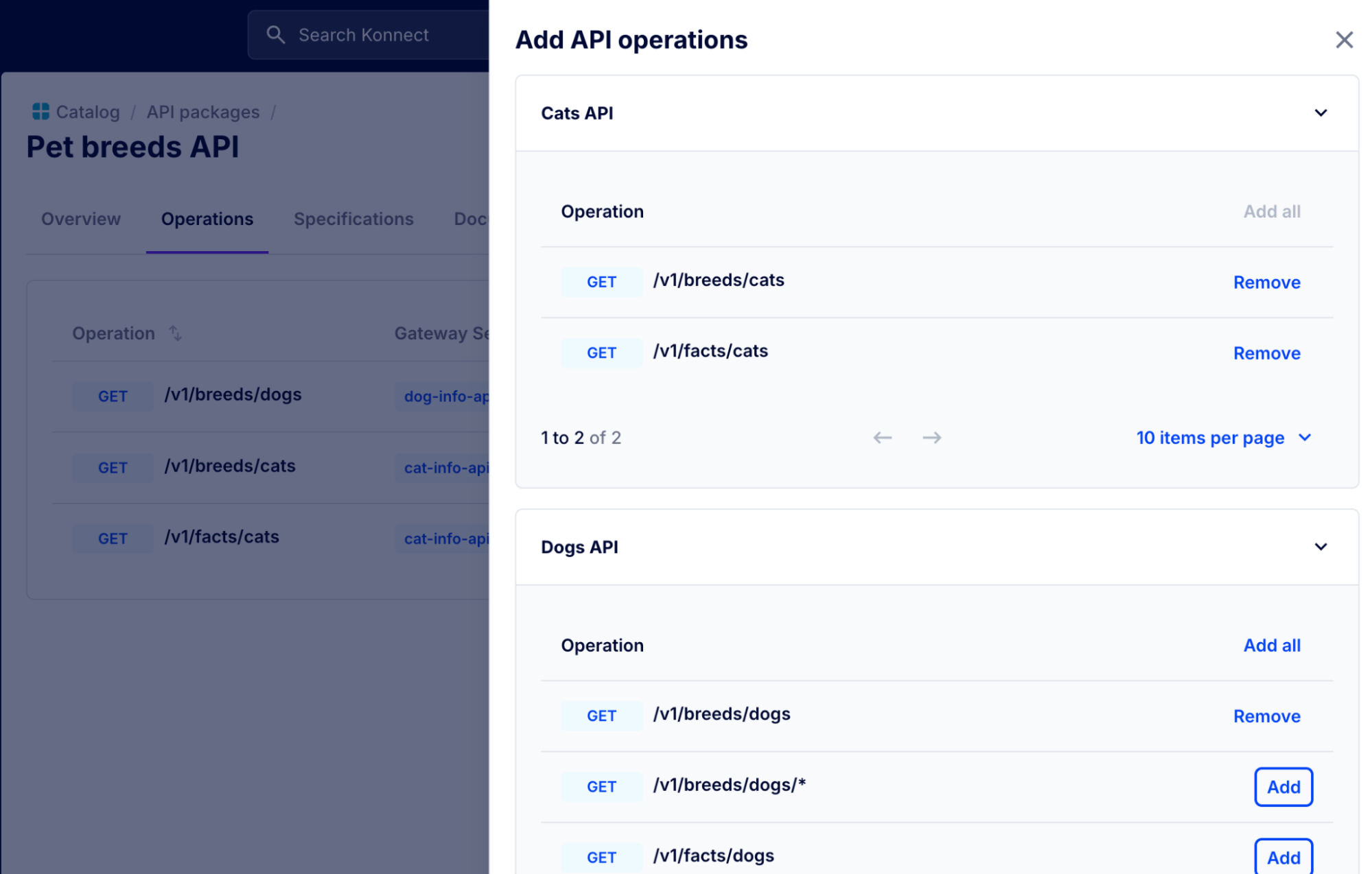
API packages, available in Catalog / APIs, allow you to group operations from one or more existing Catalog APIs into a single package. Think of a package as a curated API product built from your underlying building blocks.

With API packages, you’re able to:

  • Assemble operations across multiple APIs
  • Apply rate limits at the package level
  • Override rate limits for specific operations when needed

When an application registers for an API package, those limits are enforced automatically through the gateway.

A familiar experience for developers

Once published to the Dev Portal, an API package behaves just like any other API

Developers can:

  • Discover it in the portal
  • Register it to an application
  • Receive credentials
  • Start making requests


Developers don’t need to know how many backend services are involved, or how the API was composed. For them, it’s a single, well-defined contract.

When combined with Teams and role-based access control (RBAC), this allows platform teams to expose tailored APIs to specific audiences, including internal teams, partners, or external customers, without creating and managing entirely separate gateway configurations.

From architecture cleanup to platform strategy

API composition and packaging aren’t only about flexibility. They’re about acknowledging how enterprise platforms really work.

They let you do the following:

  • Represent today’s architecture transparently
  • Define the API surface you want consumers to see
  • Modernize incrementally, without breaking contracts
  • Apply consistent governance across composed APIs

Most importantly, they allow API teams to shift the conversation — from “how is this service built?” to “what capability are we offering, and to which audience?”

That is the foundation of a scalable API platform, and how to think in API-as-a-product terms.

Ready to start composing APIs? Our step-by-step guide to API packages walks you through your first implementation, starting from ACE setup to publishing your first package in the Dev Portal. To get started, check out our how-to guide for API packages.

API Management

Table of Contents

  • The realities of software at scale
  • Designing APIs around consumers, not services
  • Decoupling APIs from gateway services with ACE
  • Composing APIs from existing operations
  • Packaging APIs to reflect real dependencies
  • A familiar experience for developers
  • From architecture cleanup to platform strategy

More on this topic

Reports

Gartner® | How to Enable Agentic AI via API-Based Integration

Videos

ING’s Monolith-to-Microservices with Kong Gateway

See Kong in action

Accelerate deployments, reduce vulnerabilities, and gain real-time visibility. 

Get a Demo
Topics
API Management
Jason Harmon
Director of Product Management, Kong

Recommended posts

The Enterprise API Strategy Cookbook: 8 Ingredients for Legacy Modernization

EnterpriseFebruary 3, 2026

This is the pitch to the board and the C-suite. It must be brutally concise, focused entirely on your business outcomes, not the technology. If the first page doesn't articulate value, the strategy dies. Why? It immediately frames the initiative in

Steve Roberts

Building the Agentic AI Developer Platform: A 5-Pillar Framework

EnterpriseJanuary 15, 2026

The first pillar is enablement. Developers need tools that reduce friction when building AI-powered applications and agents. This means providing: Native MCP support for connecting agents to enterprise tools and data sources SDKs and frameworks op

Alex Drag

API Product Management Guide: 6 Strategies for the Full Lifecycle

EnterpriseJanuary 14, 2026

APIs are the connective tissue of digital products and services, and they're the lifeblood of AI. APIs shape customer experiences, power partner ecosystems, and accelerate enterprise innovation. As organizations double down on API-first strategies,

Amit Dey

Stay Vendor Agnostic: Using an Abstraction Layer to Navigate Acquisitions

EnterpriseDecember 12, 2025

The challenges of an acquisition frequently appear in a number of critical areas, especially when dealing with a platform as important as Kafka: API Instability and Change : Merged entities frequently rationalize or re-architect their services, whic

Hugo Guerrero

The Hidden AI Fragmentation Tax: AI Innovation Speed and Program Margins

EnterpriseOctober 27, 2025

Everyone's telling you to innovate faster with AI. Move quicker. Ship more features. Deploy more agents. But before we sprint headlong into the AI revolution, we need to have a proper dollars-and-cents conversation that most companies are avoiding.

Alex Drag

From APIs to Agentic Integration: Introducing Kong Context Mesh

Product ReleasesFebruary 10, 2026

Agents are ultimately decision makers. They make those decisions by combining intelligence with context, ultimately meaning they are only ever as useful as the context they can access. An agent that can't check inventory levels, look up customer his

Alex Drag

Announcing Solace as Kong’s Newest Premium Technology Partner

NewsFebruary 10, 2026

Kong is excited to announce Solace as the newest member of our Premium Technology Partner Program, a program designed to deliver high-quality, reliable integrations that provide real business value for customers. Together, Kong and Solace unify AP

Cindy Maurice

Ready to see Kong in action?

Get a personalized walkthrough of Kong's platform tailored to your architecture, use cases, and scale requirements.

Get a Demo
Powering the API world

Increase developer productivity, security, and performance at scale with the unified platform for API management, AI gateways, service mesh, and ingress controller.

Sign up for Kong newsletter

    • Platform
    • Kong Konnect
    • Kong Gateway
    • Kong AI Gateway
    • Kong Insomnia
    • Developer Portal
    • Gateway Manager
    • Cloud Gateway
    • Get a Demo
    • Explore More
    • Open Banking API Solutions
    • API Governance Solutions
    • Istio API Gateway Integration
    • Kubernetes API Management
    • API Gateway: Build vs Buy
    • Kong vs Postman
    • Kong vs MuleSoft
    • Kong vs Apigee
    • Documentation
    • Kong Konnect Docs
    • Kong Gateway Docs
    • Kong Mesh Docs
    • Kong AI Gateway
    • Kong Insomnia Docs
    • Kong Plugin Hub
    • Open Source
    • Kong Gateway
    • Kuma
    • Insomnia
    • Kong Community
    • Company
    • About Kong
    • Customers
    • Careers
    • Press
    • Events
    • Contact
    • Pricing
  • Terms
  • Privacy
  • Trust and Compliance
  • © Kong Inc. 2026