
# Know where every AI dollar goes — and control what happens next
Understand the true cost of AI across models and providers. Attribute spend to the people, agents, applications, projects, and customers driving it. Set budgets, detect overspend, and enforce controls before costs get out of hand
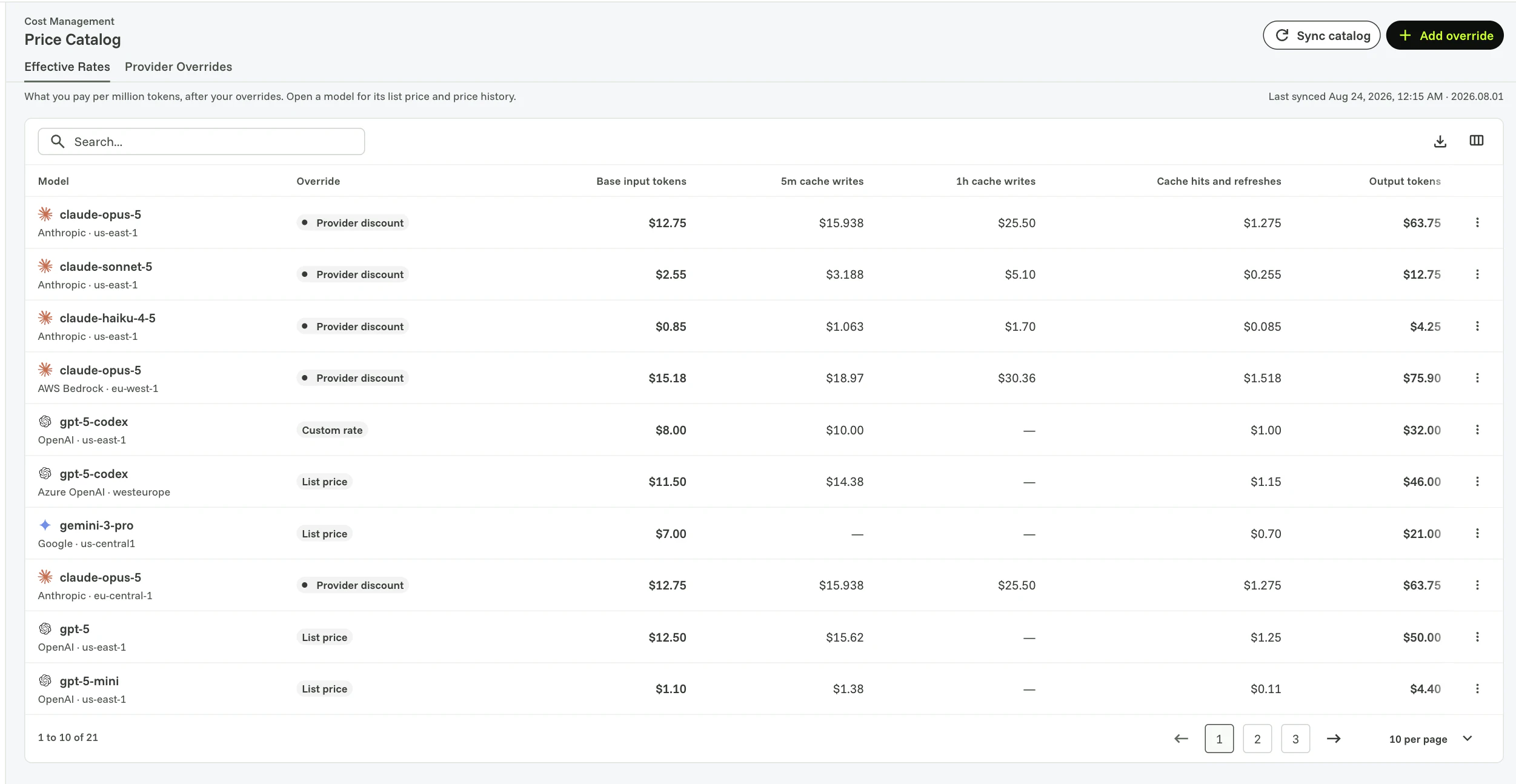
## Price every AI interaction accurately
- *
Unified AI cost model — Normalize different provider pricing structures into one consistent view of AI spend.
- *
Measures AI usage at the gateway and turns raw consumption into a financial event
- *
Create a consistent cost model across the AI infrastructure your organization uses
## Know who — and what — caused the cost
- *
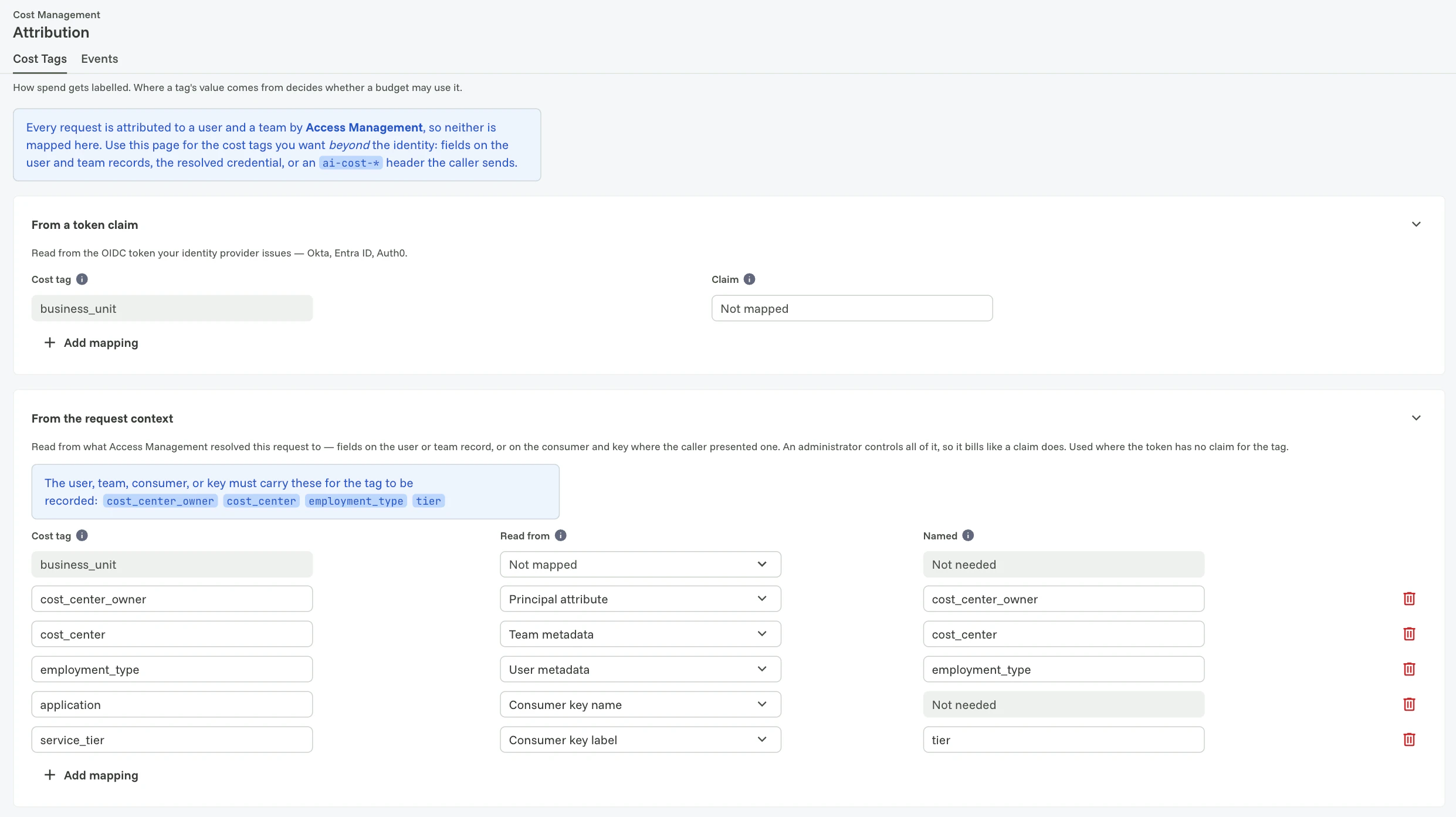
Multi-dimensional cost attribution — Attribute AI spend across people, teams, applications, agents, projects, products, customers, and cost centers.
- *
Request-level cost traceability — Drill from aggregate spend all the way down to the individual AI request, model, token usage, and cost.
- *
Custom attribution dimensions — Structure AI cost reporting around the dimensions that matter to you.
- *
Open cost telemetry — Analyze AI cost and consumption in Kong or export the data to your existing observability and FinOps systems.
## Put AI budgets where the spending happens
- *
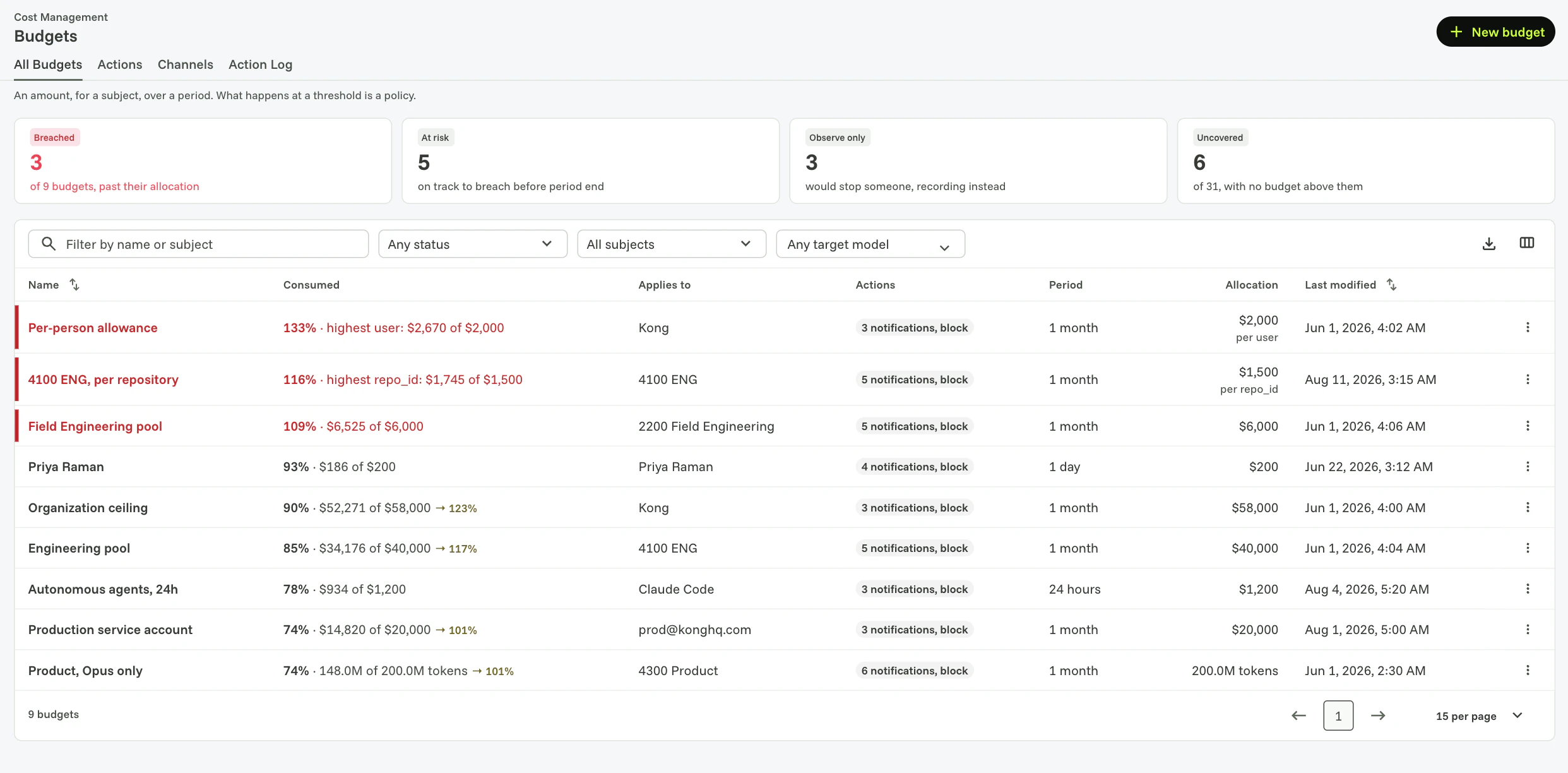
Multi-dimensional budgets — Budget by team, project, application, agent, person, customer, or cost center.
- *
Budget vs. actual tracking — See how actual AI spend is tracking against allocated budgets.
- *
Business-aligned cost planning — Structure AI budgets around your organization rather than individual model providers.
## Act before AI spend becomes AI overspend
- *
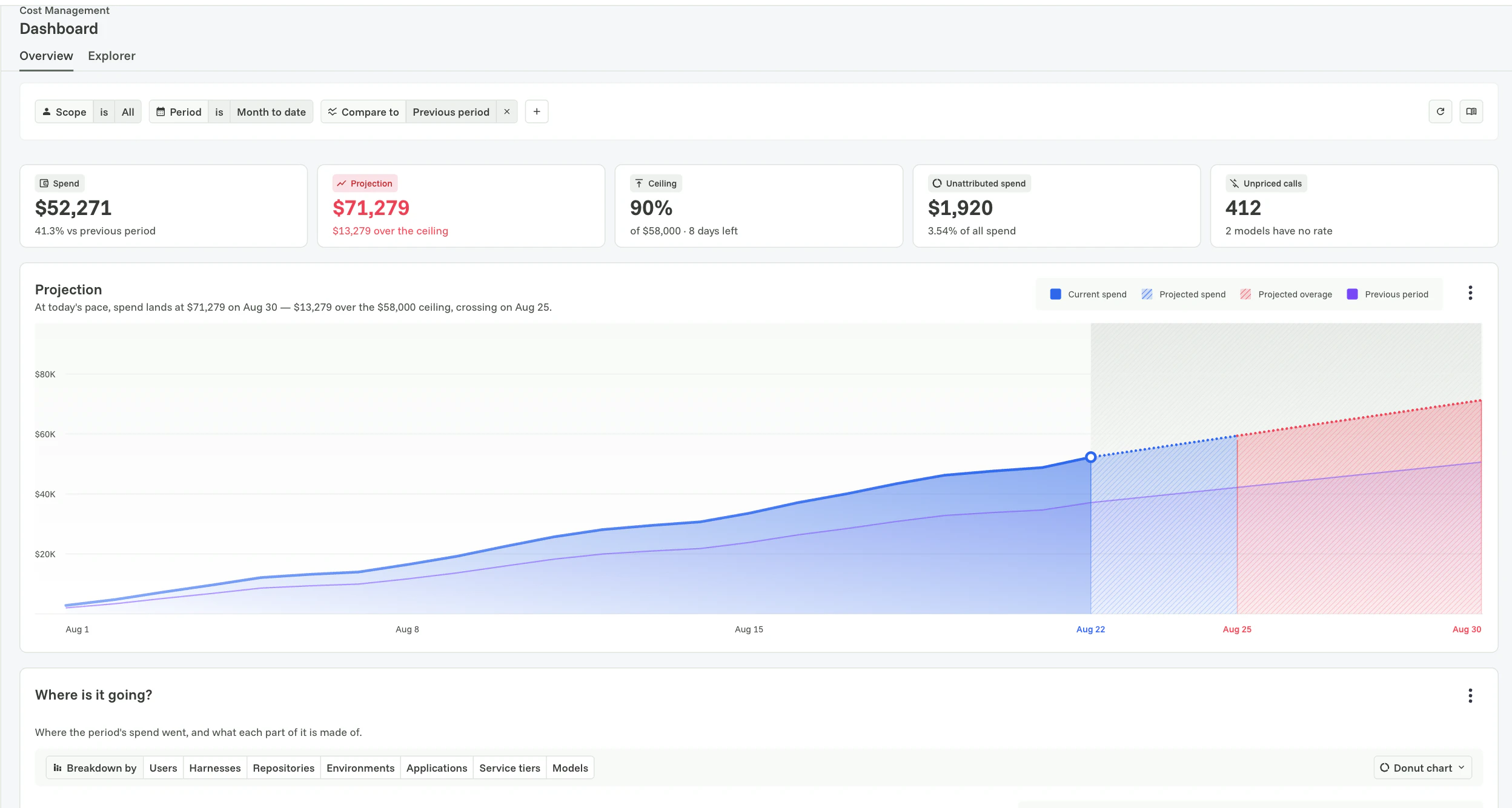
Real-time spend monitoring — Track AI consumption and costs as they happen, and catch unexpected spikes or unusual spending patterns before they compound.
- *
Spend forecasting — Project future AI costs based on current consumption trajectories, and notify owners as spend approaches limits or deviates from plan.
- *
Runtime cost controls — Enforce consumption limits on resources like LLM tokens, MCP usage, API requests, and event-stream consumption when budgets, policies, or entitlements require it.
## Optimize the economics of AI, not the adoption of AI
- *
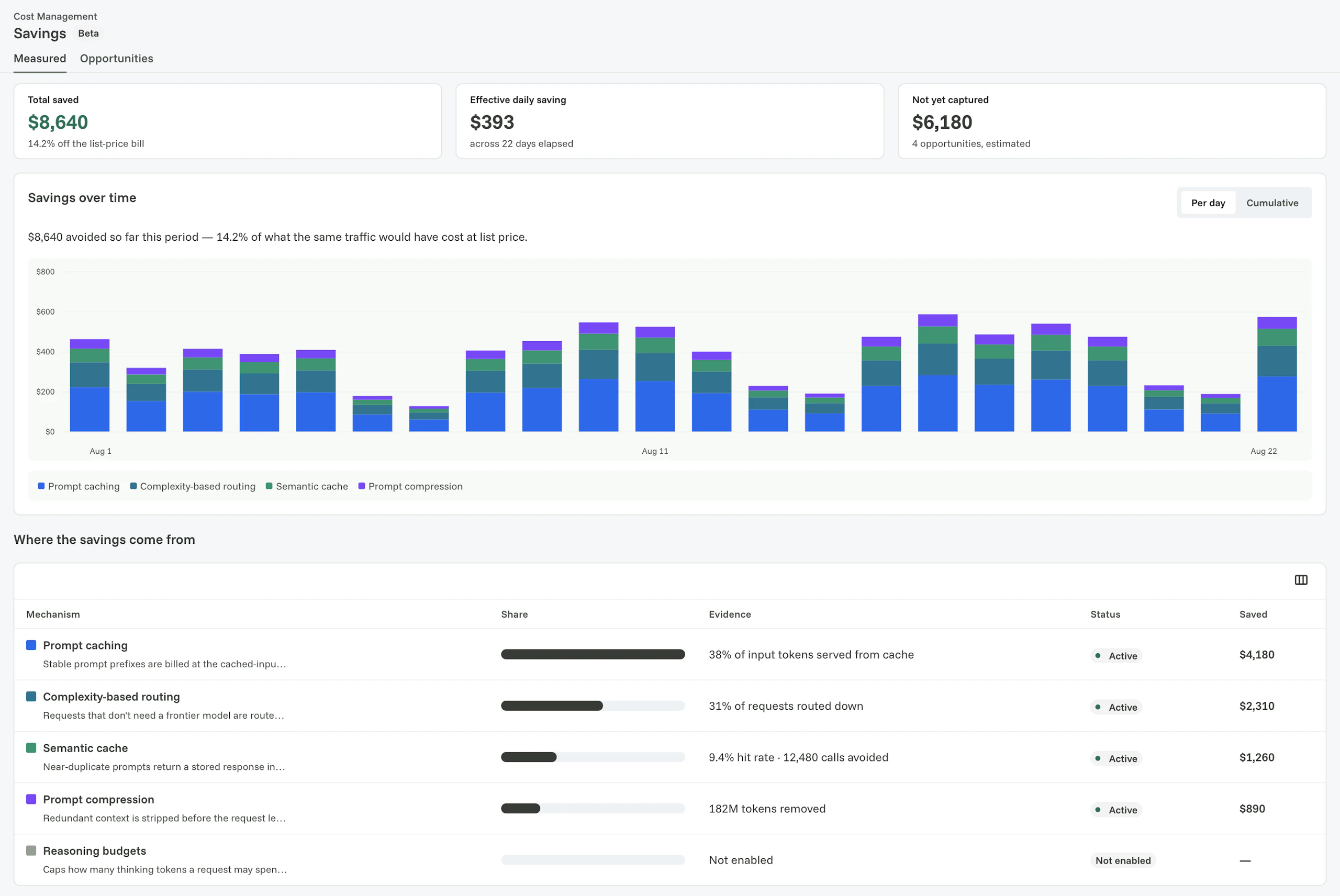
Semantic caching — Eliminate unnecessary inference by reusing responses for semantically similar requests.
- *
Intelligent model routing — Route requests to the most cost-effective model capable of delivering the required outcome.
- *
Token and reasoning efficiency — Compress inputs to cut token consumption while preserving needed context, and limit expensive reasoning when it isn't required
## Turn AI consumption into revenue
- *
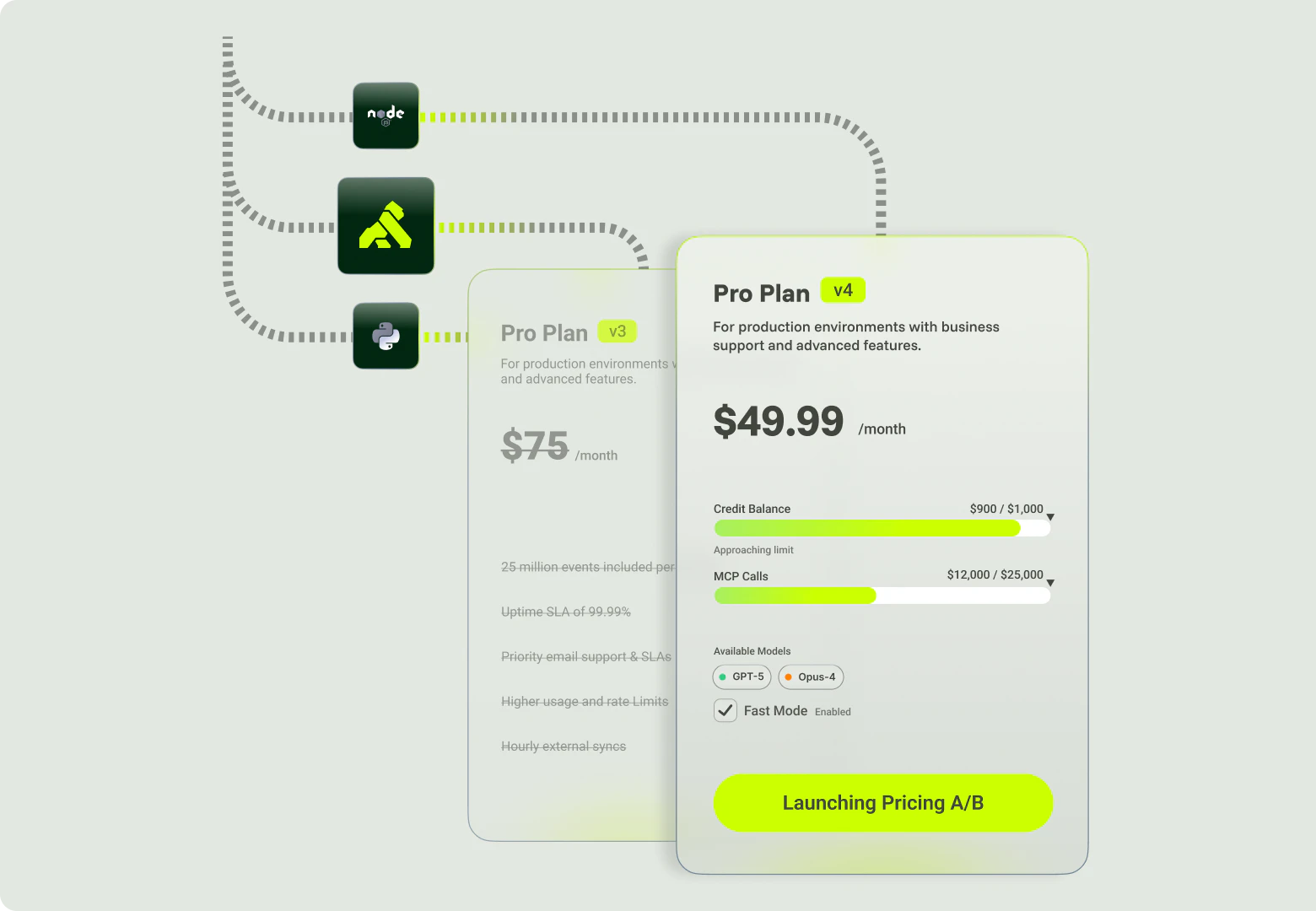
Usage-based metering — Measure customer consumption across models, agents, APIs, MCP servers, and other AI resources.
- *
Customer-level attribution — Connect AI consumption and cost to the customers and products generating it.
- *
Flexible pricing and entitlements — Define how AI consumption translates into customer-facing usage and charges, and control how much each customer or plan is entitled to consume.
- *
Margin visibility — Connect the cost of delivering AI capabilities with the revenue generated from them.


"With Kong, we've taken a big leap forward in our ability to reduce operational overhead while efficiently scaling to support the increase in traffic requests from our rapidly growing customer base."


30%
boost in efficiency

“With Kong, we provide access to our API product, Connect Your Business. With lean and efficient digital processes, we ensure that our entire journey from start to finish is truly digital.”
## Related products
## Resources
## FAQs
What is AI cost management?
AI cost management is the process of measuring, attributing, budgeting, controlling, and optimizing the cost of AI usage across an organization. Unlike basic AI usage monitoring, it connects model and token consumption to business context such as teams, applications, agents, projects, customers, and cost centers. This helps organizations understand not only how much they are spending on AI, but what is driving that spend and where it can be optimized.
How does Kong AI Cost Management track and attribute AI costs?
Kong measures AI consumption at the AI gateway, calculates the cost of each interaction, and connects that cost to the identity and business context behind the request. AI spend can be attributed to dimensions such as business units, teams, applications, agents, projects, people, customers, and cost centers, with the ability to trace costs down to individual AI requests and token usage.
Can Kong manage AI costs across multiple models and providers?
Yes. Kong provides a consistent cost model across AI models and providers, including OpenAI, Anthropic, AWS, Azure, Google, and other AI infrastructure. It can account for model-specific pricing, input and output tokens, caching, service tiers, regions, and negotiated commercial rates. This gives organizations a unified view of AI costs even as their underlying models and providers change.
How does Kong help control AI spending and prevent budget overruns?
Kong enables organizations to set AI budgets around business dimensions such as teams, projects, applications, agents, and customers. Actual consumption can be monitored against those budgets to identify spending trends and anomalies, forecast potential overruns, notify responsible owners, and enforce controls when necessary. This allows organizations to manage AI costs proactively rather than waiting for a month-end provider bill.
How does Kong help reduce and optimize AI costs?
Kong helps organizations improve the economics of AI without simply restricting AI usage. Because Kong sits in the path of AI traffic, organizations can use capabilities such as semantic caching, prompt caching, prompt compression, intelligent model routing, and reasoning controls to reduce unnecessary consumption and use more cost-effective models. Combined with cost attribution, this helps teams identify where optimization will have the greatest business impact.