Here's where it gets interesting — and where most enterprise AI strategies have a blind spot.
A durable reasoning trace is only as useful as your ability to govern the infrastructure it flows through. An agentic AI doesn't reason in a vacuum. It calls APIs. It queries databases. It invokes tools. It passes context between services. And increasingly, it communicates through event streams — publishing decisions to a Kafka topic, consuming signals from a message broker, reacting to real-time data flowing through your pipeline. Every one of those interactions is a moment where data moves — and where visibility can either be preserved or lost.
If your AI system is calling 12 different services and publishing events to three different topics and you can only see what happened inside the model itself, your reasoning trace is incomplete. You have the agent's side of the conversation. You don't have the full picture.
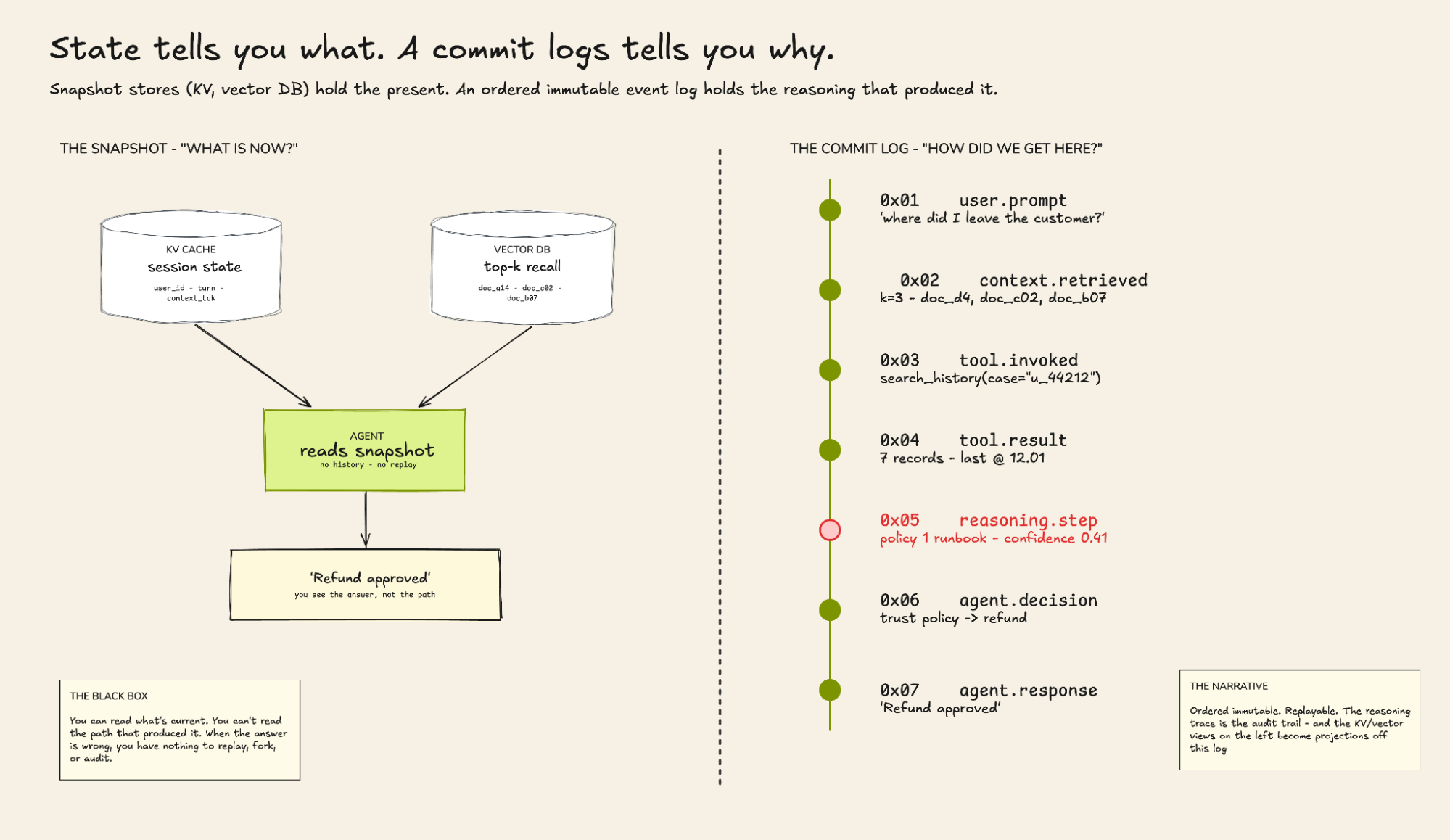
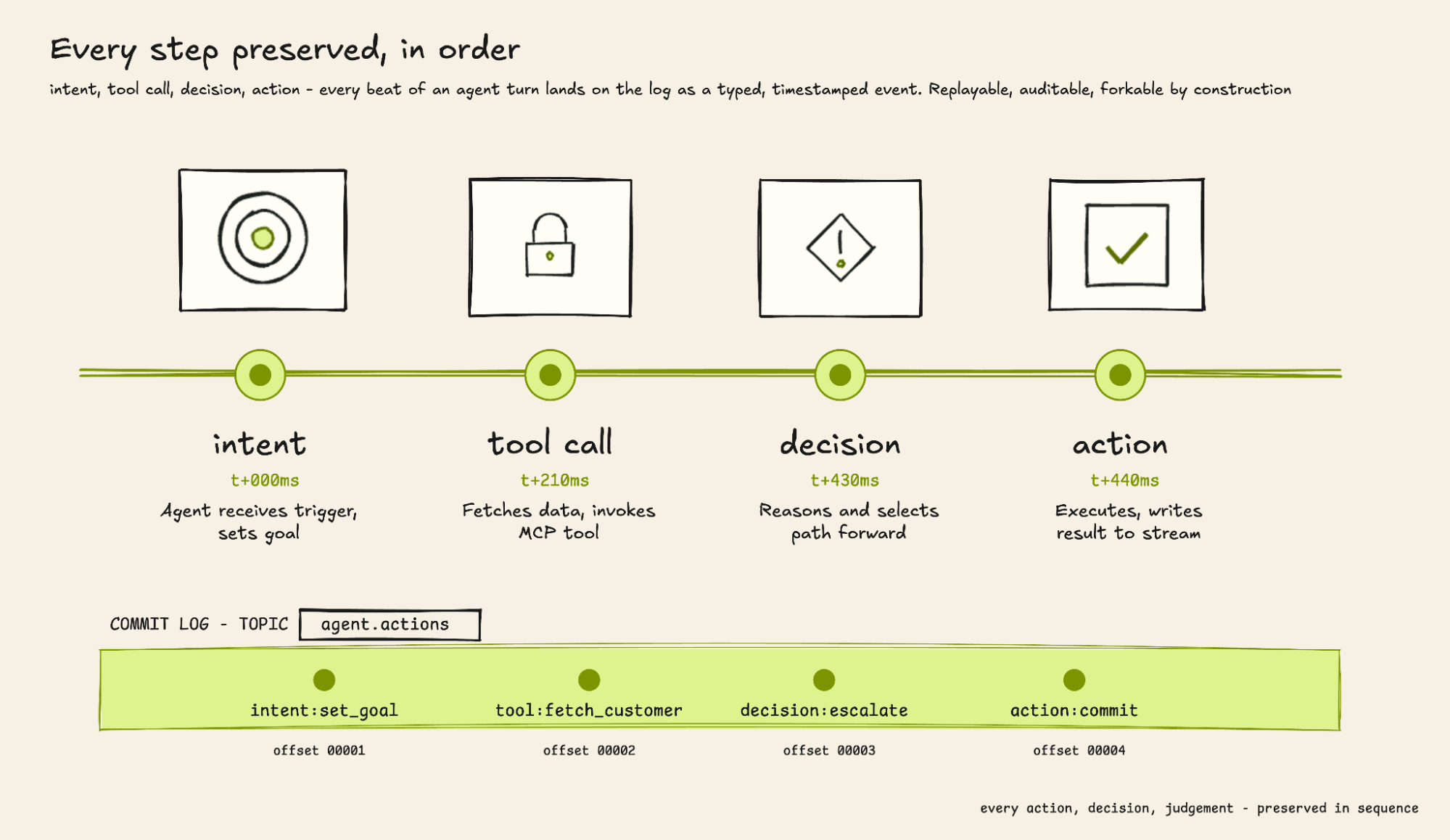
Here's something worth appreciating: the commit log concept that makes durable agent memory so powerful is the same idea that underpins event streaming systems. Apache Kafka, for instance, is literally a distributed commit log — an ordered, immutable record of everything that happened. That's not a coincidence. It's a hint about the right architecture. Event streams are a natural substrate for capturing the reasoning trace of an agentic system, because they're designed from the ground up to be ordered, replayable, and durable.
But a stream you can't govern is just noise at scale. That's where Kong Event Gateway comes in. Kong Event Gateway brings the same policy enforcement, security controls, and observability you'd apply to your APIs to your event-driven communication layer — Kafka topics, AsyncAPI-described streams, real-time data flows. It means you can enforce who produces to a topic, who consumes from it, and what's allowed to flow through it, all with the same governance posture you apply to the rest of your data path.
This is why governing the entire data path matters so much. The reasoning trace lives across your infrastructure — in the synchronous API calls that fetch context, in the tool responses that shape decisions, and in the asynchronous events that trigger and propagate agent actions. You need visibility, security, and control at every hop, not just at the model boundary.
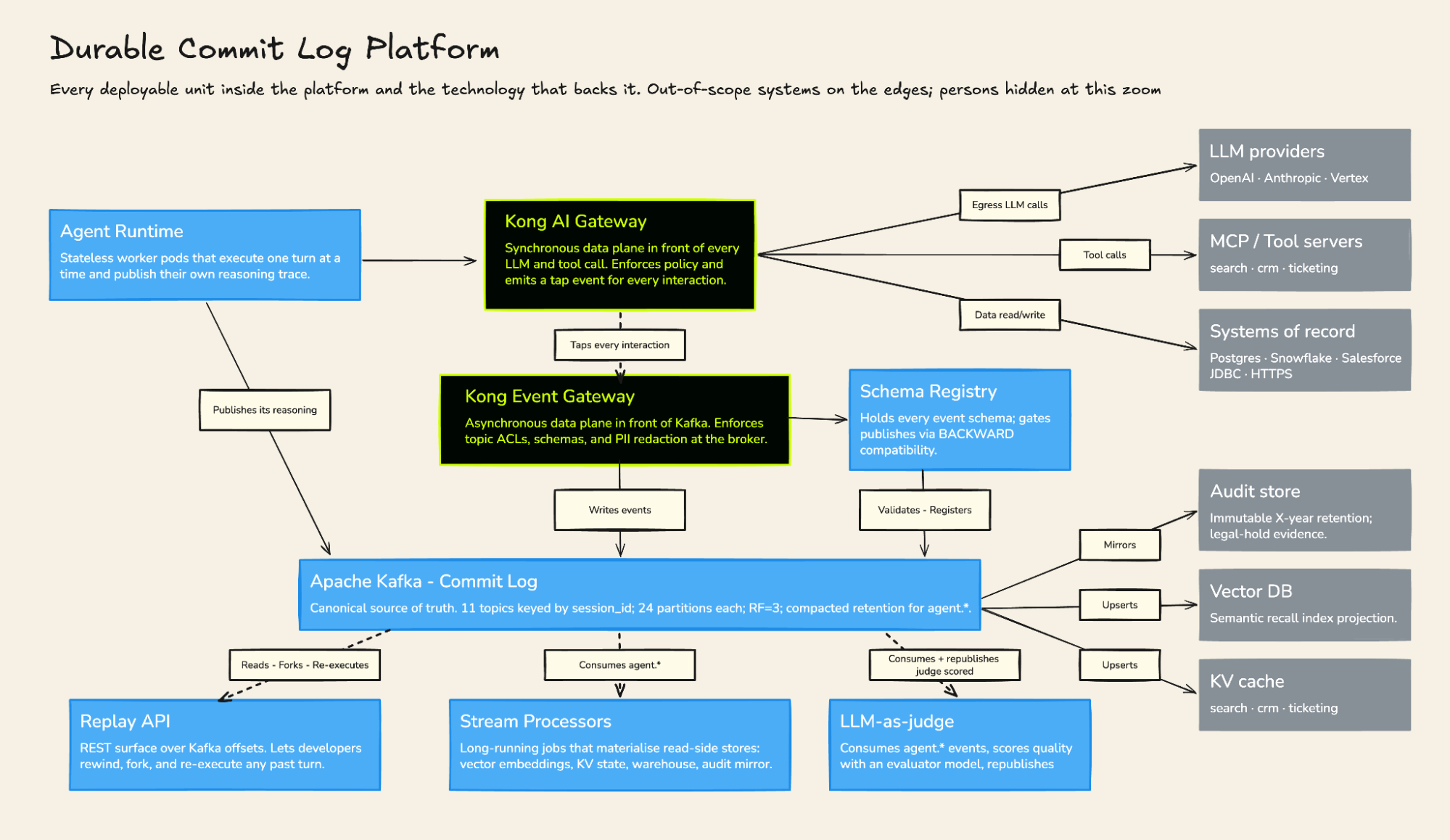
That's exactly why Kong's approach to AI connectivity is built around the full data path. Kong AI Gateway instruments the synchronous traffic between your agents, tools, APIs, and data sources. Kong Event Gateway sits in front of the log that is the source of truth — governing who can publish agent actions, who can subscribe to consume them, what schemas are enforced, how long data is retained, what gets redacted, and where PII (personally identifiable information) is masked before it reaches downstream consumers. The downstream systems — your vector DB, your KV cache, your data warehouse, your compliance store — are all projections off that governed log, not the truth itself. When an auditor asks "what did this agent see when it made this decision?", the answer isn't a reconstructed guess. The log is the answer. Together, Kong AI Gateway and Kong Event Gateway give you a governed, observable connectivity surface that spans the entire stack your agents operate across.
A reasoning trace without infrastructure-level visibility is like a flight data recorder that only captures the last 10 minutes. Useful. But not the whole story.