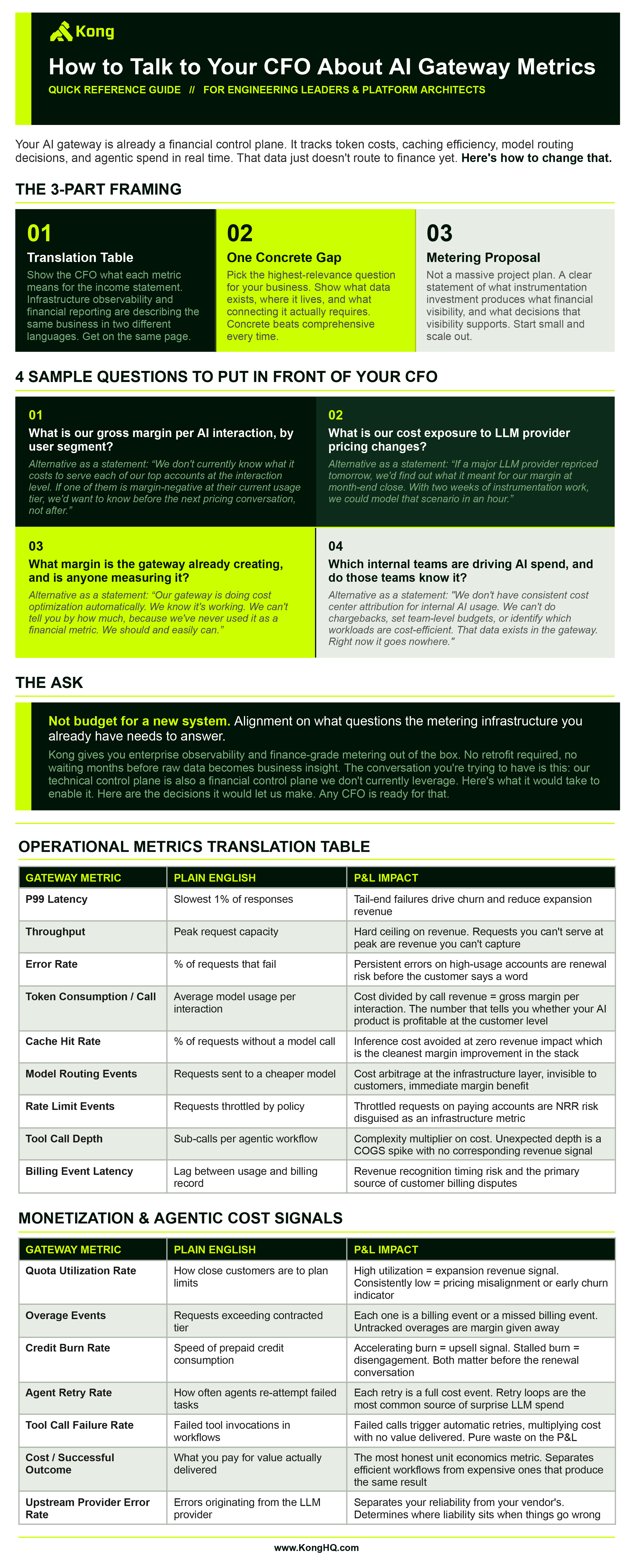
These are questions finance should be asking about AI economics that most aren't because the data hasn't been made available in a form that makes them natural to ask. Part of your job is to surface not the raw data but consumable data. Here are some example questions that can aid in the conversation.
**Question 1: What is our gross margin per AI interaction, by user segment?**
Aggregate gross margin can look acceptable while specific user segments or feature workloads run margin-negative. You can't see it in the top-line numbers. You need cost and revenue attribution at the level of individual customers and agentic workloads.
Most organizations cannot answer this today. The token consumption data exists in the gateway. The revenue data exists in the billing system. Nobody has taken the time to connect them.
Put it to your CFO this way: “We don't currently know what it costs to serve each of our top accounts at the interaction level. If one of them is margin-negative at their current usage tier, we'd want to know before the next pricing conversation, not after.”
**Question 2: What is our cost exposure to LLM provider pricing changes?**
Every AI product routing through third-party large language models has direct exposure to repricing by those providers. Most finance teams have no quantified view of this because the token consumption data that would allow it doesn't route to finance. When a provider changes pricing, it shows up as a margin compression event in the quarter because the organization never had the data to forecast it.
The gateway captures every token consumed, by model, by workload. That's enough to model the P&L impact of a pricing change from any given provider before it happens.
Put it to your CFO this way: “If a major LLM provider repriced tomorrow, we'd find out what it meant for our margin at month-end close. With two weeks of instrumentation work, we could model that scenario in an hour.”
**Question 3: What margin is the gateway already creating, and is anyone measuring it?**
Model routing, semantic caching, and request optimization reduce inference costs without changing the user-facing pricing. The same revenue, at lower cost, with no degradation in the product. This is the margin the gateway is producing automatically, right now.
Most organizations can't quantify it. Which means it's happening outside any financial accountability structure. Nobody is getting credit for it. Nobody knows if it's worth investing in further.
The framing here is different from the first two questions. This isn't about a gap that needs closing instead it’s about value that already exists and isn't being measured. Put it to your CFO this way: “Our gateway is doing cost optimization automatically. We know it's working. We can't tell you by how much, because we've never used it as a financial metric. We should and easily can because the answer will inform every conversation we have about pricing and infrastructure investment.”
**Question 4: Do you know which internal teams are driving AI spend, and do these teams also know it?**
External customer economics get most of the attention, but internal developer usage is where unattributed AI spend quietly accumulates. A developer running an agentic workflow in a shared environment has no reason to optimize it. The cost is invisible to them and lands somewhere else on the P&L. Finance sees an aggregate LLM bill. The platform team sees traffic. Nobody sees which internal team's inefficient agent is responsible for 40% of token consumption this month.
This is the AI equivalent of shadow IT. The spend is authorized. The attribution isn't.
The gateway is the only place where that changes in a unified way for every vendor and model. The gateway can tag every request by team, cost center, workload type, and environment. The same metering schema that creates customer-level visibility creates internal chargeback capability. Without it, there's no basis for team-level AI budgets, no signal for identifying inefficient workloads, and no accountability structure connecting developer behavior to cost outcomes.
Put it to your CFO this way: “We don't have a consistent cost center attribution for internal AI usage. We can't do chargebacks, can't set team-level budgets, and can't identify which internal workloads are cost-efficient and which aren't. That data exists in the gateway. Right now it goes nowhere.”









here](https://assets.prd.mktg.konghq.com/images/2026/05/6a0b8ac4-kong---ai-gateway-metrics-for-your-cfo-guide.png)