# BMW Drives Intelligence for 24M+ Connected Vehicles with Kong
German motor vehicle manufacturer manages 24M+ connected vehicles by decentralizing API gateways


7 weeks
migration timeline
140+
gateways deployed
24M+
connected vehicles managed
95 ms
response time
"Our migration wasn’t just an upgrade. It was a revolution that empowered our API developers and accelerated sheer driving pleasure.”


German motor vehicle manufacturer manages 24M+ connected vehicles by decentralizing API gateways
[www.bmw.com/](https://www.bmw.com/)www.bmw.com/- Transportation
- Europe
- Innovate Faster
- Modernization
- Governance
## Delivering seamless digital experiences to millions of drivers worldwide
BMW’s engineering legacy is built on precision, reliability, and performance, and in the digital era, that commitment extends far beyond the vehicle itself. Every modern BMW is a “rolling computer,” as Oliver Heinze, Product Owner, Connected Company, said during his talk at Kong’s [API Summit 2025.](https://konghq.com/blog/news/api-summit-2025-recap)API Summit 2025.
“Our job at Connected Company is to make sure your car is connected and your My BMW or My MINI app is always working,” Heinze said. “If you preheat your car on a cold morning or update your navigation maps, all of that runs through our backend infrastructure.”
That backend is massive, supporting more than 24 million connected vehicles, powering critical functions like infotainment, over-the-air updates, and remote vehicle commands. Every driver interaction, from checking charge status to activating climate control, depends on seamless, secure API communication.
As the number of connected cars and digital touchpoints grew, the scale and complexity of BMW’s systems compounded multifold. What once worked as a robust, centralized platform was now curbing the company’s ability to innovate and respond to demand in real time.
"20 years ago, a car was for driving. Today, it’s a distributed software system on wheels. That shift demanded an equally modern API strategy."
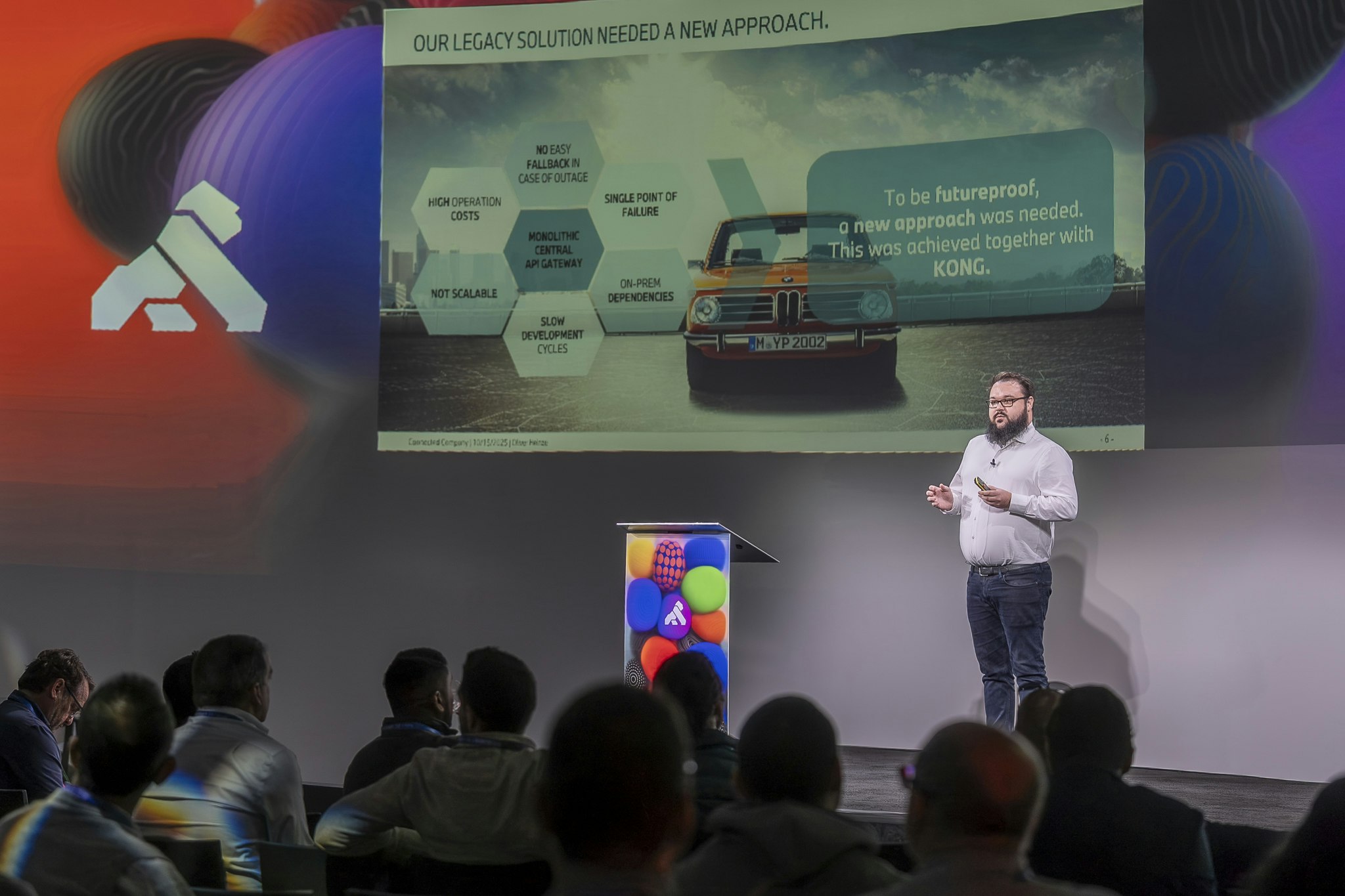
“You need an entire team just to run a data center. You have to service the hardware, manage capacity, and deal with high operational costs. That’s not where innovation happens.”
## Scaling a monolithic architecture for a global, always-on fleet
BMW’s Connected Drive infrastructure had a heavy reliance on a centralized, on-prem API gateway. It had served the company well enough for years, delivering reliability and predictability. However, it was increasingly falling short in terms of the pace and scale of modern mobility.
“It was a very robust setup,” Heinze said. “We had almost no downtime. Everything was plannable, but it wasn’t fast.”
Scaling required extensive planning and resources. When temperatures dropped across Europe or North America, millions of users simultaneously preheated their cars. The surge in requests could spike API traffic overnight.
“We needed to size our infrastructure for those moments,” Heinze said. “But that’s not scalable in minutes; it’s scalable in months.”
The central gateway also created a single point of failure. If one system went down, it could affect multiple connected services at once. And maintaining uptime across data centers was expensive.
## From evolution to revolution: A decentralized gateway architecture
Rather than simply migrating the old gateway to the cloud, Heinze’s team reimagined API management completely.
“We asked our architects to come up with something new, something bold,” Heinze said. “They locked themselves in a room for two weeks and came back with an idea that was completely crazy. That’s how revolutions start.”
That idea became BMW’s fully decentralized API gateway model, powered by Kong.
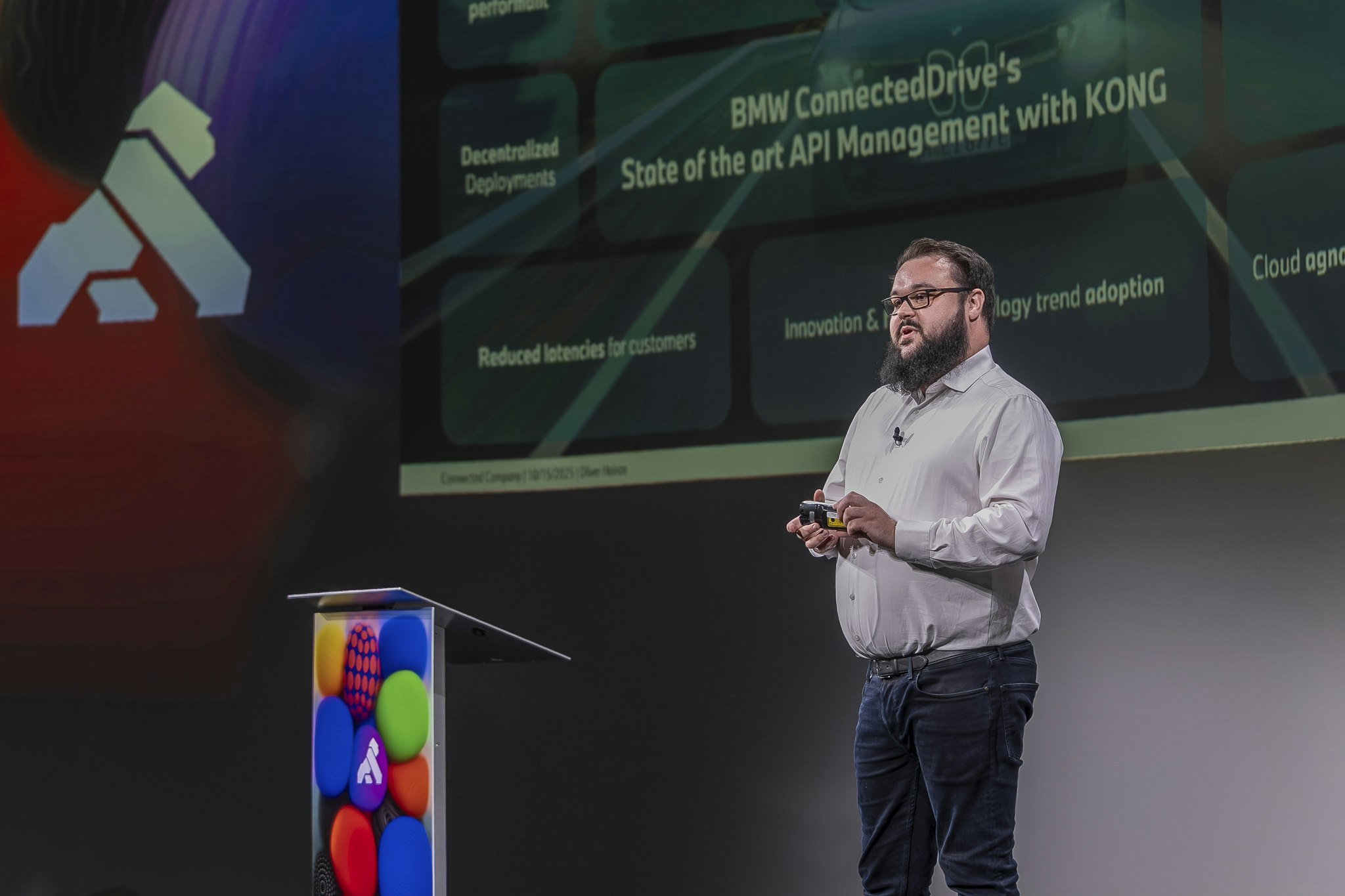
Instead of one central gateway, BMW distributed API management across its ecosystem. Today, each of its 140 internal IT products operates its own API gateway. This shift eliminated bottlenecks, improved resilience, and gave product teams control over their own deployments.
“There’s no longer one single API gateway for us,” Heinze said. “Every product team runs its own. Everyone can deploy and service their own API gateway. It’s not even a full-time job; it’s something you can do as part of your normal development work.”
This decentralization instantly improved reliability.
“If one gateway fails, who cares?” Heinze said with a grin. “It’s only one microservice affected, not the whole Connected Drive.”
To maintain consistency across so many teams, BMW automated governance within its GitHub CI/CD pipelines. Every API specification is validated before deployment. If an API doesn’t comply with BMW’s security or design standards, it simply doesn’t go live. This automation also helped scale security posture and observability.
"We can check the API specs before they’re deployed. If they’re not following our guidelines or best practices, they don’t get published. That’s how we balance speed with control.”
The migration itself became a showcase in precision. It took just seven weeks to complete the full transition.
“We started small: 5% of traffic at night, then 15%, then 50%, then 100%,” Heinze said. “No one noticed a thing. That’s how we knew it worked.”
Throughout the process, BMW coordinated with three external providers and 140 product owners, keeping services online the entire time. When some teams lacked the budget or capacity to migrate, Heinze’s group offered free migration support to ensure adoption.
“We wanted everyone on board by the end of the year,” Heinze said. “So we said, 'We’ll do it for you.'”
The team began with its largest internal stakeholder — what Heinze called a “lighthouse function.” Once that major system migrated successfully, other teams quickly followed.
“Combined with Kong’s cloud-agnostic capabilities, BMW gained flexibility to run its gateways anywhere — from Raspberry Pi devices to global hyperscalers. We’re not cloud-native. We’re cloud-agnostic. We run everywhere.”
## Zero disruption, double the speed, half the cost
BMW’s decentralized gateway initiative delivered immediate, measurable improvements across its connected vehicle ecosystem.
- - 50% reduction in operational costs compared to the legacy system
- - Latency cut in half, from 200ms to 95ms per request
- - 24 release cycles per year, up from three — keeping infrastructure continuously updated
- - Zero downtime throughout the migration period
- - Seamless driver experience, with no visible service interruptions
“Your car now preheats faster than before,” Heinze said. “You probably didn’t notice it, but we did and that’s the best kind of success.”
Beyond performance, the initiative reshaped BMW’s culture of software engineering. Each product team now owns its APIs, enabling a developer-centric model with shared governance and full autonomy.
“Everyone can work in their own cycles,” Heinze said. “You can move as fast or as slow as you want. We’ve built speed without chaos.”
The transformation also established a modern, distributed foundation for the company’s growing portfolio of AI-driven services.
“We can scale without limits. Our infrastructure is faster, more secure, and ready for whatever comes next.”
Heinze closed his talk with the perspective of a technologist proud of both the result and the process.
“We called it an overnight revolution, and that’s what it was. We prepared for a year to shine in seven weeks. And the best part? Nobody noticed.”
BMW’s Connected Company redefined how a global enterprise can modernize its digital backbone. By decentralizing API management with Kong, the company achieved faster releases, improved reliability, and developer autonomy — all while delivering seamless digital experiences to millions of drivers worldwide.
“It wasn’t just an upgrade,” Heinze said. “It was a revolution that empowered our API developers and accelerated sheer driving pleasure.”
More Customer Stories




“We use Kong Konnect for vitals, management, and the dev portal that exposes our APIs—all as a central platform for automation."

“With Kong, we provide access to our API product, Connect Your Business. With lean and efficient digital processes, we ensure that our entire journey from start to finish is truly digital.”


"Kong helps us build once and reuse everywhere, which is how we move at the speed of our customers."


30%
boost in efficiency


“Kong has supported our goal of moving fully to the cloud, streamlining business processes, automating wherever possible, generating actionable insights from data, and driving efficiency through the intelligent adoption of new technology.”


2 Billion
Requests on Super Bowl Sunday