# Verifone Revamps APIOps & Developer Workflows with Kong
Global payments leader streamlines API governance, accelerates delivery, and explores agentic automation through spec-first design and Model Context Protocol (MCP).


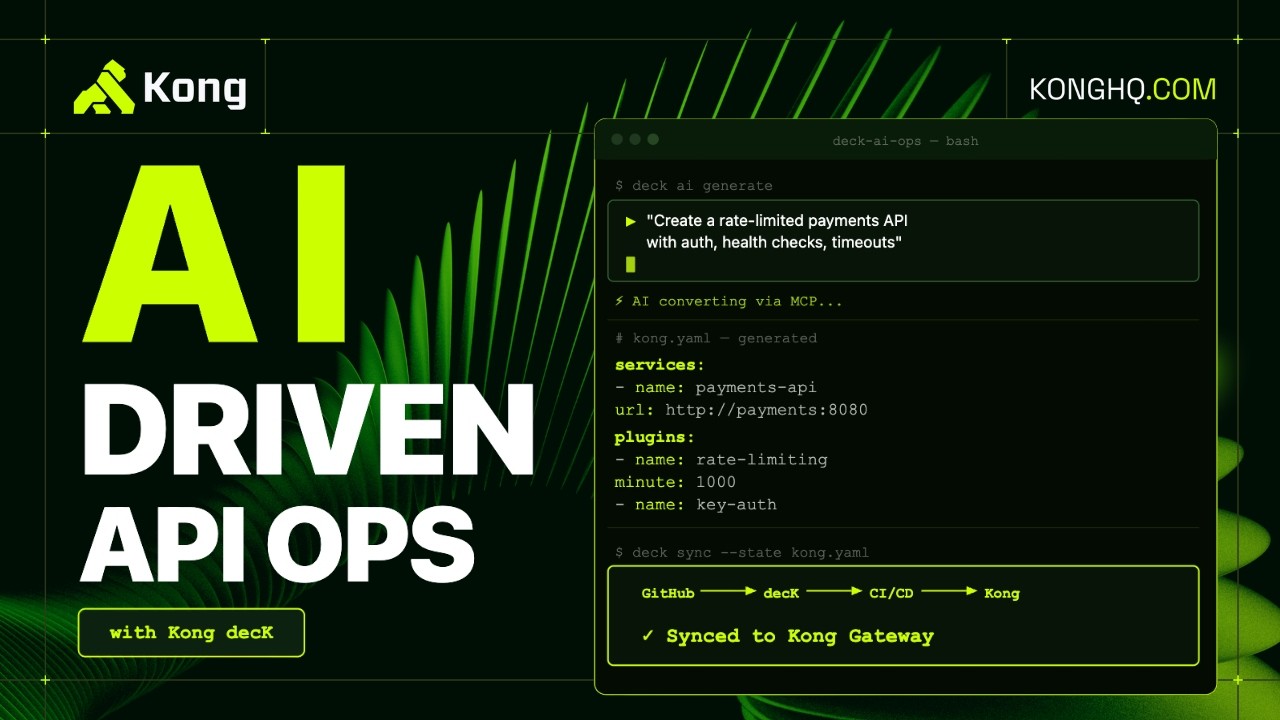


Global payments leader streamlines API governance, accelerates delivery, and explores agentic automation through spec-first design and Model Context Protocol (MCP).
[www.verifone.com/](https://www.verifone.com/)www.verifone.com/- Business Services
- North America
- Modernization
- Development Productivity
## Scaling mission-critical APIs across a global commerce platform
In the payments industry, APIs are mission-critical infrastructure. They're responsible for moving sensitive transaction data, orchestrating interactions between devices and backend systems, and enforcing security and compliance requirements at scale. Even minor disruptions can have a significant business impact, making reliability and consistency non-negotiable.
At Verifone, APIs sit at the center of a globally distributed commerce platform that spans payment terminals, merchant services, backend processing systems, and partner integrations. As the company modernized its architecture and adopted microservices, API traffic increased significantly, both in volume and in importance.
Verifone began using Kong Gateway in 2019, adopting it early as a standardized API gateway layer to manage traffic routing, security controls, and extensibility across services.
Initially, Kong solved a clear need by providing a flexible, high-performance gateway capable of supporting Verifone’s evolving microservices architecture. Over time, however, Kong became more than a traffic router. It evolved into a central operational control point for how APIs were deployed, secured, and managed across environments.
As API usage expanded across teams and regions, Verifone began to recognize that how APIs were configured and operated would matter just as much as the gateway itself.
## Managing API complexity without slowing delivery
In the early stages of Kong adoption, Verifone configured APIs using imperative, command-based workflows. Engineers interacted directly with Kong’s Admin API, issuing a series of calls to create services, routes, plugins, and consumers.
For a single microservice, onboarding an API required multiple discrete steps. Each change was applied incrementally, often without a clear picture of how it affected the overall configuration state.
This approach introduced several systemic challenges:
- - Rollback complexity: Many Kong entities, particularly plugins, are identified by Universally Unique Identifiers (UUIDs) that differ across environments. Rolling back a change required environment-specific scripts and careful sequencing, making reversions fragile and time-consuming.
- - Limited visibility into changes: Imperative updates could overwrite existing configuration silently. Engineers often had no immediate indication that something had gone wrong until downstream systems or users reported issues.
- - Operational overhead: When deployments failed, rollback procedures involved running long chains of scripts, increasing the risk of human error during already stressful situations.
- - Reduced resilience: Small configuration mistakes could undermine reliability, especially problematic for payment flows that depend on predictable latency and consistent behavior.
For a global payments platform, this lack of safety and predictability was untenable. Verifone needed a way to make API changes observable, reversible, and repeatable without slowing down delivery teams.
## Declarative configuration with decK
To address these challenges, Verifone adopted declarative configuration using decK, Kong’s configuration management tool.
Rather than issuing individual updates, teams defined the desired state of Kong — services, routes, upstreams, targets, and plugins in a single configuration file. That file could then be synchronized atomically with the gateway.
This shift fundamentally changed how API changes were managed.
With declarative configuration, Verifone gained:
- - Fail-fast validation: Using
`deck diff`, teams could preview changes before deployment, seeing exactly what would be created, updated, or deleted. - - Versioned rollbacks: By tagging configurations, Verifone could roll back specific API versions without affecting unrelated services, an essential capability in a shared gateway environment.
- - Faster recovery and bootstrapping: Entire Kong environments could be recreated quickly by dumping and reapplying configuration, improving resilience and reducing recovery time.
“Using decK diff, before even syncing, we can clearly see what is created, what is updated, and what is going to be deleted.”
Declarative workflows significantly reduced configuration-related incidents and increased confidence in production changes. However, as usage expanded, Verifone encountered a new limitation not with Kong itself, but with how humans interacted with it.
### The next bottleneck: Configuration complexity
While declarative configuration improved safety, it also introduced template-heavy workflows. Engineers needed to understand Kong concepts, decK commands, and internal conventions to onboard or modify APIs.
For experienced platform engineers, this was manageable. For new team members, the learning curve was steep. Developers were spending time reasoning about gateway internals instead of focusing on API design and business logic.
Verifone wanted to make API operations more developer-centric without sacrificing control or consistency. The goal was clear: reduce cognitive load while maintaining strong governance.
This led to a pivotal architectural shift.
### Moving to a spec-first APIOps model
To simplify API onboarding and standardize behavior, Verifone adopted a spec-first approach, using OpenAPI specifications as the source of truth.
Instead of manually defining Kong entities, teams could provide a single OpenAPI document, often representing hundreds of endpoints for a single microservice. Using decK’s OpenAPI conversion capabilities, that specification could be automatically translated into Kong services, routes, and upstreams.
This approach delivered several benefits:
- - Consistency at scale: APIs were defined uniformly across teams and environments, reducing variability and drift.
- - CI/CD readiness: OpenAPI specifications could be version-controlled, reviewed, and promoted through pipelines like any other artifact.
- - Reduced onboarding friction: Developers no longer needed deep knowledge of Kong to onboard APIs; familiarity with OpenAPI was sufficient.
Under the hood, Kong mapped OpenAPI fields directly to gateway entities. Titles became service and route names. Paths became routing rules. Server definitions became upstreams and targets.
Where default behavior was sufficient, this conversion eliminated the need for manual gateway configuration entirely.
### Advanced control without polluting specifications
Payments platforms often require fine-grained control over timeouts, health checks, routing behavior, and security plugins. While Kong supports OpenAPI extensions such as x-kong-*, Verifone intentionally avoided embedding vendor-specific configuration directly into specifications.
Instead, the team used decK patch files to layer Kong-specific behavior on top of clean OpenAPI definitions.
This approach allowed Verifone to:
- - Keep specifications portable and reusable
- - Apply consistent gateway policies across APIs
- - Evolve Kong configuration independently of API design
By separating concerns, Verifone preserved the integrity of its API contracts while still taking full advantage of Kong’s advanced capabilities.
### Establishing APIOps Through CI/CD
With declarative configuration and spec-first design in place, Verifone formalized an APIOps operating model.
API configuration became a pipeline-driven process:
- - Commit OpenAPI specification
- - Apply decK patch files
- - Validate changes using deck diff
- - Tag configuration versions
- - Synchronize declaratively to Kong
This made API onboarding and updates fully automated, auditable, and repeatable. Operational best practices were embedded directly into tooling rather than relying on tribal knowledge.
The result was a structured, scalable approach to managing APIs across a growing organization.
### Extending APIOps into the agentic era with MCP
Even with mature [APIOps](https://konghq.com/products/apiops-automation)APIOps pipelines, Verifone continued to look ahead. As AI agents and large language models gained traction, the team explored how natural language interfaces could reduce friction for developers without compromising safety.
This experimentation led Verifone to the [Model Context Protocol (MCP)](https://konghq.com/blog/learning-center/what-is-mcp)Model Context Protocol (MCP).
Rather than allowing AI systems to act freely, Verifone exposed controlled, deterministic tools — such as decK commands — through an MCP server. Each tool was explicitly defined, with clear inputs and behavior.
Developers could interact in a conversational way. For example, they could ask the system to convert an OpenAPI spec and deploy it to Kong. Behind the scenes, the AI agent discovered the available tools, chose the right ones, and ran them in the correct order. Just as importantly, the agent was restricted to registered tools only. It could not make up commands or bypass built-in safeguards. This meant the system could not hallucinate actions and could only execute what the MCP server explicitly allowed.
This approach demonstrated how AI could assist APIOps responsibly, bridging human intent and platform execution without introducing risk.
## Faster delivery with stronger safeguards
Verifone’s evolution from manual configuration to declarative, spec-first, and agent-assisted workflows produced tangible operational improvements.
- - **Increased reliability** — Declarative syncs, diff-based validation, and versioned rollbacks significantly reduced configuration errors. Teams gained confidence that changes could be promoted or reverted safely, even under time pressure.
- - **Simplified onboarding** — New engineers no longer needed deep Kong expertise on day one. Familiarity with OpenAPI specifications was enough to begin contributing, lowering the barrier to entry across teams.
- - **APIOps at scale** — By codifying API configuration into CI/CD pipelines, Verifone achieved consistent behavior across environments. Manual steps were eliminated, and operational knowledge was embedded directly into tooling.
- - **Developer-friendly automation** — The MCP-based chatbot demonstrated how AI could assist, not replace engineering workflows. Routine tasks like spec conversion and gateway syncs became faster and more accessible, without compromising governance.
- - **Future-ready architecture** — With MCP, Verifone laid the groundwork for deeper automation, including integrations with version control systems and automated plugin management. The platform is now positioned to evolve alongside emerging agentic patterns.
### Looking ahead
Verifone’s journey highlights a broader transformation underway in mission-critical industries. API platforms are no longer just about routing traffic, they are about enabling teams to move quickly without breaking trust.
By combining Kong Gateway, decK, spec-first design, and MCP-based automation, Verifone built an API operating model that balances control, resilience, and developer experience. The result is not only better API management today, but a platform ready for the next generation of AI-assisted software delivery.
More Customer Stories








30%
boost in efficiency


“Kong has supported our goal of moving fully to the cloud, streamlining business processes, automating wherever possible, generating actionable insights from data, and driving efficiency through the intelligent adoption of new technology.”


2 Billion
Requests on Super Bowl Sunday
Global payments leader streamlines API governance, accelerates delivery, and explores agentic automation through spec-first design and Model Context Protocol (MCP).
[Read the full story](https://konghq.com/customer-stories/verifone-apiops-developer-workflows-kong)Read the full story