# Connecting Our Country: How APIs Sit at the Heart of Our COVID-19 Response
UK's largest public service department accelerated its digital transformation through APIs and process automation, underpinned by Kong as its central API gateway.




UK's largest public service department accelerated its digital transformation through APIs and process automation, underpinned by Kong as its central API gateway.
[https//www.gov.uk/government/organisations/department-for-work-pensions](https://https//www.gov.uk/government/organisations/department-for-work-pensions)https//www.gov.uk/government/organisations/department-for-work-pensions- Government
- Europe
- Scalability
- Governance
- Modernization
## When public services become critical infrastructure
The UK’s Department of Work and Pensions (DWP) is the country’s largest public service department, supporting more than 20 million citizens. From children and low-income families to retirees and bereaved families, DWP touches nearly every household in the UK. The department manages 800 million to 1 billion pounds in daily payments and has a staff of about 100,000 across the nation.
When COVID-19 hit in early 2020, DWP became a critical support system for millions of citizens facing unemployment, illness, and uncertainty. At the same time, like most of the UK, DWP itself was impacted by the national lockdown with over half its operational staff unable to work on-site and limited remote capabilities in place.
## A historic surge in demand
The lockdown brought a surge in demand that DWP had never seen before. Nearly 3 million new benefit claims came in almost immediately, overwhelming a system that relied heavily on face-to-face and manual processes. These traditional methods were no longer viable due to social distancing and remote work restrictions. With offices closed and call centers overwhelmed, the department needed a new way to serve citizens safely and quickly.
At the same time, demand for access to DWP data spiked across government departments. Other agencies urgently needed up-to-date information to support national logistics and health responses, such as delivering PPE and standing up temporary hospitals. DWP had to rapidly modernize and scale its digital infrastructure while ensuring service continuity for the people who needed help the most.
## APIs at the core of a nationwide emergency response
DWP accelerated its digital transformation through APIs and process automation, underpinned by Kong as its central API gateway. Running in AWS, the gateway provided the elasticity and scalability needed to handle soaring traffic and new service demands. A contract-first development mindset enabled teams to move quickly and work in parallel. The digital platform supported a hub-and-spoke architecture that simplified onboarding for internal and external partners across multiple cloud providers.
Three key API use cases illustrate how this strategy played out during the crisis.
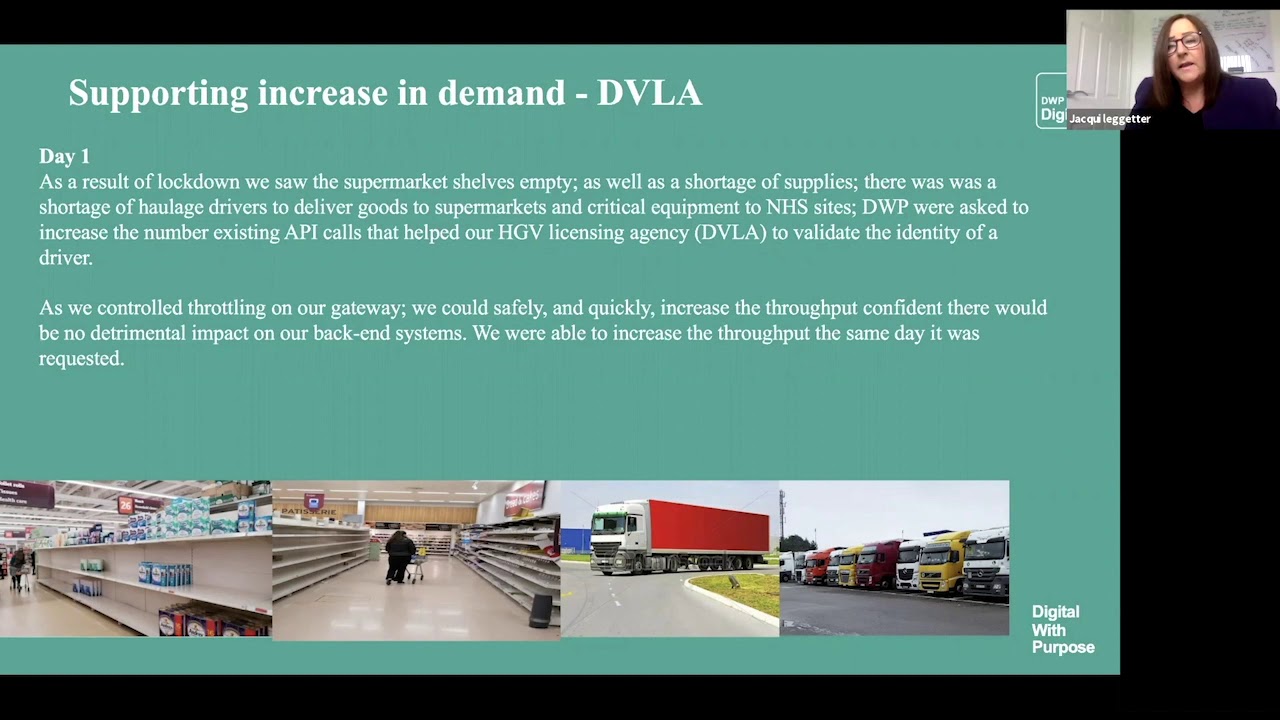
First, to support the national supply chain, DWP enhanced an existing API that validated driver identities in partnership with the Driver and Vehicle Licensing Authority. As HGV drivers became scarce due to illness and self-isolation, the API helped get more trucks back on the road quickly. With Kong, DWP could safely increase throughput while protecting backend systems that were also handling millions of new benefit claims.
Second, in response to 2.5 million Universal Credit applications in the first three weeks of lockdown, DWP created and deployed new APIs to automate the initial steps of the claims process. These APIs connected with backend systems and artificial intelligence tools, enabling automated eligibility checks and payment releases. As a result, 97% of claims were paid on time, consistent with DWP’s pre-pandemic key performance indicators. The remaining 3% required manual handling, but the overall system held strong. The APIs developed during this time remain in use today and continue to support other business lines as well.
Third, DWP launched APIs to receive digital medical assessments for the roughly 500,000 citizens who submitted new claims due to health issues. Previously, these assessments were done in person and processed via physical paperwork. With offices closed and in-person GP visits curtailed, DWP worked with partners to accept medical documents through an API. Those documents were then routed through robotic process automation systems that mimicked keystrokes in legacy systems, allowing for straight-through processing. This blend of new APIs, AI, and RPA enabled the department to process claims efficiently and safely, despite relying on older back-end infrastructure.
Kong’s gateway ensured visibility, protection, and throttling across all these services. The platform enabled shared access to reusable APIs across teams, reducing duplication and accelerating development. A centralized developer portal made it easy for teams to discover existing APIs and onboard quickly, even during periods of high stress.
## From crisis response to a foundation for future innovation
In just the first three months of lockdown, DWP deployed 37 new APIs. API traffic grew dramatically. Daily API requests rose from 4.5 million to more than 7.5 million. Weekly traffic increased from 25 million to a peak of 40 million. Monthly traffic climbed from 100 million to over 160 million requests. All of this was supported by just two nodes running in AWS, demonstrating the strength and efficiency of the Kong API gateway.
DWP maintained critical services without disruption, ensured on-time payments for millions of citizens, and enabled 25,000 agents to work remotely. These efforts not only met the demands of the crisis but also validated and accelerated the department’s long-term digital transformation strategy.
COVID-19 proved the value of DWP’s API-first approach. The organization is now driving toward a more holistic, citizen-centered experience that goes beyond product-based service lines. During the crisis, many citizens had needs spanning multiple benefit programs, such as Universal Credit and child support. DWP is working to simplify these journeys by building shared components—such as payment engines, identity verification, and inquiry systems—that can be reused across departments.
Future plans include deeper adoption of self-service capabilities, intelligent monitoring, and federated gateways aligned with cloud-native architectures. The team is exploring how to give developers full autonomy to mock, test, and publish APIs with minimal friction. By embracing contract-first workflows and continuous integration, DWP is setting itself up to deliver faster, more resilient services well beyond the pandemic.
More Customer Stories








30%
boost in efficiency


“Kong has supported our goal of moving fully to the cloud, streamlining business processes, automating wherever possible, generating actionable insights from data, and driving efficiency through the intelligent adoption of new technology.”


2 Billion
Requests on Super Bowl Sunday


Global payments leader streamlines API governance, accelerates delivery, and explores agentic automation through spec-first design and Model Context Protocol (MCP).
[Read the full story](https://konghq.com/customer-stories/verifone-apiops-developer-workflows-kong)Read the full story